Getting started with Classification (original) (raw)
Last Updated : 15 Jun, 2026
Classification is a supervised machine learning technique used to predict labels or categories from input data. It assigns each data point to a predefined class based on learned patterns.
- **Predict categories: Determines the class of new data points.
- **Uses labeled data: Trained on datasets where the correct class is known.
- **Common examples: Spam vs non spam emails, diseased vs. healthy patients.
**For example: A classification model might be trained on dataset of images labeled as either dogs or cats and it can be used to predict the class of new and unseen images as dogs or cats based on their features such as colour, texture or shape.
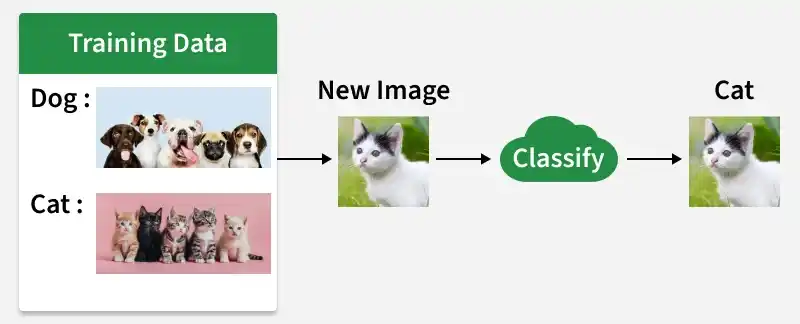
Cat-Dog Classification
Types of Classification
Classification in machine learning involves sorting data into categories based on their features or characteristics. The type of classification problem depends on how many classes exist and how the categories are structured.
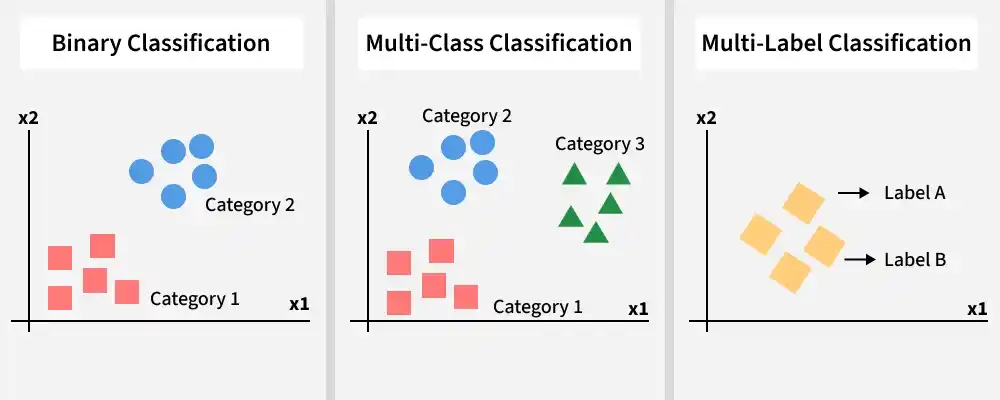
Types of Classification
1. Binary Classification
Binary classification is the simplest type of classification where data is divided into two possible categories. The model analyzes input features and decides which of the two classes the data belongs to. Some important aspects of binary classification are:
- **Two classes only: Each data point is assigned to one of two categories.
- **Common examples: Spam vs not spam emails, diseased vs healthy patients.
- **Decision based on features: The model uses input features to determine the correct class.
2. Multiclass Classification
Multiclass classification is used when data needs to be divided into more than two categories. The model analyzes the input features and selects the class that best matches the data. Some important aspects of multiclass classification are:
- **Multiple classes: Each data point is assigned to one of several possible categories.
- **Single final prediction: The model selects only one class for each input.
- **Common examples: Image classification such as identifying animals like cat, dog or bird.
**3. Multi Label Classification
Multi label classification allows a single piece of data to belong to multiple categories at the same time. Unlike multiclass classification, where each data point is assigned only one class, this approach allows the model to assign multiple labels to the same input. Key aspects include:
- **Multiple labels per data point: One input can belong to more than one category.
- **Labels can overlap: Classes are not mutually exclusive.
- **Common example: A movie recommendation system may tag a movie as both action and comedy based on features like plot, actors or genre tags.
Working
Classification works by training a model on labeled data so it can learn patterns and predict the correct class for new inputs. The main steps involved are:
- **Data Collection: Start with a dataset where each data point has a correct label.
- **Feature Extraction: Identify important features such as color, shape or texture that help distinguish classes.
- **Model Training: The algorithm learns patterns that connect features to the correct class.
- **Model Evaluation: The trained model is tested on unseen data to measure its accuracy.
- **Prediction: The model predicts the class of new data based on learned patterns.
- **Model Improvement: If performance is not satisfactory, the model or its parameters are adjusted and retrained.
Classification Algorithms
To implement a classification model, it is important to understand the algorithms used for classification. One of the most commonly used algorithms is Logistic Regression. Classification algorithms can be grouped into different categories, such as:
1. Linear Classifiers
Linear classifier models create a linear decision boundary between classes. They are simple and computationally efficient. Some of the linear classification models are as follows:
- Logistic Regression
- Support Vector Machines
- Single-layer Perceptron
- Stochastic Gradient Descent (SGD) Classifier
2. Non linear Classifiers
Non linear models create non linear decision boundaries to separate classes. They can capture more complex relationships between input features and the target variable. Some common non linear classification models include:
- K-Nearest Neighbours
- Kernel SVM
- Decision Tree Classification
- Random Forests
- AdaBoost
- Bagging Classifier
- Voting Classifier
- Extra Trees Classifier
- Multi layer Artificial Neural Networks
Applications
- **Email Spam Filtering: Classifies emails as spam or not spam based on message content.
- **Credit Risk Assessment: Predicts whether a loan applicant is likely to default using factors like credit score and income.
- **Medical Diagnosis: Classifies whether a patient has diseases such as cancer or diabetes using medical data.
- **Image Classification: Used in applications like facial recognition, autonomous driving and medical imaging.
- **Sentiment Analysis: Determines whether text sentiment is positive, negative or neutral.
- **Fraud Detection: Identifies unusual transaction patterns to detect financial fraud.
- **Recommendation Systems: Not strictly classification but often uses ranking or similarity-based methods.