Candidate Key in DBMS (original) (raw)
Last Updated : 23 Jul, 2025
A candidate key is a minimal set of attributes that uniquely identifies each tuple within a table. In other words, there should not be any two rows in a table that can have the same values for the columns that are the part of candidate key. Candidate key is a subset of Super key. It is very important for establishing relationships between tables and maintaining data integrity. Candidate keys play a pivotal role in database normalization as they help us to eliminate data redundancy and anomalies.
Key Features of Candidate Key in DBMS
Some key features of Candidate Key are:
- A candidate key has unique values for every row in a table.
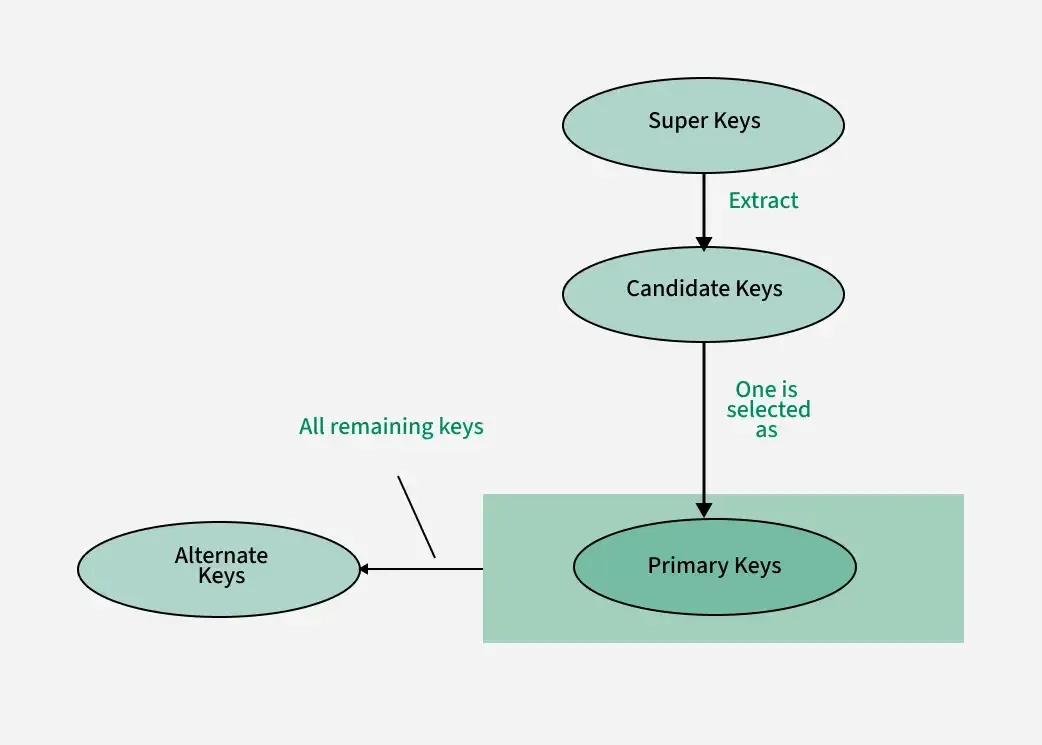
- Every candidate key is a super key, but not all super keys qualify as candidate keys. Simply put, a candidate key is a minimal super key.
- A candidate key can contain null values, but this depends on the database's design and constraints.
- It should not have redundant attributes, meaning it must be as simple as possible to uniquely identify a row.
- Using a candidate key, we can uniquely determine the values of all other attributes in a table.
- The primary key is chosen from the set of candidate keys.
- Candidate keys help us classify table attributes into:
- **Prime Attributes: Attributes that form part of the candidate key.
- **Non-Prime Attributes: Attributes not included in any candidate key.
- Candidate keys ensure data integrity and prevent duplication in the table.
- In a multi-table database, a foreign key in one table often refers to a candidate key (usually the primary key) in another table to establish relationships.
- Accessing rows in a table is faster when using a primary key, which is a type of candidate key.
**Example of Candidate Key
Let's try to understand, the concept of the candidate key with an example of a student table.

Candidate Key
Here’s how the candidate keys are identified from the table:
- **Roll No.:
- Each
Roll No.is unique for every student. - It can uniquely identify each row in the table.
- Hence,
Roll No.is a **candidate key.
- Each
- **Phone:
- Each
Phonenumber is also unique for every student. - It can also uniquely identify each row in the table.
- Hence,
Phoneis another **candidate key.
- Each
How to Identify a Candidate Key in a Database Table?
There are several methods to identify a candidate key in a database table:
**Method 1: Checking Unique Columns or Sets of Columns
This method involves identifying a column or a combination of columns that can uniquely identify each row in a table. By examining the values in each column, you can determine if they are unique across the entire table. Any column or combination of columns that meets this criterion can be considered a candidate key.
**Method 2: Using **Functional Dependencies (FDs)
In this approach, the functional dependencies between attributes are used to identify candidate keys. A functional dependency exists when one attribute determines another. For instance, if a table has student_ID and student_name, there is a functional dependency where student_ID determines student_name. The candidate key is found by identifying the smallest set of attributes that can determine all other attributes in the table.
**Method 3: Using Normal Forms
This method leverages the guidelines provided by database normalization (1NF, 2NF, 3NF, etc.) to identify candidate keys. For example, in a table that adheres to the 2nd normal form (2NF), a primary key is required, which is also a candidate key. By ensuring the table follows a specific normal form, you can pinpoint the candidate key.
**Why do we Need a Candidate Key?
Candidate keys are needed to maintain data accuracy and uniqueness in a database. Without them, it would be difficult to ensure that each row in a table is unique, which could lead to problems like data duplication and inconsistency.
By defining one or more candidate keys for a table, database administrators can ensure that every row has unique values for the selected attributes. This helps avoid data redundancy and prevents issues like insertion, deletion, or update errors. If a table has multiple candidate keys, one of them is typically chosen as the primary key, while the others are referred to as alternate keys.
Role of Candidate key in DBMS
**Identifying Prime Attributes:
- Prime attributes are those that are part of any candidate key.
- Non-prime attributes are not part of any candidate key.
- This distinction is useful for identifying dependencies and normalizing the database.
**Data Anomaly Prevention:
- **Insertion Anomaly: Prevents inserting duplicate records by enforcing unique values.
- **Deletion Anomaly: Ensures that removing one record does not accidentally affect another.
- **Update Anomaly: Avoids inconsistencies during updates since each record is uniquely identified.
**Facilitating Efficient Data Retrieval:
- Searching, sorting, and joining operations are optimized by using candidate keys, especially when a primary key is chosen from them.
Importance of Candidate Key in DBMS
Candidate key is widely used in DBMS for the proper functioning of a relational database. Here we try to explore some importance of candidate key.
- **Uniqueness and Data Integrity: Uniqueness meaning in DBMS, candidate keys ensure that there are no duplicate tuples in a relation. This prevents data inconsistencies and ensures data integrity.
- **Relationship Establishment: Candidate keys are used to establish relationships between tables. For example, in a customer and order scenario, the customer ID can serve as a candidate key in the customer table and as a foreign key in the order table, establishing the relationship between the two tables.
- **Indexing and Query Optimization: Candidate keys play a vital role in indexing and optimizing queries. Indexes are created on candidate keys to enhance data retrieval speed. With properly chosen candidate keys, the database management system can efficiently locate the desired data.
- **Database Normalization: Candidate keys are closely associated with database normalization. By identifying candidate keys and eliminating redundancy, a database can achieve higher levels of normalization, reducing data redundancy and anomalies.
Candidate Key Vs Super Key
Candidate Key
- A candidate key is a super key that has the extra characteristic that it would become less unique if any of its attributes were removed.
- It's a simple yet powerful key.
- A table may have more than one candidate key.
- Every candidate key is distinct and has the potential to be the main key.
Super Key
- A super key is a collection of one or more characteristics (columns) that collectively allow a record in a table to be uniquely identified.
- It can have more properties than are required for a record to be uniquely identified.
- A table may include several super keys.
- It is possible for a super key to have redundant qualities, depending on whether it is minimum or not.
Read more about differences between candidate key and super key.
Conclusion
Candidate keys form the backbone of database management systems, ensuring data integrity, relationship establishment and query optimization. Understanding and correctly identifying candidate keys is crucial for designing efficient and robust databases. By selecting appropriate candidate keys, database professionals can create well-structured databases that facilitate data retrieval, storage, and maintenance.