Difference Between Dense Index and Sparse Index in DBMS (original) (raw)
Last Updated : 23 Jul, 2025
Indexing is a technique in DBMS that is used to optimize the performance of a database by reducing the number of disk access required. An index is a type of data structure. With the help of an index, we can locate and access data in database tables faster. The dense index and Sparse index are two different approaches to organizing and accessing data in the data structure. These are commonly used in databases and information retrieval systems.
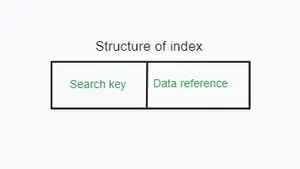
Indexing
Different Types of Indexing Methods
Indexing improves the speed of data retrieval operations in a DBMS by maintaining a smaller, quickly searchable data structure that references the actual records. Indexes can be categorized based on structure, usage, and mapping technique.
Indexing methods in a database management system (DBMS) can be classified as dense or sparse indexing methods, depending on the number of index entries in the database.
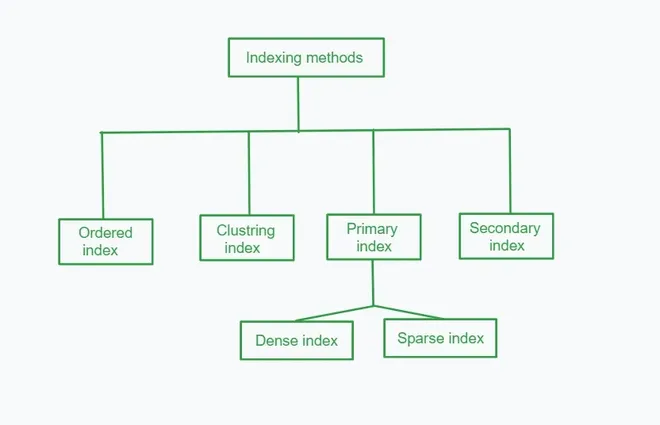
The below table shows the different types of indexing :
| Index Type | Description | Usually Dense or Sparse | Use Case |
|---|---|---|---|
| Ordered Index | Maintains sorted index entries | Both | Binary search on sorted keys |
| Clustering Index | Matches physical record order, can be non-unique | Sparse | Grouped records (e.g., by department) |
| Primary Index | Based on primary key, records are physically sorted | Sparse or Dense | Fast access via primary key |
| Secondary Index | On non-primary keys, data is not sorted | Typically Dense | Searching by non-key attributes |
| Dense Index | Entry for every record | - | Fast lookups, small datasets |
| Sparse Index | Entry for first record in each block | - | Space-saving, sorted data |
Dense indexing and Sparse indexing are types of primary indexing. Now let's take an overview of these terms:
Dense Index
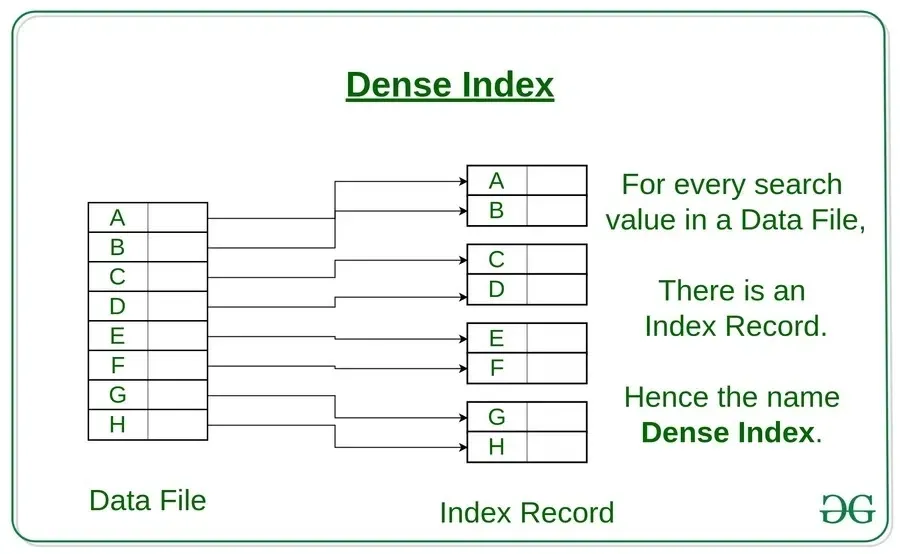
It contains an index record for every search key value in the file. This will result in making searching faster. The total number of records in the index table and main table are the same. It will result in the requirement for more space to store the index of records itself.
- Each record in the data file has a corresponding index entry.
- Faster searching since every search key is directly mapped to its address.
- Total number of index entries = number of records in the main data file.
- Requires more storage space for the index itself.
- Efficient for range and equality queries.
- Commonly used for secondary indexes, where the data file is not sorted.
- Insertion and deletion operations require updates to the index, making maintenance more costly.
- Best for read-intensive applications where fast lookups are critical.
Advantages
- **Fast Record Lookup: No need to scan blocks; the record is directly found via index.
- **Efficient for Range Queries: Since every key is indexed, traversing a range is easy.
- **Good for Frequently Queried Fields: Especially useful in read-heavy applications.
Disadvantages
- **Space Overhead: Requires more memory and disk space to store the index.
- **Maintenance Cost: Every insertion or deletion in the main table requires an update in the index.
- **Not Optimal for Huge Tables: For very large tables, a multi-level indexing or B+ tree might be preferred.
Sparse Index
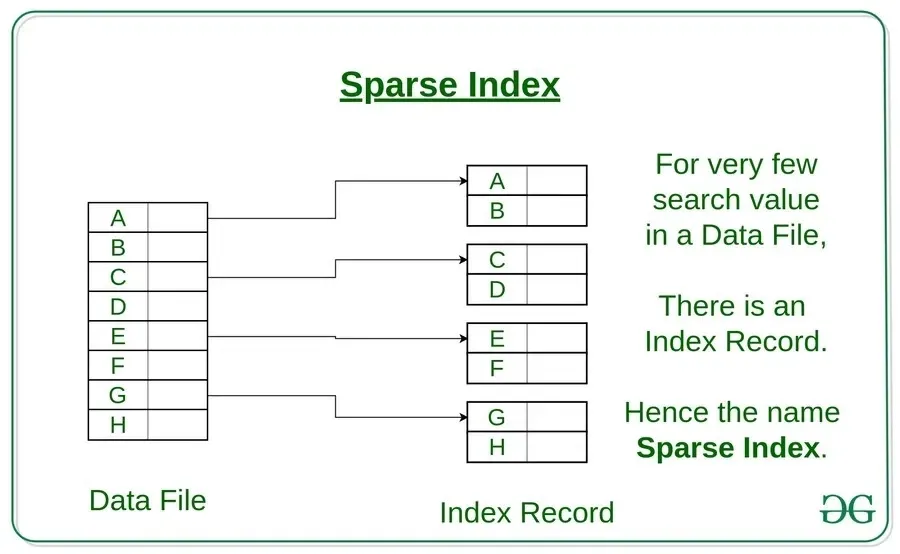
Sparse index contains an index entry only for some records. In the place of pointing to all the records in the main table index points records in a specific gap. This indexing helps you to overcome the issues of dense indexing in DBMS.
- Index entries are created only for some records, typically the first record of each data block.
- Faster searching than no index, but slower than dense index due to extra step of block scanning.
- Number of index entries < number of data records, leading to a more compact index table.
- Consumes less storage space compared to dense indexing.
- Typically used for primary indexes where the data is physically sorted on the indexed field.
- Easier to maintain during insertions or deletions, as fewer entries need updating.
- May require a linear scan within the data block after locating it through the index.
- Good trade-off between performance and storage in large datasets.
- Often used in combination with clustering indexes and multi-level indexes.
Advantages
- **Faster record access : Direct lookup for every search key.
- Efficient : It is efficient for range and equality queries.
- **No need to scan blocks : Reduces lookup time.
Disadvantages
- **High storage overhead : One index entry per record.
- **Maintenance is costly : Every insert/delete/update requires index update.
- **Space Issue : Less suitable for very large datasets due to space and performance impact.
Difference Between Dense Index and Sparse Index
The below table shows the difference between the dense index and sparse index :
| Dense index | Sparse index |
|---|---|
| The index size is larger in dense index. | In sparse index, the index size is smaller. |
| Time to locate data in index table is less. | Time to locate data in index table is more. |
| There is more overhead for insertions and deletions in dense index. | Sparse indexing have less overhead for insertions and deletions. |
| Records in dense index need not to be clustered. | In case of sparse index, records need to be clustered. |
| Computing time in RAM (Random access memory) is less with dense index. | In sparse index, computing time in RAM is more. |
| Data pointers in dense index point to each record in the data file. | In sparse index, data pointers point to fewer records in data file. |
| Search performance is generally faster in dense index. | In sparse index, search performance may require additional steps, which will result in slowing down the process. |