Introduction of DBMS (original) (raw)
Last Updated : 14 May, 2026
DBMS (Database Management System) is a software system that manages, stores, and retrieves data efficiently in a structured format. DBMS acts as a bridge between a central database and multiple clients, including apps and users.
- A DBMS connects the central database with multiple clients (applications and users).
- It allows users to create, update, and query databases efficiently.
- Ensures data integrity, consistency, and security across multiple users and applications.
- Reduces data redundancy and inconsistency through centralized control.
- Supports concurrent data access, transaction management, and automatic backups.
- Uses APIs to handle data requests, ensuring secure and efficient access.

Problems with Traditional File-Based Systems
Before the introduction of modern DBMS, data was managed using basic file systems on hard drives. While this approach allowed users to store, retrieve and update files as needed, it came with numerous challenges
- **Data Redundancy: Duplicate entries across files
- **Inconsistency: Conflicting or outdated information
- **Difficult Access: Manual file search required
- **Poor Security: No control over data access
- **Lack of Multi-user Support: No support for collaboration
- **No Backup/Recovery: Data loss was often permanent
A university file-based system storing data in separate files (e.g., Academics, Results, Hostels) often faced these problems.
Components of DBMS Applications
Any DBMS based application is made up of six key components that work together to handle data effectively.
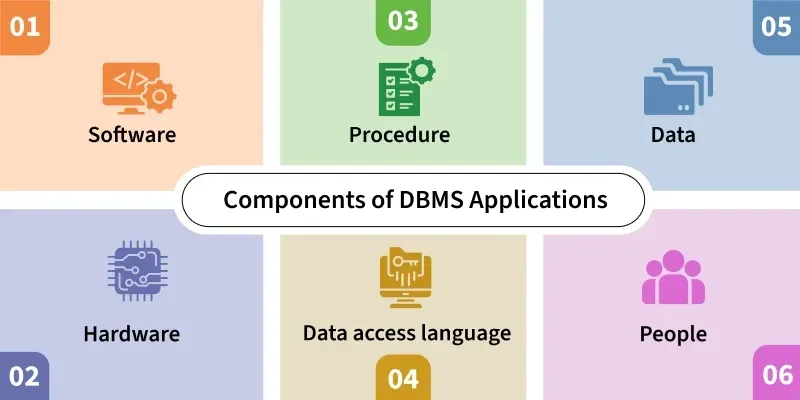
Components of DBMS Applications
1. **Hardware
- Physical devices like servers, disks, input-output devices (keyboard, monitor, printer).
- Stores and processes data; interfaces between real-world inputs and digital systems.
- Examples: Personal computer hard disk, RAM, network devices used for DBMS operations.
2. **Software
- Actual DBMS software like MySQL, Oracle, PostgreSQL.
- Includes the database engine, OS, network software, and application tools.
- Translates database access languages into operations.
3. **Data
- Raw facts stored in structured or unstructured formats.
- **Operational Data: Actual user data (e.g., name, age).
- **Metadata: Data about data (e.g., storage time, size, data type).
- Core reason DBMS exists—to manage and store data efficiently.
4. **Procedures
- Instructions and rules for using DBMS effectively.
- Covers setup, login/logout, data validation, backup, access control, and report generation.
- Helps ensure consistent and secure use of the system.
5. **Database Access Language
- Used to interact with the database (create, read, update, delete data).
- Examples: SQL, MyAccess, Oracle PL/SQL.
- **DDL (Data Definition Language) –
CREATE,ALTER,DROP - **DML (Data Manipulation Language) –
INSERT,UPDATE,DELETE
6. **People
- Users interacting with DBMS at different levels:
- **Database Administrators (DBA) – Manage security, performance, user access.
- **Developers – Build applications using the database.
- **End Users – Use applications to access the database (e.g., students, employees).
Types of DBMS
There are several types of Database Management Systems (DBMS), each tailored to different data structures, scalability requirements and application needs. The most common types are as follows:
**1. Relational Database Management System (RDBMS)
- It organizes data into tables (relations) composed of rows and columns.
- Uses primary keys to uniquely identify rows and foreign keys to establish relationships between tables.
- Queries are written in **SQL (Structured Query Language), which allows for efficient data manipulation and retrieval.
**Examples: MySQL, Oracle, Microsoft SQL Server and PostgreSQL.
**2. NoSQL DBMS
- They are designed to handle large-scale data and provide high performance for scenarios where relational models might be restrictive.
- They store data in various non-relational formats, such as key-value pairs, documents, graphs or columns.
- These flexible data models enable rapid scaling and are well-suited for unstructured or semi-structured data.
**Examples: MongoDB, Cassandra, DynamoDB and Redis.
**3. Object-Oriented DBMS (OODBMS)
- It integrates object-oriented programming concepts into the database environment, allowing data to be stored as objects.
- Supports complex data types and relationships, making it ideal for applications requiring advanced data modeling and real-world simulations.
**Examples: ObjectDB, db4o.
**4. Hierarchical Database
- Organizes data in a tree-like structure, where each record (node) has a single parent and have multiple children.
- This model is similar to a file system with folders and subfolders.
- It is efficient for storing data with a clear hierarchy, such as organizational charts or file directories.
- Navigation is fast and predictable due to the fixed structure.
- It lacks flexibility and is difficult to restructure or handle complex many-to-many relationships.
**Example: IBM Information Management System (IMS).
**5. Network Database
- It uses a graph-like model to allow more complex relationships between entities.
- Unlike the hierarchical model, it permits each child to have multiple parents, enabling many-to-many relationships.
- Data is represented using records and sets, where sets define the relationships.
- It is more flexible than the hierarchical model and better suited for applications with complex data linkages.
**Example: Integrated Data Store (IDS), TurboIMAGE.
**6. Cloud-Based Database
- They are hosted on cloud computing platforms like AWS, Azure or Google Cloud.
- They offer on-demand scalability, high availability, automatic backups and remote accessibility.
- These databases can be relational (SQL) or non-relational (NoSQL) and are maintained by cloud service providers, reducing administrative overhead.
- They support modern application requirements, including distributed access and real-time analytics.
**Example: Amazon RDS (for SQL), MongoDB Atlas (for NoSQL), Google BigQuery.
Database Languages
Database languages are specialized sets of commands and instructions used to define, manipulate and control data within a database. Each language type plays a distinct role in database management, ensuring efficient storage, retrieval and security of data. The primary database languages include:
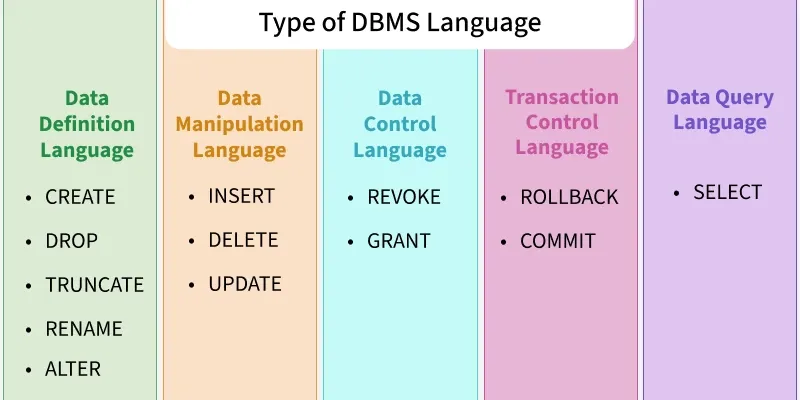
1. Data Definition Language (DDL)
DDL is the short name for Data Definition Language, which deals with database schemas and descriptions, of how the data should reside in the database.
- **CREATE: to create a database and its objects like (table, index, views, store procedure, function and triggers)
- **ALTER: alters the structure of the existing database
- **DROP: delete objects from the database
- **TRUNCATE: remove all records from a table, including all spaces allocated for the records are removed
- **COMMENT: add comments to the data dictionary
- **RENAME: rename an object
2. Data Manipulation Language (DML)
DML focuses on manipulating the data stored in the database, enabling users to retrieve, add, update and delete data.
- **INSERT: insert data into a table
- **UPDATE: updates existing data within a table
- **DELETE: Delete all records from a database table
- **MERGE: UPSERT operation (insert or update)
- **CALL: call a PL/SQL or Java subprogram
- **EXPLAIN PLAN: interpretation of the data access path
- **LOCK TABLE: concurrency Control
3. Data Control Language (DCL)
DCL commands manage access permissions, ensuring data security by controlling who can perform certain actions on the database.
- **GRANT: Provides specific privileges to a user (e.g., SELECT, INSERT).
- **REVOKE: Removes previously granted permissions from a user.
**4. Transaction Control Language (TCL)
TCL commands oversee transactional data to maintain consistency, reliability and atomicity.
- **ROLLBACK: Undoes changes made during a transaction.
- **COMMIT: Saves all changes made during a transaction.
- **SAVEPOINT: Sets a point within a transaction to which one can later roll back.
**5. Data Query Language (DQL)
DQL is a subset of SQL used to retrieve data from a database without modifying it. Its main command is SELECT, which allows users to fetch specific information based on their requirements.
Applications of DBMS
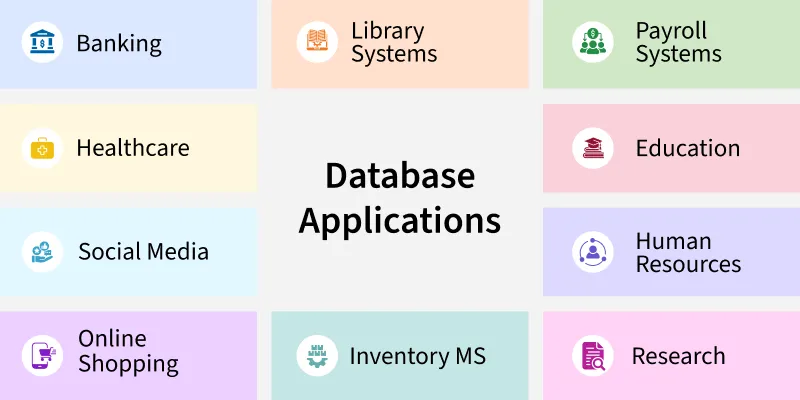
- **Banking: Manages accounts and transactions.
- **E-commerce: Tracks products, orders, and customers.
- **Healthcare: Stores patient records and diagnoses.
- **Education: Handles student grades and schedules.
- **Social Media: Manages user profiles and interactions.
- **Data Science: Supports analytics and predictions.