Normalization vs. Denormalization (original) (raw)
Last Updated : 31 Jan, 2026
Normalisation and denormalisation are used to alter the structure of a database. The key difference is that normalisation reduces redundancy by organising data into smaller, well-structured tables, while denormalisation intentionally introduces redundancy by merging tables to speed up query performance.
Normalisation
Normalisation is the method used in a database to reduce data redundancy and data inconsistency in the table. It is the technique in which non-redundant and consistent data are stored in a set schema. By using normalisation, the number of tables is increased instead of decreased.
Benefits
- Data is reduced in the table.
- Optimized memory.
- Maintain data integrity.
Drawbacks
- The number of tables is increased.
- Consume more resources when using expensive operations.
- Query performance may decrease due to multiple table joins.
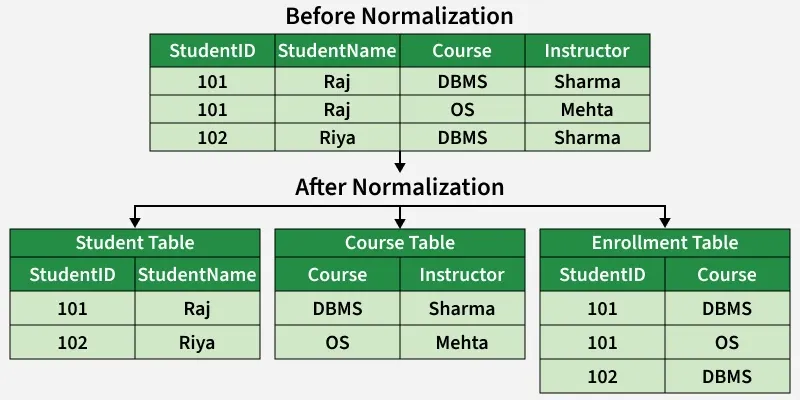
Example of Normalization
Denormalization
Denormalization is also the method which is used in a database. It is used to add the redundancy to execute the query quickly. It is a technique in which data are combined to execute the query quickly. By using denormalization the number of tables is decreased which oppose to the normalization.
Benefits
- Execute the query quickly.
- Fewer joins are needed, so queries execute faster.
- Improves read performance for complex queries.
Drawbacks
- Wastage of memory because store the duplicate data.
- Complex data maintenance occurs because INSERT, UPDATE, and DELETE operations become harder due to data redundancy.
- Does not maintain data integrity.
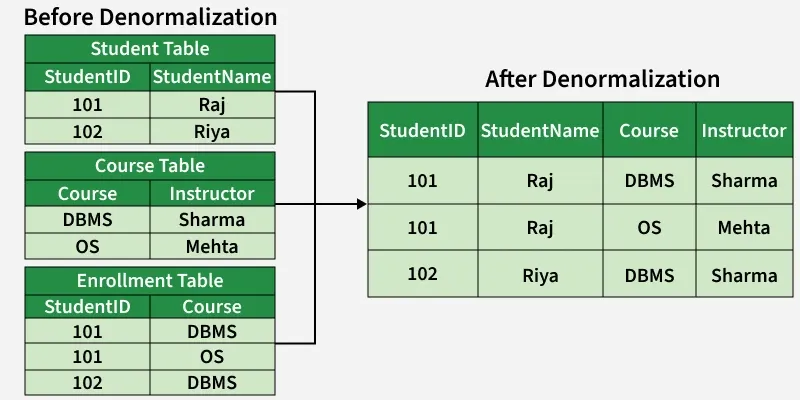
Example of Denormalization
**Normalization and Denormalization
| **Normalization | **Denormalization |
|---|---|
| It stores non-redundant and consistent data in a structured schema. | It combines data from multiple tables to execute queries faster. |
| Data redundancy and inconsistency are minimized. | Data redundancy is intentionally added for faster query execution. |
| Data integrity is maintained . | Data integrity is not maintained . |
| Redundancy is reduced or eliminated. | Redundancy is added instead of being eliminated. |
| The number of tables increases. | The number of tables decreases. |
| Disk space usage is optimized. | Disk space usage is not optimized. |
| Query execution may be slower due to joins. | Query execution is faster due to fewer joins. |
| Used in OLTP systems where accuracy and consistency are important. | Used in OLAP systems where quick data retrieval and fast query responses are required. |