Difference Between RAID 0 and RAID 1 (original) (raw)
Last Updated : 11 Jul, 2025
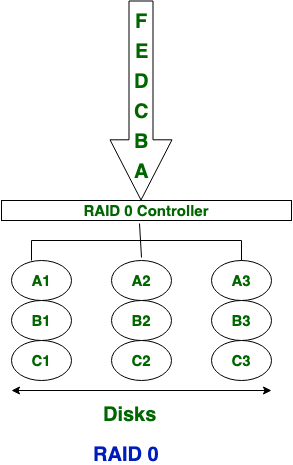
**RAID stands for **Redundant Array of Independent Disk, and is the technique used for disk organization for reliability and performance. Both **RAID 0 stands for **Redundant Array of Independent Disk level 0 and **RAID 1 stands for **Redundant Array of Independent Disk level 1 are the categories of RAID. The main difference between RAID 0 and RAID 1 is that, In RAID 0 technology, Disk stripping is used. On the other hand, in RAID 1 technology, Disk mirroring is used.
What is RAID 0?
RAID 0, or "striping,” is a RAID configuration involving the division of data across the disks where there is no redundancy of the disks. It increases performance since it provides both read and write access, while it does not support data backup. Data is only safe when it’s stored in two drives at once; if one fails, then the data is gone. RAID 0 is used for applications that demand very high speed but do not concern themselves with data protection.
Examples of RAID 0
- High-performance gaming rig with multiple SSDs to help load games and increase performance.
- A video editing workstation with two or more hard drives to improve on data access and data processing.
- A system that needs to read a high amount of data in a short space of time; a high-performance data retrieval server.
- A RAID 0 array in a NAS unit for increased rate of sharing files across the network.
- An example of an application that will get faster with higher throughput is a data-driven application such as a scientific simulation.
Advantages of RAID 0
- Efficiency enhancement as a result of conducting read and/or write operations on more than one disk at a time.
- High storage capacity as all the drives are used for storing data without incurring in redundant overheads.
- Faster data access rates can improve system interaction speed and concomitantly increase the effectiveness of the system.
- The system setup and configuration are easier when using RAID 3 and 4 than in the use of RAID levels that incorporate redundancy.
- It provides a cost-effective way for requiring high-speed storage without the cost of extra drives for giving redundancy.
Disadvantages of RAID 0
- No duplication and no backup or redundancy.
- If one of the drives goes bad, then your entire data is gone.
- An absence of alternative planned recovery procedures where drives fail.
- Lacked in ability to safely store data in addition to the efficiency enhancement in performance.
- Must have two drives at the least, which will increase the cost of the hardware.
What is RAID 1?
RAID 1 is defined as the ‘mirroring’ in which the same set of data is written onto two or more drives. It will help to have duplication, and if one of the drives fails, the data is still available in the other drives. Although it provides extremely high data reliability and data protection features, this concept does not enhance performance and demands double space as compared to the data.

Examples of RAID 1
- A server that has duplicated drives in order to ensure availability of the data in case that the drives fail.
- A Network Attached Storage (NAS) box designed for a small business and working with RAID 1 aimed at ensuring safe storage of files.
- A home office computer with two SSDs in a mirrored configuration for documents.
- An application that requires high availability and maximum data consistency.
- A data backup system that provides near-real-time duplicates of the essential data in at least two drives.
Advantages of RAID 1
- Full data backups with a duplication of the data to each drive in use.
- Increased efficiency in data security and integrity; data is retrievable in the event that one drive is corrupted.
- Easy to recover the data since the data is already backed up.
- Better read times because more than one drive can be accessed at a time.
- Less complicated to configure and administer as compared to other RAID levels that have complicated redundancy programs.
Disadvantages of RAID 1
- Increased cost of storage by the fact that, typically, each input or record is stored twice.
- Fifty percent Worse write operations than a single drive while offering no performance improvement for read operations.
- At least requires two drives and may be very costly.
- The storage capacity is set at the size of the smallest drive that is to be put in the array.
- It does not guard data against corruption or loss due to an accident.
Difference Between RAID 0 and RAID 1
| RAID 0 | RAID 1 |
|---|---|
| RAID 0 stands for Redundant Array of Independent Disk level 0. | While RAID 1 stands for Redundant Array of Independent Disk level 1. |
| In RAID 0 technology, Disk stripping is used. | While in RAID 1 technology, Disk mirroring is used. |
| The cost of RAID 0 technology is low. | While RAID 1 is costly or expensive. |
| In RAID 0, There is no write penalty. | While in RAID 1, There is write penalty. |
| The Relative storage efficiency of RAID 0 is 100%. | While the relative storage efficiency of RAID 1 is 50%. |
| The write performance of RAID 0 is better than RAID 1. | While the write performance of RAID 1 is slower than RAID 0. |
| RAID 0 emphasis on data accessing speed. | While in RAID 1, data availability is emphasized. |
| RAID 0 is well in read performance. | While RAID 1 is moderate in read performance. |
| In RAID 0, there is no protection available. | In RAID 1, mirror protection is provided. |
| RAID 0, also known as disk striping, involves the splitting of data into small blocks and spreading it across multiple disks in a way that allows for simultaneous read and write operations. In this configuration, each disk contains a portion of the data, and data is written to and read from the disks in parallel. RAID 0 does not provide fault tolerance, as there is no redundancy or backup copy of the data. If one disk fails, all data on the array is lost. | RAID 1, also known as disk mirroring, involves the duplication of data on two or more disks. In this configuration, all data is written to two or more disks simultaneously, so that each disk contains an identical copy of the data. This provides fault tolerance, as if one disk fails, the system can continue to operate with the remaining disk(s) until the failed disk is replaced. |
Conclusion
RAID 0 and RAID 1 are two types of RAID that have different functions in the management of data. RAID 0 works through data stripping and thus increases performance but includes no data protection and is therefore very dangerous with regards to data loss. RAID 1 operates on the principle of mirroring, thus providing the system with backup data in case there is a failure of the drive, while on the other hand, it is not a performance-enhancing mode for the write function and in addition demands much storage space for the data. The decision between the two of them depends on what is more important: fast and efficient results or correct results.