Working of MongoDB (original) (raw)
Last Updated : 5 May, 2026
MongoDB is a document-oriented NoSQL database that stores data in BSON format with a flexible schema.
- Uses a document-based model instead of traditional tables.
- Supports flexible schema design for dynamic data.
- Efficiently handles large volumes of data with high scalability.
Components of MongoDB
MongoDB consists of core components that work together to store, manage, and retrieve data efficiently in a distributed environment.
1. Drivers
MongoDB drivers are client libraries that enable applications to connect to and interact with MongoDB databases using language-specific APIs.
- Provide interfaces and methods for database communication.
- Support multiple programming languages.
- Enable easy integration with applications.
- Popular drivers include C, C++, C#, .NET, Go, Java, Node.js, PHP, Python, Ruby, Scala, Swift, and Mongoid.
2. MongoDB Shell
MongoDB Shell is an interactive JavaScript-based command-line interface used to interact with MongoDB databases.
- Provides a CLI for working with MongoDB.
- Allows running queries and updating data.
- Supports administrative tasks such as backups and restores.
3. Storage Engine
The storage engine manages how data is stored and retrieved from memory and disk.
- Handles low-level data storage operations.
- Manages reading/writing data efficiently.
- Does not process queries or business logic.
- Default engine: WiredTiger.
MongoDB primarily uses the WiredTiger storage engine, with limited support for specialized engines.
| Storage Engine | Description | Use Case |
|---|---|---|
| WiredTiger | Default and primary storage engine, it supports document-level concurrency and compression. | Ideal for most applications, including high-performance and write-intensive workloads. |
| In-Memory Engine | Stores data in RAM for ultra-fast access; data is not persisted after restart. | Suitable for caching and real-time, low-latency applications. |
Working of MongoDB
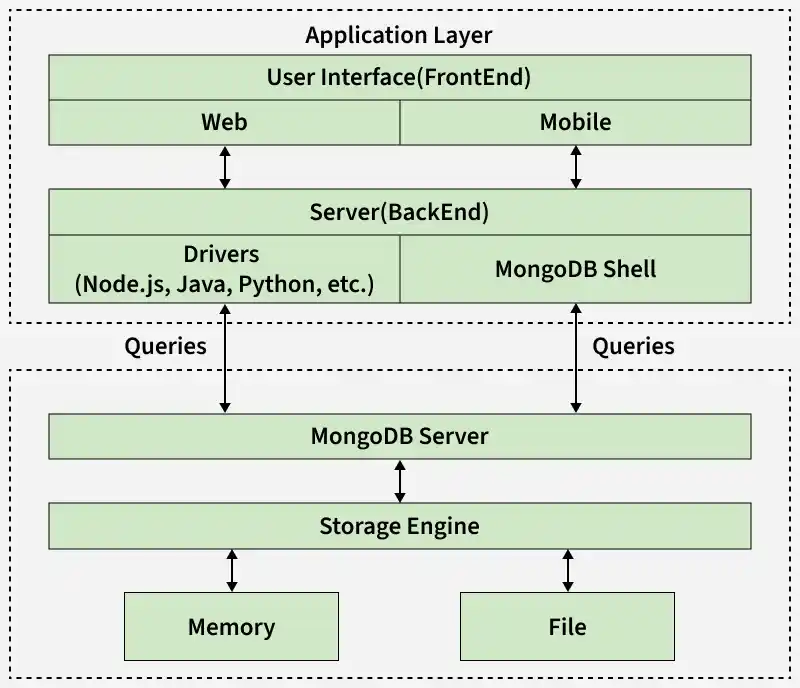
MongoDB works on Application Layer and the Data Layer. The following image shows the working of MongoDB.
1. Application Layer
The Application Layer, also known as the abstraction layer, connects users to MongoDB by handling user interaction and server-side processing.
- Consists of two parts: Frontend and Backend
- Frontend (User Interface): Includes web and mobile applications used by users to interact with the system.
- Backend (Server): Handles server-side logic and communicates with MongoDB using drivers or the MongoDB shell.
- The frontend sends requests to the backend, which processes them and communicates with the MongoDB server in the Data Layer.
2. Data Layer
The Data Layer is responsible for storing and processing data in MongoDB, handling queries and managing data storage through core components.
- **MongoDB Server: Receives queries from the application layer and forwards them to the storage engine.
- **Storage Engine: Handles actual data read and write operations and manages data storage in memory and on disk.
**Note: Reading and writing data from memory is much faster than from disk. MongoDB optimizes performance by using memory for frequently accessed data while relying on disk for long-term storage.
MongoDB Data Flow
This describes the internal flow of data across MongoDB components during operations:
- **User Interaction: The user interacts with the application (frontend) and sends a request.
- **Backend Processing: The backend server receives the request, processes it, and communicates with MongoDB using drivers or the MongoDB shell.
- **MongoDB Server: The MongoDB server receives the request, processes the query, and determines the required data operations.
- **Storage Engine: The storage engine performs data read/write operations in memory or on disk as instructed by the MongoDB server.
- **Response Return: The result is sent back from MongoDB to the backend, and then to the frontend for the user.