Introduction of 3Tier Architecture in DBMS (original) (raw)
Last Updated : 23 Jul, 2025
The 3-Tier Architecture is one of the most popular and effective architectural models in the design and development of modern database-driven applications. It is widely used in Database Management Systems (DBMS) for organizing and managing complex data interactions across various layers of an application. Whether you're building a scalable enterprise application or a responsive web service, understanding 3-Tier Architecture is crucial for efficient system design and management.
In this article, we will explain the details of the **3-Tier Architecture in DBMS, explaining each of its components, the role it plays in application development, and the key benefits it offers for building robust, secure, and maintainable systems.
What is 3 Tier Architecture in DBMS?
In DBMS, the 3-tier architecture is a **client-server architecture that separates the **user interface, **application processing, and **data management into three distinct tiers or layers. The 3-tier architecture is widely used in modern web applications and enterprise systems because it offers scalability, flexibility, and security. Here is a brief description of each tier in the 3-tier architecture:
- **Presentation Tier (User Interface Layer)
- **Application Tier (Business Logic Layer)
- **Data Management Tier (Database Layer)
This separation of concerns allows for easier maintenance, scalability, and flexibility in system design, enabling developers to work independently on each layer without disturbing the others.
3rd tier Architecture
Components of the 3-Tier Architecture
**1. Presentation Tier (User Interface Layer)
The presentation tier is the **user interface or **client layer of the application. It is responsible for presenting data to the user and receiving input from the user. This tier communicates with the Application Tier to process user requests and display relevant information. This tier can be a web browser, mobile app, or desktop application.
- **What It Does: It ensures the application is user-friendly by providing interfaces such as web browsers, mobile apps, or desktop applications.
- **Example: If you’re using a banking app, the presentation tier would display your account balance, allow you to make transfers, and display results based on your actions.
Why it is Important?
- The Presentation Layer focuses purely on the user interface, ensuring smooth interactions and enhancing user experience (UX).
- It abstracts the business logic and data management complexities, making the system more user-friendly.
**2. Application Tier ( Business Logic Layer)
The application tier is the **middle layer of the 3-tier architecture. It acts as the intermediary between the Presentation Tier and the Data Management Tier. It is responsible for **processing and **managing the business logic of the application. This tier communicates with the presentation tier to receive user input and communicates with the data management tier to retrieve or store data. This tier may include application servers, web servers, or APIs.
- **What It Does: It houses the application's core functionality, such as calculating values, applying rules, handling workflows, etc.
- **Example: If you're purchasing an item through an e-commerce platform, the Application Layer handles all the logic like verifying available stock, applying discounts, calculating taxes, and confirming your payment method.
**Why is it Important?
- It decouples the core business logic from the user interface, making it easier to change or update business rules without affecting the user-facing part of the application.
- This tier allows for better management of application workflows and business decisions
**3. Data Management Tier ( Database Layer)
The **Data Management tier is the bottom layer of the 3-tier architecture. It is responsible for managing and storing data. This tier can include databases, data warehouses, or any other persistent data storage solution. The data management tier communicates with the application tier save, retrieve, or manipulate data according to the business logic.
- **What It Does: It ensures that the data is safely stored, retrieved, and maintained. It handles the database connections and ensures data integrity.
- **Example: In a customer relationship management (CRM) system, this tier would store customer details, transaction history, and other data relevant to the business.
**Why is it Important?
- This layer ensures data consistency, security, and integrity. By abstracting the database layer from the application logic, it allows developers to modify database structures without impacting the overall application functionality.
- It is also where optimizations like indexing, data replication, and data security are handled.
Why Choose 3-Tier Architecture?
The 3-tier architecture in DBMS provides several advantages for developers and organizations working on large-scale, database-driven applications. Here are a few key benefits:
1. **Scalability: The separation of the three tiers allows each layer to scale independently. For instance, if the number of users increases, you can scale the Presentation Tier by adding more web servers, or you can enhance the Data Management Tier by optimizing or adding additional databases without affecting the Application Tier.
2. **Flexibility: Each layer is loosely coupled, meaning you can modify or upgrade any of the layers without disrupting the others. For example, you could swap out the database system in the Data Management Tier (e.g., from MySQL to PostgreSQL) without affecting the business logic or user interface layers.
3. **Security: By isolating the Data Management Tier, you can enforce better security practices, such as restricting direct access to the database and protecting sensitive data. The Presentation Tier and Application Tier interact via secure APIs or middleware, reducing the risk of unauthorized access.
4. **Maintainability: Because the architecture is modular, it’s easier to maintain and update. If you need to change the user interface or tweak the business logic, these changes won’t require touching the underlying data storage or database. The separation of concerns also means that developers can specialize in one of the layers (frontend, backend, or database), allowing for more focused development and faster updates.
5. **Improved Performance: The layered approach improves system performance by ensuring that each tier is optimized for its specific function. For instance, database queries in the Data Management Tier can be optimized independently, and the Application Tier can focus on processing requests efficiently.
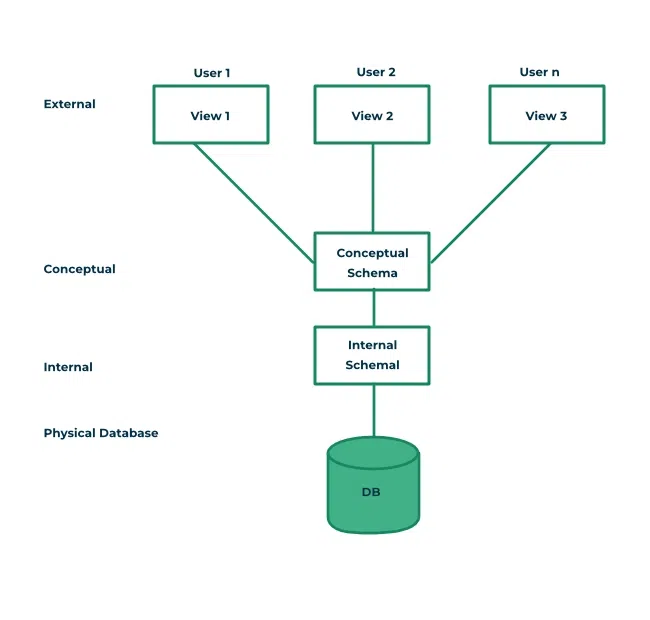
3-Tier Schema Architecture in DBMS
In DBMS, the 3-Tier Schema Architecture refers to how the data is logically and physically organized in three layers:

3-Tier Schema Architecture in DBMS
**1. Physical Level
At the physical level, the information about the location of database objects in the data store is kept. Various users of DBMS are unaware of the locations of these objects.In simple terms,physical level of a database describes how the data is being stored in secondary storage devices like disks and tapes and also gives insights on additional storage details.
**2. Conceptual Level
At conceptual level, data is represented in the form of various database tables. For Example, STUDENT database may contain STUDENT and COURSE tables which will be visible to users but users are unaware of their storage.Also referred as logical schema,it describes what kind of data is to be stored in the database.
**3. External Level
An external level specifies a view of the data in terms of conceptual level tables. Each external level view is used to cater to the needs of a particular category of users. For Example, FACULTY of a university is interested in looking course details of students, STUDENTS are interested in looking at all details related to academics, accounts, courses and hostel details as well. So, different views can be generated for different users. The main focus of external level is data abstraction.
Conclusion
In conclusion, a Database Management System (DBMS) employs the 3-Tier Architecture, a tried-and-true structure that separates an application into three main layers: Presentation, Application Logic, and Data. This architectural technique is increasingly popular for creating dependable and maintainable software systems that communicate with databases because it improves the modularity, scalability, security, reusability, and flexibility of applications.