What is Data Dictionary? (original) (raw)
Last Updated : 23 Jul, 2025
In a database management system (DBMS), a data dictionary can be defined as a component that stores a collection of names, definitions, and attributes for data elements used in the database. The database stores metadata, that is, information about the database. These data elements are then used as part of a database, research project, or information system.
It stores all information about relationships or tables, from the schema and constraints used. All metadata is preserved. In general, metadata refers to information about data. Thus, storing the connection scheme and other metadata in a single structure called a data dictionary or system directory. A data dictionary is like an A-Z dictionary of a relational database system that stores all the information about every relationship in the database.
What is a Data Dictionary?
The data dictionary consists of two words, data, which represents data collected from several sources, and dictionary, which represents where this data is available. The data dictionary is an important part of the relational database because it provides additional information about the relationship between several tables in the database. A data dictionary in a DBMS helps users manage data in an orderly and orderly manner, thereby preventing data redundancy.
Below is a data dictionary that describes the table that contains employee details.
| Field Name | Data Type | Field Size for Display | Description | Example |
|---|---|---|---|---|
| EmployeeID | Integer | 8 | Unique ID of each employee | 100025 |
| FullName | Text | 30 | Full name of the employee | Emily Johnson |
| DOB | Date/Time | 10 | Date of birth of employee | 1990-05-15 |
| PhoneNumber | Integer | 10 | Phone number of employee | 555-123-4567 |
Some of the advantages of using a data dictionary are:
- In DBMS, the data model provides very little information about the database, so the data dictionary is very important to get the right knowledge about the entities, relationships, and attributes that exist in the data model.
- The data dictionary provides consistency by reducing data redundancy in data collection and use among different team members.
- Data dictionaries provide structured analysis and design tools by implementing data standards. Data standards are sets of rules that govern the collection, recording, and presentation of data.
- Using a data dictionary helps define the naming convention used in the model.
Types of Data Dictionary in DBMS
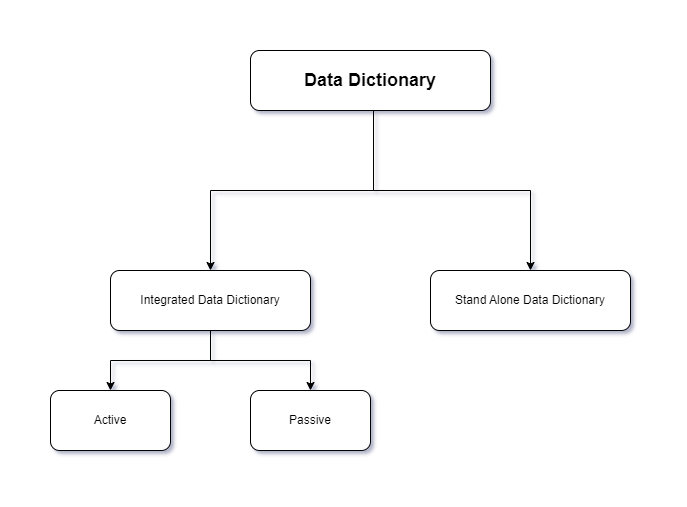
Types of data dictionary
There are basically two types of data dictionaries in a database management system:
- Integrated Data Dictionary
- Stand Alone Data Dictionary
Integrated Data Dictionary
Every relational database has an Integrated Data Dictionary available in the DBMS. This integrated data dictionary acts as a system directory that is accessed and updated by the relational database. The old database does not have an integrated data dictionary, so the database administrator must use the Stand Alone Data Dictionary. An Integrated Data Dictionary in a DBMS can link metadata.
The integrated data dictionary can be further divided into two types:
**Active: When any changes are made to the database, the active data dictionary is automatically updated by the DBMS. It is also known as a self-updating dictionary because it continuously updates its data.
**Passive: Unlike active dictionaries, passive dictionaries must be updated manually when there are changes in the database. This type of data dictionary is difficult to manage because it requires proper functionality. Else, the database and data dictionary will be synchronized.
Stand Alone Data Dictionary
This type of database in the DBMS is very adaptive because it grants the administrator in charge of the confidential information complete autonomy to define and manage all crucial data. Whether the information is printed or not has nothing to do with it. A data dictionary that has a stand-alone format enables database designers to have the flexibility to communicate with end users regardless of their data dictionaries format.
There is no standard format for data dictionaries. Here are some common elements:
- Data Elements: The data dictionary describes each data element by specifying the names, data types, storage formats and validation rules.
- Table: All information about the table, such as the user who created the table, the number of rows and columns, the date the table was created and entered, etc.
- Indexes: Indexes for database tables are stored in the data dictionary. The DBMS stores the index name used and index attributes, locations, and properties, as well as the creation date, in each index.
- Programs: Applications defined for database access, reports, application formats and screens, SQL queries, etc. also stored in the data dictionary.
- Relationships between data elements: A data dictionary stores relationship types; for example, if it is mandatory or optional, the nature of the relationship and connection, etc.
- Administration and End Users: The data dictionary stores all administrative and end user data.
Metadata in a DBMS, stored in a data dictionary, is like a monitor that controls database usage and whether users are allowed to access the database.
How to Create a Data Dictionary?
As mentioned above, most businesses rely on a database management system that has an integrated data dictionary because it is automatically updated and easy to maintain. Documentation for databases including MySQL, SQL Server, Oracle, etc. This can be done in various relational databases such as
Database administrators can use templates in SQL Server, Oracle, or Microsoft Excel to create a stand-alone data dictionary.
The various notations used to create a data dictionary are:
| Data Construct | Notation | Stands For |
|---|---|---|
| Composition | = | is composed of |
| Sequence | + | AND |
| Selection | [ | ] | OR |
| Repetition | { }^n | n repetitions |
| Parentheses | ( ) | to represent optional data |
| Comment | *…* | to define a comment |
Examples
**1. Employee Table:
| Column Name | Data Type | Description |
|---|---|---|
| EmployeeID | INT | Unique identifier for each employee |
| FirstName | VARCHAR | First name of the employee |
| LastName | VARCHAR | Last name of the employee |
| DepartmentID | INT | Foreign key referencing the `Department` table |
| Salary | DECIMAL | Numeric value representing the employee's salary |
| JoinDate | DATE | Date when the employee joined the company |
**Constraints:
- **Primary Key: `EmployeeID`
- **Foreign Key: `DepartmentID` references `Department.DepartmentID`
**2. Product Inventory Table:
| Column Name | Data Type | Description |
|---|---|---|
| ProductID | INT | Unique identifier for each product |
| ProductName | VARCHAR | Name of the product |
| CategoryID | INT | Foreign key referencing the `ProductCategory` table |
| QuantityInStock | INT | Numeric value representing the available quantity |
| UnitPrice | DECIMAL | Price per unit of the product |
**Constraints:
- Primary Key: `ProductID`
- Foreign Key: `CategoryID` references `ProductCategory.CategoryID`
Disadvantages of Data Dictionary
- Data dictionaries have little functional detail.
- Non-technical users may experience difficulties when using the data dictionary for the first time.
- Data dictionary relational diagrams are often not visible.
Conclusion
- The Data Dictionary in the DBMS provides additional information about the relationship between several database tables, helps organize data, and prevents data redundancy in the DBMS.
- A database dictionary is a set of files that contain database metadata. Therefore, it is also known as metadata repository.
- The data dictionary in the database management system is wide and consists of two types:
- Integrated Data Dictionary
- Stand Alone Data Dictionary
- This article discusses the topic of Data Dictionary in DBMS in detail. We have seen definitions, examples, types, needs, advantages of Data Dictionary in DBMS.
- We hope this blog has helped you to improve your knowledge about Data Dictionary in DBMS.