Difference between Data Mart, Data Lake, and Data Warehouse (original) (raw)
Last Updated : 4 Dec, 2025
A Data Mart, Data Lake and Data Warehouse are all types of data repositories used for storing and analyzing data, but they differ in purpose, structure, and scope.
- **Data Warehouse: Stores structured, processed data for enterprise-level reporting.
- **Data Lake: Stores raw, unstructured or semi-structured data for flexible analysis.
- **Data Mart: A smaller, subject-specific subset of a Data Warehouse used by a single department.
**In short: Data Lake -> Data Warehouse -> Data Mart (Data flow from raw to refined to specialized)
Data Marts v/s Data Lakes v/s Data Warehouses
1. Data Mart
- A data mart is a specialized subset of a data warehouse focused on a specific functional area or department within an organization.
- Think of it as a specialized bookstore with only finance or marketing books.
2. Data Lake
- Data lake is a storage space that stores raw, unstructured or semi-structured data from various sources.
- It’s like a huge digital storage box where data is dumped first, and later refined when needed.
3. Data Warehouse
- A data warehouse is a large, structured storage system that organizes and processes data from different sources for reporting and decision-making.
- Consider it as a central library with categorized and verified books (data).
When to use what
| Scenario | Best Choice | Reason |
|---|---|---|
| Need to store large volumes of raw, unprocessed data | Data Lake | Supports all data formats, flexible for future analysis |
| Need company-wide reporting and analytics | Data Warehouse | Stores integrated, structured, and historical data |
| Need department-level analytics (e.g., sales or HR) | Data Mart | Fast, specialized, cost-efficient |
Comparison Table
Although both a data mart, a data warehouse, and a Data Lake are methods for storing and analyzing data, their scopes, objectives, and structures vary in these terms:
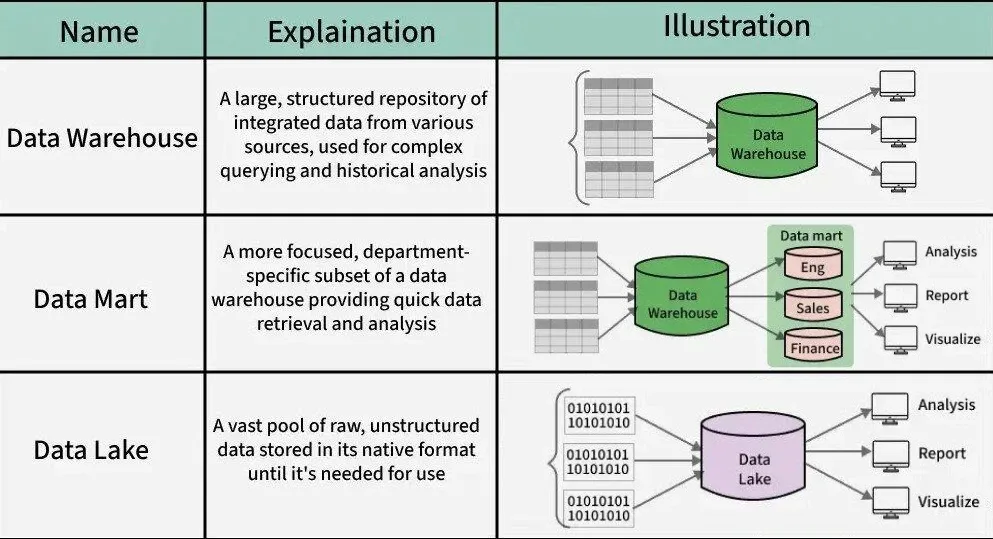
Difference between Data Mart, Data Lake, and Data Warehouse
| Feature | Data Mart | Data Lake | Data Warehouse |
|---|---|---|---|
| Purpose | Department-level analytics | Store raw data of all types | Enterprise-wide analytics |
| Data Type | Structured | Structured, Semi-structured, Unstructured | Structured |
| Data Source | Subset of Data Warehouse | Multiple raw data sources | Multiple operational systems |
| Data Processing | Processed | Raw | Processed |
| Schema | Schema-on-Write | Schema-on-Read | Schema-on-Write |
| Scalability | Limited to department | Very high (cheap storage) | High but costlier |
| Speed of Access | Fast for its domain | Slower (raw data needs prep) | Optimized for queries |
| Users | Business analysts | Data scientists | BI analysts, management |
| Cost | Low–Medium | Low (cheap storage) | High (complex structure) |