Don't Care (X) Conditions in KMaps (original) (raw)
Last Updated : 12 Jul, 2025
One of the most important concepts in simplifying output expressions using Karnaugh Maps (K-Maps) is the 'Don't Care' condition. The 'Don't Care' conditions allow us to treat certain cells in a K-Map as either 0, 1, or to ignore them altogether, which can help in forming larger and more efficient groups compared to grouping without 'Don't Care' cells. When forming groups, we can consider a 'Don't Care' cell as either 0 or 1, or we can choose to ignore it. Therefore, the "Don't Care" condition can help us to form a larger group of cells.
A Don't Care cell can be represented by a cross(X) or minus(-) or phi(Φ) in K-Maps representing an invalid combination. For example, in the Excess-3 code system, the states 0000, 0001, 0010, 1101, 1110, and 1111 are invalid or unspecified. These states are called don't cares.
A standard Sum of Products (SOP) function with 'Don't Care' conditions can be converted into a Product of Sums (POS) expression by retaining the 'Don't Care' cells and converting the missing minterms of the SOP form into maxterms of the POS form. Similarly, a POS function having don't cares can be converted to SOP form keeping the don't cares as they are and writing the missing maxterms of the POS expression as the minterms of SOP expression.
What is K-Map
Karnaugh Maps (K-Maps) are a visual approach that is used to simplify Boolean expressions and is especially used in times of handling don't care conditions. They offer an organized way of creating and joining groups of ones and don't care terms, thereby, reducing the logic expressions.
Steps to Use Don’t Care Conditions
- Identify Don't Care Conditions: Find out which combinations of variables result in don't care conditions. These can be portrayed directly in the question.
- Place Don't Care Values on the K-Map: Put the don't care conditions in the K-Map with the help of symbols like X, -, or Φ.Form
- Groups with Don't Care Values: Use don't-care cells to extend the number of 1s and thus, form bigger groups. These groups help to further minimize the expression.
- Simplify the Expression: The simplified Boolean expression should be written using the grouped terms. Only don't care values should be used to form larger groups.
**Example-1
Minimize the following function in SOP minimal form using K-Maps:
f = m(1, 5, 6, 11, 12, 13, 14) + d(4)
**Explanation:
The SOP K-map for the given expression is:
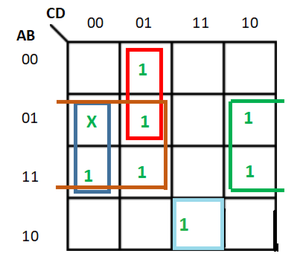
Therefore, SOP minimal is,
f = BC' + BD' + A'C'D + AB'CD
**Example-2:
Minimize the following function in POS minimal form using K-Maps:
F(A, B, C, D) = m(0, 1, 2, 3, 4, 5) + d(10, 11, 12, 13, 14, 15)
**Explanation:
Writing the given expression in POS form
F(A, B, C, D) = M(6, 7, 8, 9) + d(12, 13, 14, 15)
The POS K-map for the given expression is:
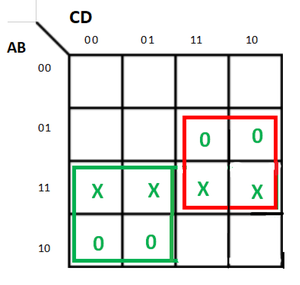
Therefore, POS minimal is,
F = (A'+ C)(B' + C')
**Example-3:
Minimize the following function in SOP minimal form using K-Maps:
F(A, B, C, D) = m(1, 2, 6, 7, 8, 13, 14, 15) + d(0, 3, 5, 12)
**Explanation:
The SOP K-map for the given expression is:
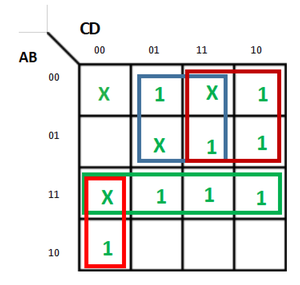
Therefore,
f = AC'D' + A'D + A'C + AB
**Advantages of Using "Don't Care" Conditions
- **Simplification of the output:
These conditions denote inputs that are invalid for a given digital circuit. Thus, they can be used to further simplify the Boolean output expression of a digital circuit. - **Reduction in number of gates required:
Simplification of the expression reduces the number of gates to be used for implementing the given expression. Therefore, don't cares make the digital circuit design more economical. - **Reduced Power Consumption:
While grouping the terms along with don't cares reduces switching of the states. This decreases the memory space that is required to represent a given digital circuit which in turn results in less power consumption. - **Represent Invalid States in Code Converters:
Don't Care' conditions are also used in code converters. For example- In design of 4-bit BCD-to-XS-3 code converter, the input combinations 1010, 1011, 1100, 1101, 1110, and 1111 are don't cares. - **Prevention of Hazards in Digital Circuits:
Don't cares also prevent hazards in digital systems.