Seven Segment Displays (original) (raw)
Last Updated : 12 Jul, 2025
Light Emitting Diode (LED) is the most widely used semiconductor which emits either visible light or invisible infrared light when forward biased. Remote controls generate invisible light. A Light-emitting diode (LED) is optical-electrical energy into light energy when voltage is applied.
Seven Segment Displays
Seven segment displays are the output display device that provides a way to display information in the form of images or text or decimal numbers which is an alternative to the more complex dot matrix displays. It is widely used in digital clocks, basic calculators, electronic meters, and other electronic devices that display numerical information. It consists of seven segments of light-emitting diodes (LEDs) which are assembled like numerical 8.
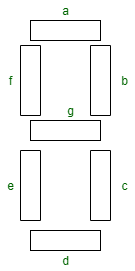 **Working of Seven Segment Displays
The number 8 is displayed when the power is given to all the segments and if you disconnect the power for ‘g’, then it displays the number 0. In a seven-segment display, power (or voltage) at different pins can be applied at the same time, so we can form combinations of display numerical from 0 to 9. Since seven-segment displays can not form alphabets like X and Z, so it can not be used for the alphabet and they can be used only for displaying decimal numerical magnitudes. However, seven-segment displays can form alphabets A, B, C, D, E, and F, so they can also be used for representing each display unit is usually has a dot point (DP). The display point could be located either towards the left or towards the right of the display pattern. This type of pattern can be used to display numerals from 0 to 9 and letters from to F hexadecimal digits.
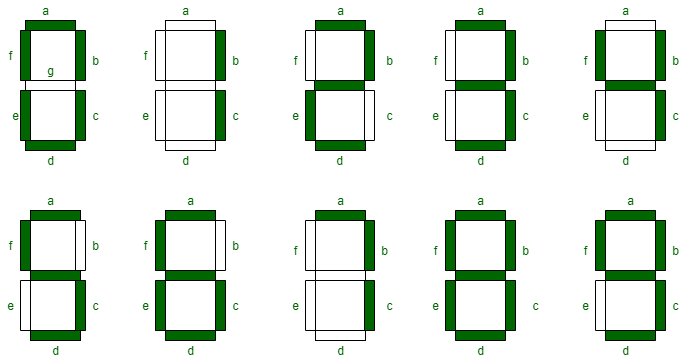
Truth Table
We can produce a truth table for each decimal digit
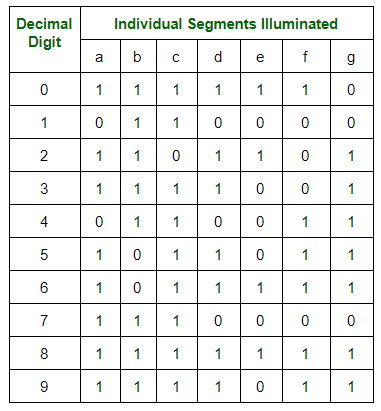
Therefore, Boolean expressions for each decimal digit that requires respective light-emitting diodes (LEDs) are ON or OFF. The number of segments used by digit: 0, 1, 2, 3, 4, 5, 6, 7, 8, and 9 are 6, 2, 5, 5, 4, 5, 6, 3, 7, and 6 respectively. Seven segment displays must be controlled by other external devices where different types of microcontrollers are useful to communicate with these external devices, like switches, keypads, and memory.
Types of Seven Segment Displays
According to the type of application, there are two types of configurations of seven-segment displays: common anode display and common cathode display.
- In common cathode seven segment displays, all the cathode connections of LED segments are connected together to logic 0 or ground. We use logic 1 through a current limiting resistor to forward bias the individual anode terminals a to g.
- Whereas all the anode connections of the LED segments are connected together to logic 1 in a common anode seven segment display. We use logic 0 through a current limiting resistor to the cathode of a particular segment a to g.
Common anode seven segment displays are more popular than cathode seven segment displays because logic circuits can sink more current than they can source and it is the same as connecting LEDs in reverse.
**Applications of Seven Segment Displays
- Digital clocks
- Clock radios
- Calculators
- Wristwatches
- Speedometers
- Motor-vehicle odometers
- Radiofrequency indicators
**Advantages of Seven Segment Displays
- **Simplicity: Seven Section Presentations are straightforward and simple to use since they just showcase mathematical digits (0-9) and a couple of characters like A-F for hexadecimal numbers.
- **Cost-viable: Seven Section Presentations are generally modest and require less parts to work than different sorts of showcases like LCDs or OLEDs.
- **High perceivability: Seven Portion Presentations have high perceivability even in low light circumstances as they are intended to emanate splendid, high-contrast light in a particular example that is not difficult to peruse.
- **Durability: Seven Section Presentations are strong and sturdy since they are produced using materials that are impervious to temperature changes and mechanical pressure.
Disadvantages of Seven Segment Displays
- **Limited usefulness: Seven Section Presentations are restricted to showing mathematical digits and a couple of characters, which can be a disservice in applications that require more mind boggling shows like designs or message.
- **Limited review points: Seven Fragment Showcases have restricted survey points, and that implies that the presentation might be hard to peruse from specific points or in splendid daylight.
- **Power utilization: Seven Portion Presentations consume more power than different sorts of showcases since they produce light constantly, which can be a burden in battery-worked gadgets.
- **Limited customization: Seven Portion Showcases are not effectively adaptable since they are intended to show just unambiguous examples of digits and characters, making it hard to show custom images or illustrations.
Common Cathode (CC) Configuration
In the common cathode configuration, all the cathodes (negative terminals) of the seven LEDs are connected to a common ground. Display segments are controlled independently by applying a HIGH (Logic 1) voltage to the anode of the particular LED. On applying the HIGH signal to an anode, current flows from the anode to the common cathode, and accordingly, the respective segment lights up.
Key-Points
- Connection: Cathodes are grounded.
- Control: HIGH to light up the segments.
- Power Consumption: Usually greater than Common Anode since it has to source current
Example Use Case
Common anode displays are used in any case with multiple displays driven by a microcontroller because it is easier to handle current sourcing with such configurations.
Common Anode (CA) Configuration
In an anode common configuration, the positive terminals of the seven LEDs are connected together to a common positive voltage. Typically, this is VCC. Individual segments are turned on by grounding the respective cathode. A LOW, or logic 0, voltage at a cathode sends current flowing from the CA, through the LED segment, to ground and turns it on.
Key Points
- Connection: All anodes are tied to the common positive voltage (Vcc).
- Control: Apply LOW to light up the segments.
- Power Consumption: Normally less than Common Cathode because of current sinking.
Example Use Case
Common Anode displays are used when ICs or microcontrollers are better at current sinking than sourcing.
Conclusion
Thus, seven-segment displays are an integral part of digital electronics since numeric information gets presented easily and with simplicity. Having found applications in a host of electronic and digital applications, from calculators and clocks to more complicated digital devices, they are relatively easy in terms of design and use. Be it a hobbyist or a professional, knowing how to interface and drive a seven-segment display is a skill that will pay dividends for their electronic projects.
Even with advancing technology day in and day out, seven-segment displays can still be envisioned as a sure and more economical approach to numeric output. Their ease of use and wide application make them arguably one of the most persistent elements in electronics design.