Universal Shift Register in Digital logic (original) (raw)
Last Updated : 25 Mar, 2026
A universal shift register is a general-purpose digital circuit that supports left and right shifting, parallel loading, and both serial and parallel data input/output, combining the features of unidirectional and bidirectional shift registers with the ability to hold data statically. It operates in three modes—Shift Left, Shift Right, and Parallel Load—based on control signals, and retains its current data when no control signal is active.
- Internally, it uses flip-flops to store bits and multiplexers to select the input source for each operation.
- Shift Left/Right operations move data by one position, replacing the vacant bit with serial input and discarding the shifted-out bit.
- Parallel Load allows simultaneous loading of data into all bits, while idle mode keeps the register unchanged.
- Often implemented using digital ICs like 74291 and 74395 in digital systems for full functionality.
**n-Bit Universal Shift Register
A n-bit universal shift register consists of n flip-flops and n 4x1 multiplexers. All the n multiplexers share the same select lines(S1 and S0)to select the mode in which the shift register operates. The select inputs select the suitable input for the flip-flops.
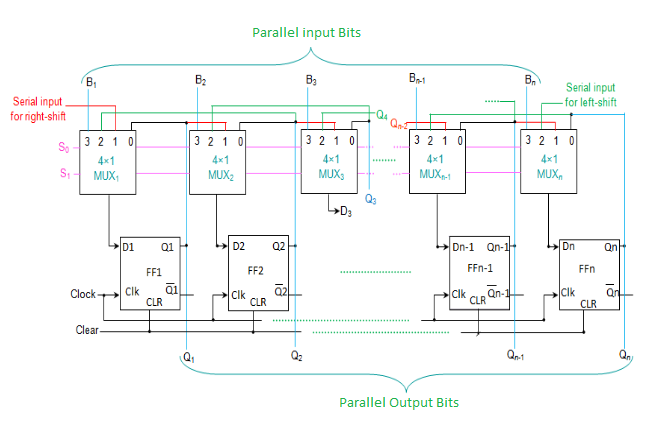
**Basic connections
- The first input (zeroth pin of multiplexer) is connected to the output pin of the corresponding flip-flop.
- The second input (first pin of multiplexer) is connected to the output of the very-previous flip flop which facilitates the right shift.
- The third input (second pin of multiplexer) is connected to the output of the very-next flip-flop which facilitates the left shift.
- The fourth input (third pin of multiplexer) is connected to the individual bits of the input data which facilitates parallel loading.
The working of the Universal shift register depends on the inputs given to the select lines. The register operations performed for the various inputs of select lines are as follows
| S1 | s0 | Register operation |
|---|---|---|
| 0 | 0 | No changes |
| 0 | 1 | Shift right |
| 1 | 0 | Shift left |
| 1 | 1 | Parallel load |
Advantages
- **Multifunctionality: left and right shifts, parallel load, and static hold can all be performed.
- **Flexibility: can be used in many different digital systems.
- **Efficient: reduces the hardware to manipulate the data.
Disadvantages
- **Complexity: More complex and expensive as compared to the simple shift registers.
- **Slower Operations: Sometimes additional control logic makes them slower.
- **Higher Cost: Additional functionalities raise the cost of implementation.
Applications
- **Data Serializing/Deserializing: Data can be transferred from parallel to serial format and vice-versa.
- **Digital Signal Processing: Digital signal processingfinds its applications in arithmetic operations and data manipulation.
- **Delay Circuits: The circuits that introduce the delays in digital signals are known as delay circuits.
- **Frequency divider: obtains lower frequency clock signals.
- **Counters and timers: Counters and timers perform timing and counting operations.