Digital Signal Processing (DSP) (original) (raw)
Last Updated : 16 Mar, 2026
A discrete-time signal is represented as a sequence of numerical values sampled at regular time intervals. A field that uses algorithms, techniques, and mathematical methods to process digital signals to extract useful information or enhance specific features.
- Involves the processing, analysis, and transformation of digital signals.
- Uses algorithms and computational techniques to retrieve information or modify signal characteristics.
- These signals are represented as sequences of numbers sampled at regular intervals.
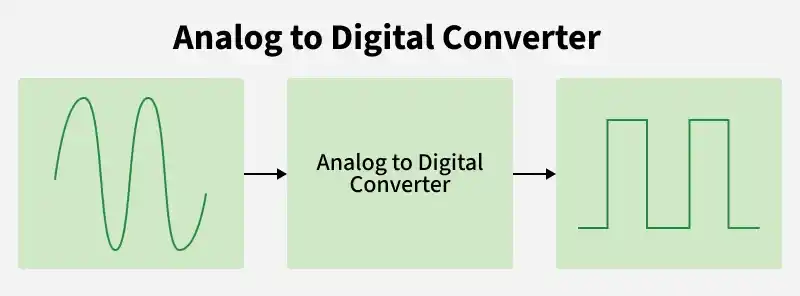
Types of Digital Signal Processors
Digital signal processors include two types such as fixed-point processors and floating-point processors.
- **Fixed Point : Each number is justified through a 16 bits which are minimum, although length can be used which is different. Each number is designated with unique patterns. Fixed point implies that we have to assume the fractional point location to be fixed and same for the operands as well as the output operations.
- **Floating Point : These processors specifically utilizes a 32 bits which are minimum to store each value. This processor has unique feature that is the signified numbers are not equally spaced. This leads to the implementation of counters and signals which are required and is received from the analog to digital converter and send to the digital to analog converter by leading to process the fixed-point numbers.
Components of DSP
- **Program Memory: This is where the instructions or programs that the DSP will execute are stored.
- **Data Memory: Data memory is where the information to be processed is stored.
- **Compute Engine: The compute engine is the heart of the DSP. It's used for executing the instructions from the program memory on the data stored in the data memory.
- **Input/Output: This component facilitates the interaction between the DSP and the outside world. It handles the input of data to be processed and the output of processed data.
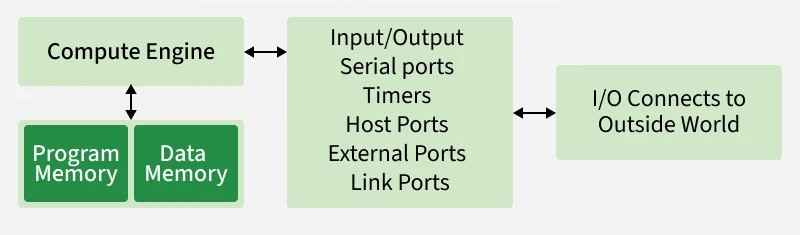
Components of Digital Signal Processing
Block Diagram of Digital Signal Processor
- **Step 1: In DSP block diagram, it starts from the receiving of electrical signal. A transducer (microphone) converts sound into an electrical signal.
- **Step 2: An operational amplifier amplifies the analog signal.
- **Step 3: An anti-aliasing low-pass filter removes unwanted high-frequency components.
- **Step 4: The anti-aliasing filter is an essential step in the conversion of analog to a digital signal. It is a low-pass filter that allowing frequencies up to a certain threshold. It attenuates all frequencies above this threshold. These unwanted frequencies create difficulties to sample an analog signal.
- **Step 5: Uses analog to digital converter (ADC) that it senses an analog signal and provides a sequence of binary digits.
- **Step 6: The main component is digital signal processor. It utilizes CMOS chips to manufacture digital signal processors.
- **Step 7: It uses digital signal processor which is important to compare the acquisition rate of the ADC by slew rate of the DAC.
- **Step 8: Here, we uses a low pass filter i.e. smoothing filter which removes high frequency components that are not necessary and refines the output.
- **Step 9: At the last stage, we use op-amp as an amplifier that has output transducer i.e. a speaker.
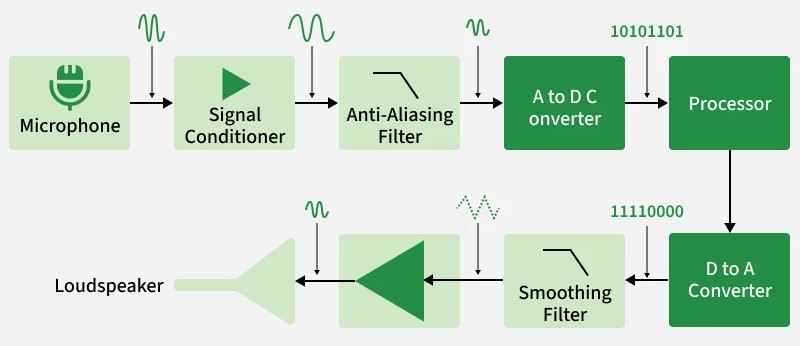
DSP Block Diagram
Features of Digital Signal Processor
- Digital signal processors are configured to design for managing repeat tasks and computationally complete tasks.
- Digital signal processors manages a data path and has tendency to transfer huge amounts of data to memory rapidly.
- To grow the efficiency of hardware, these processors manages to provide various unique instruction sets to grow the hardware efficiency.
- Digital signal processors has two features which are unique such as the data path that involves multiple-access memory architectures and fast multiply-accumulate units.
- Pipelining is also often utilized to grow the performance of processor. Various processors utilize pipelining that create programming difficult but used in the better growth to increase performance.
Architecture of Digital Signal Processor
DSP architecture uses modified Harvard design with separate program/data memories and multiple data buses for parallel access, featuring MAC units, ALUs, shifters, and specialized modes like circular buffering for efficient real-time signal processing.
**1. Von Neumann Architecture
Von Neumann’s architecture comprises of single memory and a single bus that are used to transfer data in and out of the CPU (central processing unit) of a digital signal processor. It comprises of 3 basic units that is referred to as ISA (Instruction set architecture).
- **Central Processing Unit (CPU): The CPU consists of three main units: the Control Unit, Arithmetic Logic Unit (ALU), and registers (main memory unit). It is the core part of the system that processes instructions, analyzes data, stores information, and produces output according to the program instructions.
- **Main Memory Unit (Registers): Registers are small, high-speed memory units inside the CPU used to store, accept, and transfer data and instructions during program execution. They are defined by the processor architecture and help the CPU perform operations quickly and efficiently.
- **Input/Output Device: Data is read from input devices into main memory through CPU instructions. The processed results are then sent to output devices. Stored results can also be displayed to the user using output components
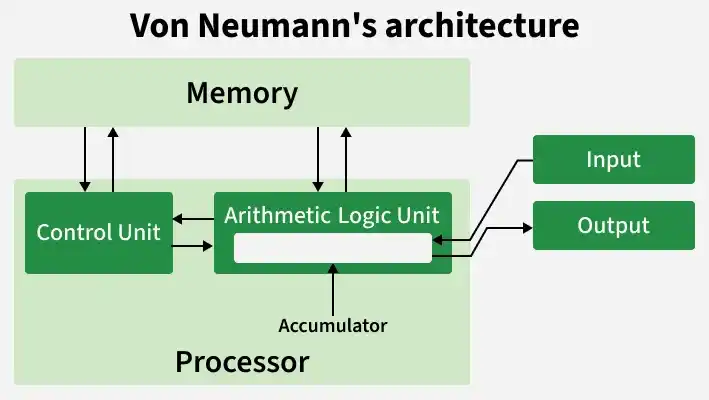
2. Harvard Architecture
Harvard architecture consists different storage and different buses to process both data and instructions. It is type of computer architecture that has been designed to resolved the limitations of Von Neumann’s Architecture.
- Uses separate memory for data and instructions.
- Has separate buses for data and instructions.
- Allows the CPU to read/write data and fetch instructions simultaneously.
- Improves speed and performance of the system.
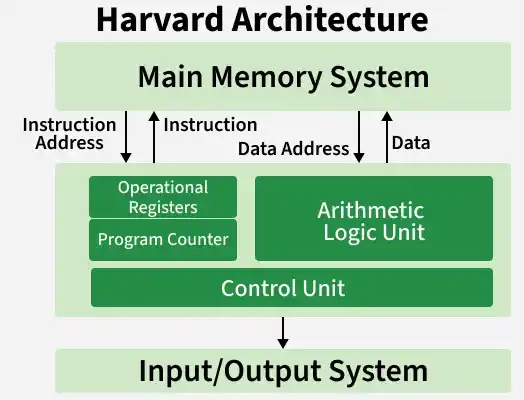
It consists of following components in the architecture mentioned below are:
**Buses
- **Data Bus: It conveys information enclosed with the processor, main memory and input or output devices.
- **Data Address Bus: It conveys the data address from the processor to the main memory.
- **Instruction Bus: It conveys instructions enclosed with the processor, main memory and input or output devices.
- **Instruction Address Bus: It conveys the instructions address from the processor to the main memory.
**Operational Registers
- **Program Counter: It contains the address of the next instruction to be carried out.
- **Arithmetic and Logic Unit: It is a component of the CPU that performs important computations of the ALU that executes addition, subtraction, comparison, and some other operations.
- **Control Unit: The component of the CPU that manages the processor control signals.
- **Input/Output System: Using input devices and with the required input instructions of CPU, data is read into main memory.
Digital Signal Processor Instruction Sets
The assembly language instructions of the TMS320F/C24x DSP are explained. These instruction sets efficiently handle complex signal-processing operations as well as general-purpose applications such as multiprocessing. The ’C24x instruction set is compatible with the ’C2x instruction set. Code written for the ’C2x processor can also be executed on the ’C24x processor. The instruction set of the TMS320F/C24x DSP is described below.
- Accumulator, arithmetic and logic instructions.
- Auxiliary register and data page pointer instructions.
- TREG, PREG and multiply instructions.
- Branch instructions.
- Control instructions.
- I/O and memory operations.
**Fundamentals of Digital Signal Processing
- **Sampling: It is the process that samples the continuous analog signal into a digital signal.
- **Quantization: It is the process that assigns digital numbers to the calculated analog signal. It makes a group of the measured values into a set of finite.
- **Discrete Fourier Transform (DFT): This method transforms a discrete time signal into its frequency domain. It helps to understand the various frequencies which are present in a signal.
- **Fast Fourier Transform (FFT): This algorithm is quite efficient hat performs the DFT quickly. Furthermore, it is the advanced technique of the DFT that assists to explore signals quickly and more productively.
**Applications
- **Telecommunications: DSP is used in mobile phones, VoIP, and video conferencing for encoding/decoding, compression, modulation, demodulation, and error correction.
- **Audio Processing: Used for filtering, equalization, noise reduction, speech recognition, and improving sound quality.
- **Image Processing: Applied in image filtering, compression, and recognition in digital cameras, medical imaging (MRI, CT), and satellite imaging.
- **Radar & Sonar: Helps in target detection, tracking, range estimation, and interference reduction in defense and aviation.
- **Control Systems: Used in feedback control, filtering, robotics, and automotive systems.
- **Wireless Communication: Supports Wi-Fi and cellular networks through modulation, demodulation, and channel estimation.
- **Sensor Signal Processing: Processes data from sensors (accelerometers, gyroscopes) in IoT devices and smart systems.
Advantages
- **Noise : It includes digital signal which has a less probability of getting mixed with unwanted signals so that overall noise will be less.
- **Detection and correction: It allows usage of numerous error detection and correction characteristics that exists to digital signals such as as a detection and correction tool and utilizes a parity generation and correction .
- **Data storage: It is used to store digital data in a simple way. It is required to select from a different varieties of digital memories.
- **Encryption : Digital signals are involved in simple encryption.
- **Data transmission : It uses a tool which is needed for digital signals to send huge data over unit time by using Time-division multiplexing technique and over one communication path so that more data can be transmitted.
Disadvantages
- **Complexity : DSP system has some complexities that leads to increase due to the use of additional components.
- **Power : Digital signal processor utilizes various transistors which needs huge power compared to the analog signal processors.
- **Cost : Digital signal processors are very expensive.
- **Bandwidth : Digital communications uses wide range of bandwidth to send the data compared to analog method.
- **Sampling and Quantization Errors: It samples analog signals and quantizing them into digital signal can give errors, gives attenuation with respect to information in the signal.
Digital Signal Processor vs Microprocessor
| **Digital Signal Processor | **Microprocessor |
|---|---|
| DSPs are mainly utilized in telecommunications, audio signal processing, etc | Microprocessors are used in computers for text editing, computation, multimedia display and communication over the Internet. |
| Parallel execution | Sequential execution |
| Two Addressing modes i.e. direct and indirect both are used in this processor | Some addressing modes are direct, immediate, register indirect, indirect register, etc, are utilized in microprocessor. |
| To generate an address, it leads to combine program sequencers and Directed Acyclic Graph (DAGs). | It provides a sequential address and increments a program counter |
| Instruction register and program counter both manages to control the program flow | Execution flow can be controlled by the Program counter |
| Address and data bus are multiplexed in digital signal processor | Address and data bus are not multiplexed in microprocessor |