Applications of Stack (original) (raw)
Last Updated : 2 Feb, 2026
A Stack is a linear data structure in which the insertion of a new element and removal of an existing element takes place at the same end represented as the top of the stack.
This property of stack is used to solve a lot of interesting problems:
- Next Greater, Previous Greater.
- Next Smaller, Previous Smaller.
- Largest Area in a Histogram
- Stock Span Problems
Stack applications are diverse, representing a dynamic data structure with various uses, some of which are mentioned below:
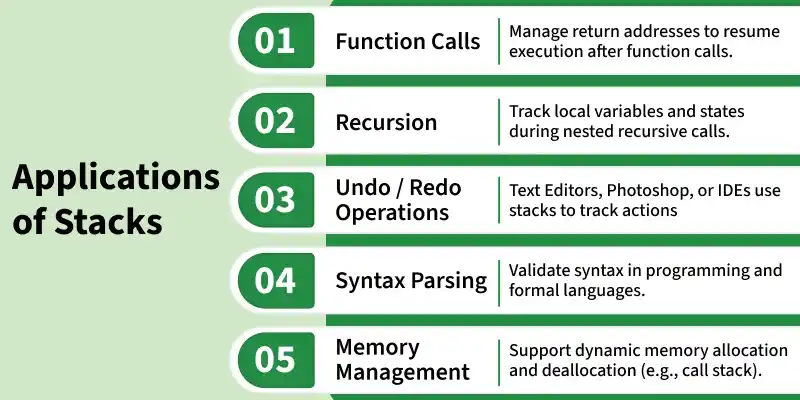
**1. Function Calls
Stacks manage the "active" functions in a program. When a function is called, its execution state is pushed onto the stack; when it finishes, it is popped to return control to the caller.
- **Example: In a program where Main() calls CalculateBill(), which then calls ApplyDiscount(), the stack ensures that once the discount is calculated, the program knows exactly how to jump back into the middle of the billing function.
**2. Recursion
Since recursion is essentially a function calling itself, the stack stores a "snapshot" of each call (including local variables) so the program doesn't lose its place.
- **Example: In calculating a Factorial (n!), the stack stores the value of n for every nested call. For 3!, it pushes 3, then 2, then 1. Once it hits the base case, it pops them off to multiply them in reverse order (1 x 2 x 3).
**3. Expression Evaluation
Stacks are used by compilers and calculators to handle the order of operations without needing complex parentheses.
- **Example: To solve the postfix expression "3 4 + 5 *", a stack pushes 3 and 4, pops them to add them (resulting in 7), pushes the 7 back, then pushes 5, and finally pops both to multiply them for a total of 35.
**4. Syntax Parsing
Stacks are perfect for "balancing" symbols. They ensure that every opening bracket has a corresponding closing bracket in the correct order.
- **Example: An IDE uses a stack to check code like " if (a > b) { print(c); } " . It pushes ' ( ' and ' { ' onto the stack as it sees them. When it encounters ' ) ' and ' } ' , it pops the top element to ensure the types match. If the stack is empty at the end, the syntax is valid.
**5. Memory Management
The "Stack" is a specific region of RAM used for automatic variable allocation. It is incredibly fast because it only allocates and deallocates memory in a strict Last-In, First-Out (LIFO) order.
- **Example: When you declare " int x = 10; " inside a Java or C++ function, that memory is allocated on the Stack. As soon as the function's closing brace ' } ' is reached, that memory is automatically reclaimed by the system without needing manual cleanup.
Advantages:
- **Time & Memory Efficiency: Push and pop operations on a stack can be performed in constant time-O(1), enabling efficient data access, they are memory-efficient because they only store pushed elements, compared to other data structures.
- **Last-In, First-Out (LIFO): Stacks follow the LIFO principle, ensuring the last element added is the first one removed. This behavior is useful in scenarios like function calls and expression evaluation.
Disadvantages:
- **Limited access: Elements in a stack can only be accessed from the top, which makes it difficult to retrieve or modify elements in the middle.
- **Potential for overflow: Pushing more elements onto a stack than it can hold results in an overflow error, leading to data loss.