Bitonic Sort (original) (raw)
Last Updated : 19 Dec, 2025
Bitonic Sort is a parallel sorting algorithm designed to take full advantage of hardware that can perform multiple operations simultaneously.
Unlike traditional sorting algorithms like Quick Sort or Merge Sort, Bitonic Sort is built to **exploit parallelism, making it highly effective on GPUs, multi-core processors, and hardware-based sorting networks.
It works only when the number of elements is a **power of 2, and it guarantees a fully sorted sequence using a predictable sequence of compare and swap operations.
Understanding Bitonic Sequences
A bitonic sequence is the core concept behind Bitonic Sort.
A sequence is **bitonic if it satisfies one of these:
- It first increases and then decreases,
- Or it can be rotated to form an increasing-then-decreasing sequence.
**Examples:
- [3, 7, 14, 12, 8, 5, 2] → increases then decreases → bitonic
- [1, 4, 6, 8, 7, 3] → bitonic after rotation
Why bitonic sequences matter:
Bitonic Sort works by recursively building bitonic sequences and then merging them into a fully sorted array. This structure allows the algorithm to perform many compare-and-swap operations simultaneously, which is why it’s ideal for parallel execution.
How Bitonic Sort Works
**Phase 1: Build a Bitonic Sequence
- Divide the array into two halves.
- Sort the first half ascending and the second half descending.
- Combine the halves → this forms a bitonic sequence (first increasing, then decreasing).
Example: [3, 7, 4, 8, 6, 2, 1, 5]
- Left [3, 7, 4, 8] → [3, 4, 7, 8] (ascending)
- Right [6, 2, 1, 5] → [6, 5, 2, 1] (descending)
- Combined → [3, 4, 7, 8, 6, 5, 2, 1] (bitonic)
This bitonic sequence allows efficient merging using compare-and-swap operations.
**Phase 2: Bitonic Merge
- Compare elements at a specific distance and swap if out of order.
- Recursively apply the process to both halves until fully sorted.
Example:
- [3, 4, 7, 8, 6, 5, 2, 1] → compare distance 4: (3,6), (4,5), (7,2), (8,1) → swap where needed
- Recursively merge smaller halves: distance 2 → distance 1
- Result → [1, 2, 3, 4, 5, 6, 7, 8]
The initial ascending/descending halves and fixed compare-swap pattern make this algorithm **highly parallelizable.
C++ `
//Driver Code Starts #include #include using namespace std; //Driver Code Ends
// Compare and swap elements based on direction // direction = 1 → ascending, direction = 0 → descending void compAndSwap(vector& arr, int i, int j, int direction) { if ((direction == 1 && arr[i] > arr[j]) || (direction == 0 && arr[i] < arr[j])) { swap(arr[i], arr[j]); } }
// Recursively merge a bitonic sequence into sorted order void bitonicMerge(vector& arr, int low, int cnt, int direction) { if (cnt > 1) { int k = cnt / 2; for (int i = low; i < low + k; i++) { compAndSwap(arr, i, i + k, direction); } bitonicMerge(arr, low, k, direction); bitonicMerge(arr, low + k, k, direction); } }
// Recursively build bitonic sequences and sort them void bitonicSort(vector& arr, int low, int cnt, int direction) { if (cnt > 1) { int k = cnt / 2;
    // Sort first half ascending
    bitonicSort(arr, low, k, 1);

    // Sort second half descending
    bitonicSort(arr, low + k, k, 0);

    // Merge entire sequence in given direction
    bitonicMerge(arr, low, cnt, direction);
}
}
// function to sort the entire array void sortArray(vector& arr) {
// up = 1 → ascending, up = 0 → descending
int up = 1;
bitonicSort(arr, 0, arr.size(), up);
}
//Driver Code Starts int main() { vector arr = {7, 3, 4, 8, 6, 2, 1, 5};
sortArray(arr);

for (int x : arr) cout << x << " ";
cout << endl;

return 0;
}
//Driver Code Ends
Java
//Driver Code Starts class GFG { //Driver Code Ends
// Compare and swap elements based on direction
// direction = 1 → ascending, direction = 0 → descending
static void compAndSwap(int[] arr, int i, int j, int direction) {
    if ((direction == 1 && arr[i] > arr[j])
        || (direction == 0 && arr[i] < arr[j])) {
        int temp = arr[i];
        arr[i] = arr[j];
        arr[j] = temp;
    }
}

// Recursively merge a bitonic sequence into sorted order
static void bitonicMerge(int[] arr, int low, int cnt, int direction) {
    if (cnt > 1) {
        int k = cnt / 2;
        for (int i = low; i < low + k; i++) {
            compAndSwap(arr, i, i + k, direction);
        }
        bitonicMerge(arr, low, k, direction);
        bitonicMerge(arr, low + k, k, direction);
    }
}

// Recursively build bitonic sequences and sort them
static void bitonicSort(int[] arr, int low, int cnt, int direction) {
    if (cnt > 1) {
        int k = cnt / 2;

        // Sort first half ascending
        bitonicSort(arr, low, k, 1);

        // Sort second half descending
        bitonicSort(arr, low + k, k, 0);

        // Merge entire sequence in given direction
        bitonicMerge(arr, low, cnt, direction);
    }
}

// function to sort the entire array
static void sortArray(int[] arr) {

    // up = 1 → ascending, up = 0 → descending
    int up = 1;
    bitonicSort(arr, 0, arr.length, up);
}
//Driver Code Starts public static void main(String[] args) { int[] arr = {7, 3, 4, 8, 6, 2, 1, 5};
    sortArray(arr);

    for (int x : arr)
        System.out.print(x + " ");
    System.out.println();
}
}
//Driver Code Ends
Python
Compare and swap elements based on direction
direction = 1 → ascending, direction = 0 → descending
def compAndSwap(arr, i, j, direction):
if (direction == 1 and arr[i] > arr[j])
or (direction == 0 and arr[i] < arr[j]):
arr[i], arr[j] = arr[j], arr[i]
Recursively merge a bitonic sequence into sorted order
def bitonicMerge(arr, low, cnt, direction): if cnt > 1: k = cnt // 2 for i in range(low, low + k): compAndSwap(arr, i, i + k, direction) bitonicMerge(arr, low, k, direction) bitonicMerge(arr, low + k, k, direction)
Recursively build bitonic sequences and sort them
def bitonicSort(arr, low, cnt, direction): if cnt > 1: k = cnt // 2
    # Sort first half ascending
    bitonicSort(arr, low, k, 1)

    # Sort second half descending
    bitonicSort(arr, low + k, k, 0)

    # Merge entire sequence in given direction
    bitonicMerge(arr, low, cnt, direction)
function to sort the entire array
def sortArray(arr):
# up = 1 → ascending, up = 0 → descending
up = 1

bitonicSort(arr, 0, len(arr), up)
#Driver Code Starts
if name == 'main': arr = [7, 3, 4, 8, 6, 2, 1, 5] sortArray(arr) print(*arr)
#Driver Code Ends
C#
//Driver Code Starts using System;
class GFG { //Driver Code Ends
// Compare and swap elements based on direction
// direction = 1 → ascending, direction = 0 → descending
static void CompAndSwap(int[] arr, int i, int j, int direction) {
    if ((direction == 1 && arr[i] > arr[j])
        || (direction == 0 && arr[i] < arr[j])) {
        int temp = arr[i];
        arr[i] = arr[j];
        arr[j] = temp;
    }
}

// Recursively merge a bitonic sequence into sorted order
static void BitonicMerge(int[] arr, int low, int cnt, int direction) {
    if (cnt > 1) {
        int k = cnt / 2;
        for (int i = low; i < low + k; i++) {
            CompAndSwap(arr, i, i + k, direction);
        }
        BitonicMerge(arr, low, k, direction);
        BitonicMerge(arr, low + k, k, direction);
    }
}

// Recursively build bitonic sequences and sort them
static void BitonicSort(int[] arr, int low, int cnt, int direction) {
    if (cnt > 1) {
        int k = cnt / 2;

        // Sort first half ascending
        BitonicSort(arr, low, k, 1);

        // Sort second half descending
        BitonicSort(arr, low + k, k, 0);

        // Merge entire sequence in given direction
        BitonicMerge(arr, low, cnt, direction);
    }
}

// function to sort the entire array
static void SortArray(int[] arr) {

    // up = 1 → ascending, up = 0 → descending
    int up = 1;
    BitonicSort(arr, 0, arr.Length, up);
}
//Driver Code Starts static void Main() { int[] arr = {7, 3, 4, 8, 6, 2, 1, 5}; SortArray(arr); Console.WriteLine(string.Join(" ", arr)); } }
//Driver Code Ends
JavaScript
// Compare and swap elements based on direction // direction = 1 → ascending, direction = 0 → descending function compAndSwap(arr, i, j, direction) { if ((direction === 1 && arr[i] > arr[j]) || (direction === 0 && arr[i] < arr[j])) { [arr[i], arr[j]] = [arr[j], arr[i]]; } }
// Recursively merge a bitonic sequence into sorted order function bitonicMerge(arr, low, cnt, direction) { if (cnt > 1) { let k = Math.floor(cnt / 2); for (let i = low; i < low + k; i++) { compAndSwap(arr, i, i + k, direction); } bitonicMerge(arr, low, k, direction); bitonicMerge(arr, low + k, k, direction); } }
// Recursively build bitonic sequences and sort them function bitonicSort(arr, low, cnt, direction) { if (cnt > 1) { let k = Math.floor(cnt / 2);
    // Sort first half ascending
    bitonicSort(arr, low, k, 1);

    // Sort second half descending
    bitonicSort(arr, low + k, k, 0);

    // Merge entire sequence in given direction
    bitonicMerge(arr, low, cnt, direction);
}
}
// function to sort the entire array function sortArray(arr) {
// up = 1 → ascending, up = 0 → descending
let up = 1;
bitonicSort(arr, 0, arr.length, up);
}
// Driver Code //Driver Code Starts let arr = [7, 3, 4, 8, 6, 2, 1, 5]; sortArray(arr); console.log(arr.join(" "));
//Driver Code Ends
`
**Time Complexity:
- **Best Case: O(n log² n)
- **Average Case: O(n log² n)
- **Worst Case: O(n log² n)
**Auxiliary Space: O(log n), due to recursion stack space
**Stability: No, Bitonic Sort is not stable, since elements may be swapped across sequences during merging.
Understanding Time Complexity for Bitonic Sort
Bitonic Sort first builds bitonic sequences (half ascending, half descending) and then merges them into sorted order.
Each of these two phases has log n levels, and every level performs O(n) comparisons.
Thus, total time = O(n × log n × log n) = O(n log² n).
Although it’s slower than Merge Sort on a single processor, Bitonic Sort is highly effective on parallel hardware, where many compare-swap operations can be executed simultaneously, reducing actual runtime significantly.
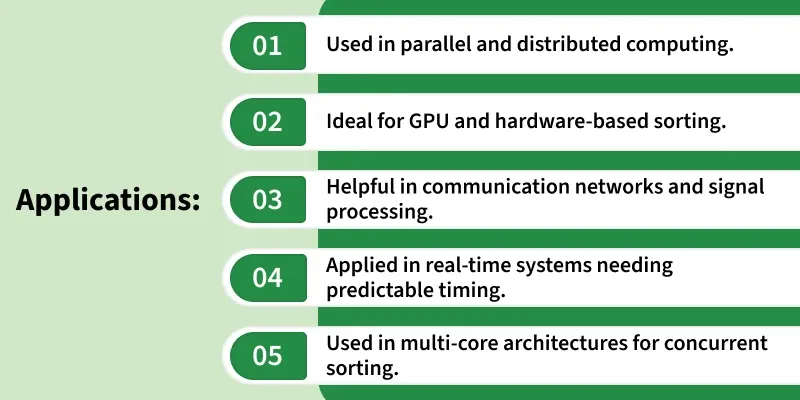
Applications of Bitonic Sort