Boyer Moore Algorithm for Pattern Searching (original) (raw)
Last Updated : 23 Jul, 2025
Pattern searching is an important problem in computer science. When we do search for a string in a notepad/word file, browser, or database, pattern searching algorithms are used to show the search results.
A typical problem statement would be-
" Given a text txt[0..n-1] and a pattern pat[0..m-1] where n is the length of the text and m is the length of the pattern, write a function search(char pat[], char txt[]) that prints all occurrences of pat[] in txt[]. You may assume that n > m. "
**Examples:
**Input: txt[] = "THIS IS A TEST TEXT"
pat[] = "TEST"
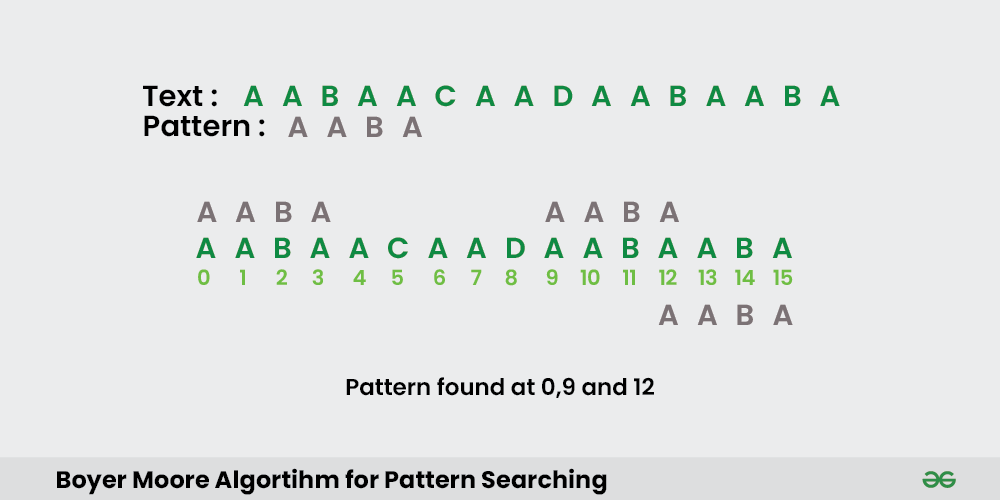
**Output: Pattern found at index 10**Input: txt[] = "AABAACAADAABAABA"
pat[] = "AABA"
**Output: Pattern found at index 0
Pattern found at index 9
Pattern found at index 12
In this post, we will discuss the Boyer Moore pattern searching algorithm. Like KMP and Finite Automata algorithms, Boyer Moore algorithm also preprocesses the pattern.
Boyer Moore is a combination of the following two approaches.
- **Bad Character Heuristic
- **Good Suffix Heuristic
Both of the above heuristics can also be used independently to search a pattern in a text. Let us first understand how two independent approaches work together in the Boyer Moore algorithm.
If we take a look at the Naive algorithm, it slides the pattern over the text one by one. KMP algorithm does preprocessing over the pattern so that the pattern can be shifted by more than one. The Boyer Moore algorithm does preprocessing for the same reason. It processes the pattern and creates different arrays for each of the two heuristics. At every step, it slides the pattern by the max of the slides suggested by each of the two heuristics. **So, it uses greatest offset suggested by the two heuristics at every step.
Unlike the previous pattern searching algorithms, the **Boyer Moore algorithm starts matching from the last character of the pattern.
In this post, we will discuss the bad character heuristic and the Good Suffix heuristic in the next post.
**Bad Character Heuristic
The idea of bad character heuristic is simple. The character of the text which doesn’t match with the current character of the pattern is called the **Bad Character. Upon mismatch, we shift the pattern until -
- The mismatch becomes a match.
- Pattern P moves past the mismatched character.
**Case 1 – Mismatch become match
We will lookup the position of the last occurrence of the mismatched character in the pattern, and if the mismatched character exists in the pattern, then we’ll shift the pattern such that it becomes aligned to the mismatched character in the text T.

**Explanation:
In the above example, we got a mismatch at position **3.
Here our mismatching character is “A”. Now we will search for last occurrence of “A” in pattern. We got “A” at position 1 in pattern (displayed in Blue) and this is the last occurrence of it. Now we will shift pattern 2 times so that “A” in pattern get aligned with “A” in text.
**Case 2 – Pattern move past the mismatch character
We’ll lookup the position of last occurrence of mismatching character in pattern and if character does not exist we will shift pattern past the mismatching character.

**Explanation:
Here we have a mismatch at position **7.
The mismatching character “C” does not exist in pattern before position 7 so we’ll shift pattern past to the position 7 and eventually in above example we have got a perfect match of pattern (displayed in Green). We are doing this because “C” does not exist in the pattern so at every shift before position 7 we will get mismatch and our search will be fruitless.
Implementation:
In the following implementation, we pre-process the pattern and store the last occurrence of every possible character in an array of size equal to alphabet size. If the character is not present at all, then it may result in a shift by m (length of pattern). Therefore, the bad character heuristic takes O(n/m) time in the best case.
Below is the implementation of the above idea:
C++ `
/* C++ Program for Bad Character Heuristic of Boyer Moore String Matching Algorithm */ #include <bits/stdc++.h> using namespace std; #define NO_OF_CHARS 256
// The preprocessing function for Boyer Moore's // bad character heuristic void badCharHeuristic(string str, int size, int badchar[NO_OF_CHARS]) { int i;
// Initialize all occurrences as -1
for (i = 0; i < NO_OF_CHARS; i++)
    badchar[i] = -1;

// Fill the actual value of last occurrence
// of a character
for (i = 0; i < size; i++)
    badchar[(int)str[i]] = i;
}
/* A pattern searching function that uses Bad Character Heuristic of Boyer Moore Algorithm */ void search(string txt, string pat) { int m = pat.size(); int n = txt.size();
int badchar[NO_OF_CHARS];

/* Fill the bad character array by calling
the preprocessing function badCharHeuristic()
for given pattern */
badCharHeuristic(pat, m, badchar);

int s = 0; // s is shift of the pattern with
           // respect to text
while (s <= (n - m)) {
    int j = m - 1;

    /* Keep reducing index j of pattern while
    characters of pattern and text are
    matching at this shift s */
    while (j >= 0 && pat[j] == txt[s + j])
        j--;

    /* If the pattern is present at current
    shift, then index j will become -1 after
    the above loop */
    if (j < 0) {
        cout << "pattern occurs at shift = " << s
             << endl;

        /* Shift the pattern so that the next
        character in text aligns with the last
        occurrence of it in pattern.
        The condition s+m < n is necessary for
        the case when pattern occurs at the end
        of text */
        s += (s + m < n) ? m - badchar[txt[s + m]] : 1;
    }

    else
        /* Shift the pattern so that the bad character
        in text aligns with the last occurrence of
        it in pattern. The max function is used to
        make sure that we get a positive shift.
        We may get a negative shift if the last
        occurrence of bad character in pattern
        is on the right side of the current
        character. */
        s += max(1, j - badchar[txt[s + j]]);
}
}
/* Driver code */ int main() { string txt = "ABAAABCD"; string pat = "ABC"; search(txt, pat); return 0; }
// This code is contributed by rathbhupendra
C
/* C Program for Bad Character Heuristic of Boyer Moore String Matching Algorithm */ #include <limits.h> #include <stdio.h> #include <string.h>
#define NO_OF_CHARS 256
// A utility function to get maximum of two integers int max(int a, int b) { return (a > b) ? a : b; }
// The preprocessing function for Boyer Moore's // bad character heuristic void badCharHeuristic(char* str, int size, int badchar[NO_OF_CHARS]) { int i;
// Initialize all occurrences as -1
for (i = 0; i < NO_OF_CHARS; i++)
    badchar[i] = -1;

// Fill the actual value of last occurrence
// of a character
for (i = 0; i < size; i++)
    badchar[(int)str[i]] = i;
}
/* A pattern searching function that uses Bad Character Heuristic of Boyer Moore Algorithm / void search(char txt, char* pat) { int m = strlen(pat); int n = strlen(txt);
int badchar[NO_OF_CHARS];

/* Fill the bad character array by calling
   the preprocessing function badCharHeuristic()
   for given pattern */
badCharHeuristic(pat, m, badchar);

int s = 0; // s is shift of the pattern with
           // respect to text
while (s <= (n - m)) {
    int j = m - 1;

    /* Keep reducing index j of pattern while
       characters of pattern and text are
       matching at this shift s */
    while (j >= 0 && pat[j] == txt[s + j])
        j--;

    /* If the pattern is present at current
       shift, then index j will become -1 after
       the above loop */
    if (j < 0) {
        printf("\n pattern occurs at shift = %d", s);

        /* Shift the pattern so that the next
           character in text aligns with the last
           occurrence of it in pattern.
           The condition s+m < n is necessary for
           the case when pattern occurs at the end
           of text */
        s += (s + m < n) ? m - badchar[txt[s + m]] : 1;
    }

    else
        /* Shift the pattern so that the bad character
           in text aligns with the last occurrence of
           it in pattern. The max function is used to
           make sure that we get a positive shift.
           We may get a negative shift if the last
           occurrence  of bad character in pattern
           is on the right side of the current
           character. */
        s += max(1, j - badchar[txt[s + j]]);
}
}
/* Driver program to test above function */ int main() { char txt[] = "ABAAABCD"; char pat[] = "ABC"; search(txt, pat); return 0; }
Java
/* Java Program for Bad Character Heuristic of Boyer Moore String Matching Algorithm */
class AWQ {
static int NO_OF_CHARS = 256;

// A utility function to get maximum of two integers
static int max(int a, int b) { return (a > b) ? a : b; }

// The preprocessing function for Boyer Moore's
// bad character heuristic
static void badCharHeuristic(char[] str, int size,
                             int badchar[])
{

    // Initialize all occurrences as -1
    for (int i = 0; i < NO_OF_CHARS; i++)
        badchar[i] = -1;

    // Fill the actual value of last occurrence
    // of a character (indices of table are ascii and
    // values are index of occurrence)
    for (int i = 0; i < size; i++)
        badchar[(int)str[i]] = i;
}

/* A pattern searching function that uses Bad
Character Heuristic of Boyer Moore Algorithm */
static void search(char txt[], char pat[])
{
    int m = pat.length;
    int n = txt.length;

    int badchar[] = new int[NO_OF_CHARS];

    /* Fill the bad character array by calling
       the preprocessing function badCharHeuristic()
       for given pattern */
    badCharHeuristic(pat, m, badchar);

    int s = 0; // s is shift of the pattern with
               // respect to text
    // there are n-m+1 potential alignments
    while (s <= (n - m)) {
        int j = m - 1;

        /* Keep reducing index j of pattern while
           characters of pattern and text are
           matching at this shift s */
        while (j >= 0 && pat[j] == txt[s + j])
            j--;

        /* If the pattern is present at current
           shift, then index j will become -1 after
           the above loop */
        if (j < 0) {
            System.out.println(
                "Patterns occur at shift = " + s);

            /* Shift the pattern so that the next
               character in text aligns with the last
               occurrence of it in pattern.
               The condition s+m < n is necessary for
               the case when pattern occurs at the end
               of text */
            // txt[s+m] is character after the pattern
            // in text
            s += (s + m < n) ? m - badchar[txt[s + m]]
                             : 1;
        }

        else
            /* Shift the pattern so that the bad
               character in text aligns with the last
               occurrence of it in pattern. The max
               function is used to make sure that we get
               a positive shift. We may get a negative
               shift if the last occurrence  of bad
               character in pattern is on the right side
               of the current character. */
            s += max(1, j - badchar[txt[s + j]]);
    }
}

/* Driver program to test above function */
public static void main(String[] args)
{

    char txt[] = "ABAAABCD".toCharArray();
    char pat[] = "ABC".toCharArray();
    search(txt, pat);
}
}
Python
Python3 Program for Bad Character Heuristic
of Boyer Moore String Matching Algorithm
NO_OF_CHARS = 256
def badCharHeuristic(string, size): ''' The preprocessing function for Boyer Moore's bad character heuristic '''
# Initialize all occurrence as -1
badChar = [-1]*NO_OF_CHARS

# Fill the actual value of last occurrence
for i in range(size):
    badChar[ord(string[i])] = i

# return initialized list
return badChar
def search(txt, pat): ''' A pattern searching function that uses Bad Character Heuristic of Boyer Moore Algorithm ''' m = len(pat) n = len(txt)
# create the bad character list by calling
# the preprocessing function badCharHeuristic()
# for given pattern
badChar = badCharHeuristic(pat, m)

# s is shift of the pattern with respect to text
s = 0
while(s <= n-m):
    j = m-1

    # Keep reducing index j of pattern while
    # characters of pattern and text are matching
    # at this shift s
    while j >= 0 and pat[j] == txt[s+j]:
        j -= 1

    # If the pattern is present at current shift,
    # then index j will become -1 after the above loop
    if j < 0:
        print("Pattern occur at shift = {}".format(s))

        '''
            Shift the pattern so that the next character in text
                  aligns with the last occurrence of it in pattern.
            The condition s+m < n is necessary for the case when
               pattern occurs at the end of text
           '''
        s += (m-badChar[ord(txt[s+m])] if s+m < n else 1)
    else:
        '''
           Shift the pattern so that the bad character in text
           aligns with the last occurrence of it in pattern. The
           max function is used to make sure that we get a positive
           shift. We may get a negative shift if the last occurrence
           of bad character in pattern is on the right side of the
           current character.
        '''
        s += max(1, j-badChar[ord(txt[s+j])])
Driver program to test above function
def main(): txt = "ABAAABCD" pat = "ABC" search(txt, pat)
if name == 'main': main()
This code is contributed by Atul Kumar
(www.facebook.com/atul.kr.007)
C#
/* C# Program for Bad Character Heuristic of Boyer Moore String Matching Algorithm */
using System; public class AWQ {
static int NO_OF_CHARS = 256;

// A utility function to get maximum of two integers
static int max(int a, int b) { return (a > b) ? a : b; }

// The preprocessing function for Boyer Moore's
// bad character heuristic
static void badCharHeuristic(char[] str, int size,
                             int[] badchar)
{
    int i;

    // Initialize all occurrences as -1
    for (i = 0; i < NO_OF_CHARS; i++)
        badchar[i] = -1;

    // Fill the actual value of last occurrence
    // of a character
    for (i = 0; i < size; i++)
        badchar[(int)str[i]] = i;
}

/* A pattern searching function that uses Bad
Character Heuristic of Boyer Moore Algorithm */
static void search(char[] txt, char[] pat)
{
    int m = pat.Length;
    int n = txt.Length;

    int[] badchar = new int[NO_OF_CHARS];

    /* Fill the bad character array by calling
        the preprocessing function badCharHeuristic()
        for given pattern */
    badCharHeuristic(pat, m, badchar);

    int s = 0; // s is shift of the pattern with
               // respect to text
    while (s <= (n - m)) {
        int j = m - 1;

        /* Keep reducing index j of pattern while
            characters of pattern and text are
            matching at this shift s */
        while (j >= 0 && pat[j] == txt[s + j])
            j--;

        /* If the pattern is present at current
            shift, then index j will become -1 after
            the above loop */
        if (j < 0) {
            Console.WriteLine(
                "Patterns occur at shift = " + s);

            /* Shift the pattern so that the next
                character in text aligns with the last
                occurrence of it in pattern.
                The condition s+m < n is necessary for
                the case when pattern occurs at the end
                of text */
            s += (s + m < n) ? m - badchar[txt[s + m]]
                             : 1;
        }

        else
            /* Shift the pattern so that the bad
               character in text aligns with the last
               occurrence of it in pattern. The max
               function is used to make sure that we get
               a positive shift. We may get a negative
               shift if the last occurrence of bad
               character in pattern is on the right side
               of the current character. */
            s += max(1, j - badchar[txt[s + j]]);
    }
}

/* Driver program to test above function */
public static void Main()
{

    char[] txt = "ABAAABCD".ToCharArray();
    char[] pat = "ABC".ToCharArray();
    search(txt, pat);
}
}
// This code is contributed by PrinciRaj19992
JavaScript
`
Output
pattern occurs at shift = 4
**Time Complexity : O(m*n)
**Auxiliary Space: O(1)
The Bad Character Heuristic may take **O(m*n) time in worst case. The worst case occurs when all characters of the text and pattern are same. For example, txt[] = "AAAAAAAAAAAAAAAAAA" and pat[] = "AAAAA". The Bad Character Heuristic may take O(n/m) in the best case. The best case occurs when all the characters of the text and pattern are different.