Convert a Binary Tree to a Circular Doubly Link List (original) (raw)
Last Updated : 10 Jan, 2023
Given a Binary Tree, convert it to a Circular Doubly Linked List (In-Place).
- The left and right pointers in nodes are to be used as previous and next pointers respectively in the converted Circular Linked List.
- The order of nodes in the List must be the same as in Inorder for the given Binary Tree.
- The first node of Inorder traversal must be the head node of the Circular List.
Examples:
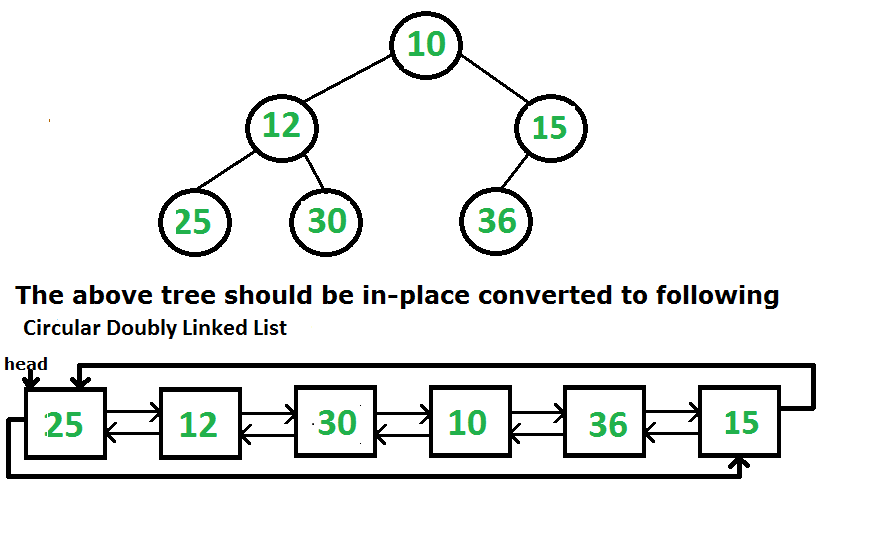
Convert a Binary Tree to a Circular Doubly Link List using Recursion:
The idea is to make a general-purpose function that concatenates two given circular doubly lists

Follow the steps below to solve the problem:
- Recursively convert the left subtree to a circular DLL. Let the converted list be leftList.
- Recursively convert the right subtree to a circular DLL. Let the converted list be rightList.
- Make a circular linked list of roots of the tree, and make the left and right root points to themselves.
- Concatenate leftList with the list of the single root node.
- Concatenate the list produced in the step above with rightList.
Note: The above approach traverses the tree in a Postorder fashion. We can traverse in an inorder fashion also. We can first concatenate left subtree and root, then recur for the right subtree and concatenate the result with left-root concatenation.
How do Concatenate two circular DLLs?
- Get the last node of the left list. Retrieving the last node is an O(1) operation since the prev pointer of the head points to the last node of the list.
- Connect it with the first node of the right list
- Get the last node of the second list
- Connect it with the head of the list.
Below are implementations of the above idea:
C++ `
// C++ Program to convert a Binary Tree // to a Circular Doubly Linked List #include using namespace std;
// To represents a node of a Binary Tree struct Node { struct Node *left, *right; int data; };
// A function that appends rightList at the end // of leftList. Node* concatenate(Node* leftList, Node* rightList) { // If either of the list is empty // then return the other list if (leftList == NULL) return rightList; if (rightList == NULL) return leftList;
// Store the last Node of left List
Node* leftLast = leftList->left;

// Store the last Node of right List
Node* rightLast = rightList->left;

// Connect the last node of Left List
// with the first Node of the right List
leftLast->right = rightList;
rightList->left = leftLast;

// Left of first node points to
// the last node in the list
leftList->left = rightLast;

// Right of last node refers to the first
// node of the List
rightLast->right = leftList;

return leftList;
}
// Function converts a tree to a circular Linked List // and then returns the head of the Linked List Node* bTreeToCList(Node* root) { if (root == NULL) return NULL;
// Recursively convert left and right subtrees
Node* left = bTreeToCList(root->left);
Node* right = bTreeToCList(root->right);

// Make a circular linked list of single node
// (or root). To do so, make the right and
// left pointers of this node point to itself
root->left = root->right = root;

// Step 1 (concatenate the left list with the list
//         with single node, i.e., current node)
// Step 2 (concatenate the returned list with the
//         right List)
return concatenate(concatenate(left, root), right);
}
// Display Circular Link List void displayCList(Node* head) { cout << "Circular Linked List is :\n"; Node* itr = head; do { cout << itr->data << " "; itr = itr->right; } while (head != itr); cout << "\n"; }
// Create a new Node and return its address Node* newNode(int data) { Node* temp = new Node(); temp->data = data; temp->left = temp->right = NULL; return temp; }
// Driver Program to test above function int main() { Node* root = newNode(10); root->left = newNode(12); root->right = newNode(15); root->left->left = newNode(25); root->left->right = newNode(30); root->right->left = newNode(36);
Node* head = bTreeToCList(root);
displayCList(head);

return 0;
}
// This code is contributed by Aditya Kumar (adityakumar129)
C
// C Program to convert a Binary Tree // to a Circular Doubly Linked List #include <stdio.h> #include <stdlib.h>
// To represents a node of a Binary Tree typedef struct Node { struct Node *left, *right; int data; } Node;
// A function that appends rightList at the end // of leftList. Node* concatenate(Node* leftList, Node* rightList) { // If either of the list is empty // then return the other list if (leftList == NULL) return rightList; if (rightList == NULL) return leftList;
// Store the last Node of left List
Node* leftLast = leftList->left;

// Store the last Node of right List
Node* rightLast = rightList->left;

// Connect the last node of Left List
// with the first Node of the right List
leftLast->right = rightList;
rightList->left = leftLast;

// Left of first node points to
// the last node in the list
leftList->left = rightLast;

// Right of last node refers to the first
// node of the List
rightLast->right = leftList;

return leftList;
}
// Function converts a tree to a circular Linked List // and then returns the head of the Linked List Node* bTreeToCList(Node* root) { if (root == NULL) return NULL;
// Recursively convert left and right subtrees
Node* left = bTreeToCList(root->left);
Node* right = bTreeToCList(root->right);

// Make a circular linked list of single node
// (or root). To do so, make the right and
// left pointers of this node point to itself
root->left = root->right = root;

// Step 1 (concatenate the left list with the list
//         with single node, i.e., current node)
// Step 2 (concatenate the returned list with the
//         right List)
return concatenate(concatenate(left, root), right);
}
// Display Circular Link List void displayCList(Node* head) { printf("Circular Linked List is :\n"); Node* itr = head; do { printf("%d ", itr->data); itr = itr->right; } while (head != itr); printf("\n"); }
// Create a new Node and return its address Node* newNode(int data) { Node* temp = (Node*)malloc(sizeof(Node)); temp->data = data; temp->left = temp->right = NULL; return temp; }
// Driver Program to test above function int main() { Node* root = newNode(10); root->left = newNode(12); root->right = newNode(15); root->left->left = newNode(25); root->left->right = newNode(30); root->right->left = newNode(36);
Node* head = bTreeToCList(root);
displayCList(head);

return 0;
}
// This code is contributed by Aditya Kumar (adityakumar129)
Java
// Java Program to convert a Binary Tree to a // Circular Doubly Linked List
// Node class represents a Node of a Tree class Node { int val; Node left, right;
public Node(int val)
{
    this.val = val;
    left = right = null;
}
}
// A class to represent a tree class Tree { Node root; public Tree() { root = null; }
// concatenate both the lists and returns the head
// of the List
public Node concatenate(Node leftList, Node rightList)
{
    // If either of the list is empty, then
    // return the other list
    if (leftList == null)
        return rightList;
    if (rightList == null)
        return leftList;

    // Store the last Node of left List
    Node leftLast = leftList.left;

    // Store the last Node of right List
    Node rightLast = rightList.left;

    // Connect the last node of Left List
    // with the first Node of the right List
    leftLast.right = rightList;
    rightList.left = leftLast;

    // left of first node refers to
    // the last node in the list
    leftList.left = rightLast;

    // Right of last node refers to the first
    // node of the List
    rightLast.right = leftList;

    // Return the Head of the List
    return leftList;
}

// Method converts a tree to a circular
// Link List and then returns the head
// of the Link List
public Node bTreeToCList(Node root)
{
    if (root == null)
        return null;

    // Recursively convert left and right subtrees
    Node left = bTreeToCList(root.left);
    Node right = bTreeToCList(root.right);

    // Make a circular linked list of single node
    // (or root). To do so, make the right and
    // left pointers of this node point to itself
    root.left = root.right = root;

    // Step 1 (concatenate the left list with the list
    //         with single node, i.e., current node)
    // Step 2 (concatenate the returned list with the
    //         right List)
    return concatenate(concatenate(left, root), right);
}

// Display Circular Link List
public void display(Node head)
{
    System.out.println("Circular Linked List is :");
    Node itr = head;
    do {
        System.out.print(itr.val + " ");
        itr = itr.right;
    } while (itr != head);
    System.out.println();
}
}
// Driver Code class Main { public static void main(String args[]) { // Build the tree Tree tree = new Tree(); tree.root = new Node(10); tree.root.left = new Node(12); tree.root.right = new Node(15); tree.root.left.left = new Node(25); tree.root.left.right = new Node(30); tree.root.right.left = new Node(36);
    // head refers to the head of the Link List
    Node head = tree.bTreeToCList(tree.root);

    // Display the Circular LinkedList
    tree.display(head);
}
}
Python3
Python3 Program to convert a Binary
Tree to a Circular Doubly Linked List
class newNode: def init(self, data): self.data = data self.left = self.right = None
A function that appends rightList
at the end of leftList.
def concatenate(leftList, rightList):
# If either of the list is empty
# then return the other list
if (leftList == None):
    return rightList
if (rightList == None):
    return leftList

# Store the last Node of left List
leftLast = leftList.left

# Store the last Node of right List
rightLast = rightList.left

# Connect the last node of Left List
# with the first Node of the right List
leftLast.right = rightList
rightList.left = leftLast

# Left of first node points to
# the last node in the list
leftList.left = rightLast

# Right of last node refers to
# the first node of the List
rightLast.right = leftList

return leftList
Function converts a tree to a circular
Linked List and then returns the head
of the Linked List
def bTreeToCList(root): if (root == None): return None
# Recursively convert left and
# right subtrees
left = bTreeToCList(root.left)
right = bTreeToCList(root.right)

# Make a circular linked list of single
# node (or root). To do so, make the
# right and left pointers of this node
# point to itself
root.left = root.right = root

# Step 1 (concatenate the left list
#          with the list with single
#         node, i.e., current node)
# Step 2 (concatenate the returned list
#          with the right List)
return concatenate(concatenate(left,
                               root), right)
Display Circular Link List
def displayCList(head): print("Circular Linked List is :") itr = head first = 1 while (head != itr or first): print(itr.data, end=" ") itr = itr.right first = 0 print()
Driver Code
if name == 'main': root = newNode(10) root.left = newNode(12) root.right = newNode(15) root.left.left = newNode(25) root.left.right = newNode(30) root.right.left = newNode(36)
head = bTreeToCList(root)
displayCList(head)
This code is contributed by PranchalK
C#
// C# Program to convert a Binary Tree // to a Circular Doubly Linked List using System;
// Node class represents a Node of a Tree public class Node { public int val; public Node left, right;
public Node(int val)
{
    this.val = val;
    left = right = null;
}
}
// A class to represent a tree public class Tree { internal Node root; public Tree() { root = null; }
// concatenate both the lists
// and returns the head of the List
public virtual Node concatenate(Node leftList,
                                Node rightList)
{
    // If either of the list is empty,
    // then return the other list
    if (leftList == null) {
        return rightList;
    }
    if (rightList == null) {
        return leftList;
    }

    // Store the last Node of left List
    Node leftLast = leftList.left;

    // Store the last Node of right List
    Node rightLast = rightList.left;

    // Connect the last node of Left List
    // with the first Node of the right List
    leftLast.right = rightList;
    rightList.left = leftLast;

    // left of first node refers to
    // the last node in the list
    leftList.left = rightLast;

    // Right of last node refers to
    // the first node of the List
    rightLast.right = leftList;

    // Return the Head of the List
    return leftList;
}

// Method converts a tree to a circular
// Link List and then returns the head
// of the Link List
public virtual Node bTreeToCList(Node root)
{
    if (root == null) {
        return null;
    }

    // Recursively convert left
    // and right subtrees
    Node left = bTreeToCList(root.left);
    Node right = bTreeToCList(root.right);

    // Make a circular linked list of single
    // node (or root). To do so, make the
    // right and left pointers of this node
    // point to itself
    root.left = root.right = root;

    // Step 1 (concatenate the left list with
    //          the list with single node,
    //        i.e., current node)
    // Step 2 (concatenate the returned list
    //           with the right List)
    return concatenate(concatenate(left, root), right);
}

// Display Circular Link List
public virtual void display(Node head)
{
    Console.WriteLine("Circular Linked List is :");
    Node itr = head;
    do {
        Console.Write(itr.val + " ");
        itr = itr.right;
    } while (itr != head);
    Console.WriteLine();
}
}
// Driver Code public class GFG { public static void Main(string[] args) { // Build the tree Tree tree = new Tree(); tree.root = new Node(10); tree.root.left = new Node(12); tree.root.right = new Node(15); tree.root.left.left = new Node(25); tree.root.left.right = new Node(30); tree.root.right.left = new Node(36);
    // head refers to the head of the Link List
    Node head = tree.bTreeToCList(tree.root);

    // Display the Circular LinkedList
    tree.display(head);
}
}
// This code is contributed by Shrikant13
JavaScript
`
Output
Circular Linked List is : 25 12 30 10 36 15
Time Complexity: O(N), As every node is visited at most once.
Auxiliary space: O(log N), The extra space is used in the recursion call stack which can grow up to a maximum size of logN as it is a binary tree.
Convert a Binary Tree to a Circular Doubly Link List by Inorder Traversal:
The idea is to do in-order traversal of the binary tree. While doing inorder traversal, keep track of the previously visited node in a variable, say prev. For every visited node, make it the next of the prev and set previous of this node as prev.
Follow the steps below to solve the problem:
- First convert the binary tree into doubly linked list refer to this post Convert a given Binary Tree to Doubly Linked List.
- Now convert this Doubly Linked List to circular Doubly linked list by connecting first and last node.
Below is the implementation of the above approach.
C++ `
// A C++ program for in-place conversion of Binary Tree to // CDLL #include using namespace std;
/* A binary tree node has - data , left and right pointers / struct Node { int data; Node left; Node* right; }; // A utility function that converts given binary tree to // a doubly linked list // root --> the root of the binary tree // head --> head of the created doubly linked list Node* BTree2DoublyLinkedList(Node* root, Node** head) { // Base case if (root == NULL) return root;
// Initialize previously visited node as NULL. This is
// static so that the same value is accessible in all
// recursive calls
static Node* prev = NULL;

// Recursively convert left subtree
BTree2DoublyLinkedList(root->left, head);

// Now convert this node
if (prev == NULL)
    *head = root;
else {
    root->left = prev;
    prev->right = root;
}
prev = root;

// Finally convert right subtree
BTree2DoublyLinkedList(root->right, head);
return prev;
} // A simple recursive function to convert a given Binary // tree to Circular Doubly Linked List using a utility // function root --> Root of Binary Tree tail --> Pointer to // tail node of created circular doubly linked list Node* BTree2CircularDoublyLinkedList(Node* root) { Node* head = NULL; Node* tail = BTree2DoublyLinkedList(root, &head); // make the changes to convert a DLL to CDLL tail->right = head; head->left = tail; // return the head of the created CDLL return head; }
/* Helper function that allocates a new node with the given data and NULL left and right pointers. / Node newNode(int data) { Node* new_node = new Node; new_node->data = data; new_node->left = new_node->right = NULL; return (new_node); }
/* Function to print nodes in a given circular doubly linked
- list / void printList(Node head) { if (head == NULL) return; Node* ptr = head; do { cout << ptr->data << " "; ptr = ptr->right; } while (ptr != head); }
/* Driver program to test above functions*/ int main() { // Let us create the tree shown in above diagram Node* root = newNode(10); root->left = newNode(12); root->right = newNode(15); root->left->left = newNode(25); root->left->right = newNode(30); root->right->left = newNode(36);
// Convert to DLL
Node* head = BTree2CircularDoublyLinkedList(root);

// Print the converted list
printList(head);

return 0;
}
// This code was contributed by Abhijeet // Kumar(abhijeet19403)
Java
// A Java program for in-place conversion of Binary Tree to // CDLL
// A binary tree node has - data, left pointer and right // pointer class Node { int data; Node left, right; public Node(int data) { this.data = data; left = right = null; } }
class BinaryTree { Node root; // head --> Pointer to head node of created doubly // linked list Node head;
// Initialize previously visited node as NULL. This is
// static so that the same value is accessible in all
// recursive calls
static Node prev = null;

// A simple utility recursive function to convert a
// given Binary tree to Doubly Linked List root --> Root
// of Binary Tree
void BTree2DoublyLinkedList(Node root)
{
    // Base case
    if (root == null)
        return;

    // Recursively convert left subtree
    BTree2DoublyLinkedList(root.left);

    // Now convert this node
    if (prev == null)
        head = root;
    else {
        root.left = prev;
        prev.right = root;
    }
    prev = root;

    // Finally convert right subtree
    BTree2DoublyLinkedList(root.right);
}
// A simple function to convert a given binary tree to
// Circular doubly linked list
// using a utility function
void BTree2CircularDoublyLinkedList(Node root)
{
    BTree2DoublyLinkedList(root);
    // make the changes to convert a DLL to CDLL
    prev.right = head;
    head.left = prev;
}

/* Function to print nodes in a given doubly linked list
 */
void printList(Node node)
{
    if (node == null)
        return;
    Node curr = node;
    do {
        System.out.print(curr.data + " ");
        curr = curr.right;
    } while (curr != node);
}

// Driver program to test above functions
public static void main(String[] args)
{
    // Let us create the tree as shown in above diagram
    BinaryTree tree = new BinaryTree();
    tree.root = new Node(10);
    tree.root.left = new Node(12);
    tree.root.right = new Node(15);
    tree.root.left.left = new Node(25);
    tree.root.left.right = new Node(30);
    tree.root.right.left = new Node(36);

    // convert to DLL
    tree.BTree2CircularDoublyLinkedList(tree.root);

    // Print the converted List
    tree.printList(tree.head);
}
} // This code has been contributed by Abhijeet // Kumar(abhijeet19403)
Python
A python program for in-place conversion of Binary Tree to DLL
A binary tree node has data, left pointers and right pointers
class Node: def init(self, val): self.data = val self.left = None self.right = None
head --> Pointer to head node of created doubly linked list
head = None
Initialize previously visited node as NULL. This is
so that the same value is accessible in all recursive
calls
prev = None
A simple recursive function to convert a given Binary tree
to Doubly Linked List
root --> Root of Binary Tree
def BinaryTree2DoubleLinkedList(root):
# Base case
if (root == None):
    return

# Recursively convert left subtree
BinaryTree2DoubleLinkedList(root.left)

# Now convert this node
global prev, head
if (prev == None):
    head = root
else:
    root.left = prev
    prev.right = root
prev = root

# Finally convert right subtree
BinaryTree2DoubleLinkedList(root.right)
Function to print nodes in a given doubly linked list
def printList(node): while (node != None): print(node.data) node = node.right
Driver program to test above functions
Let us create the tree as shown in above diagram
root = Node(10) root.left = Node(12) root.right = Node(15) root.left.left = Node(25) root.left.right = Node(30) root.right.left = Node(36)
convert to DLL
BinaryTree2DoubleLinkedList(root)
Print the converted List
printList(head)
This code is contributed by adityamaharshi21.
C#
// A C# program for in-place conversion of Binary Tree to // CDLL
using System;
public class Node { public int data; public Node left, right; public Node(int data) { this.data = data; left = right = null; } }
public class BinaryTree {
Node root;
// head --> Pointer to head node of created doubly
// linked list
Node head;

// Initialize previously visited node as NULL. This is
// static so that the same value is accessible in all
// recursive calls
static Node prev = null;

// A simple utility recursive function to convert a
// given Binary tree to Doubly Linked List root --> Root
// of Binary Tree
void BTree2DoublyLinkedList(Node root)
{
    // Base case
    if (root == null)
        return;

    // Recursively convert left subtree
    BTree2DoublyLinkedList(root.left);

    // Now convert this node
    if (prev == null)
        head = root;
    else {
        root.left = prev;
        prev.right = root;
    }
    prev = root;

    // Finally convert right subtree
    BTree2DoublyLinkedList(root.right);
}
// A simple function to convert a given binary tree to
// Circular doubly linked list
// using a utility function
void BTree2CircularDoublyLinkedList(Node root)
{
    BTree2DoublyLinkedList(root);
    // make the changes to convert a DLL to CDLL
    prev.right = head;
    head.left = prev;
}

/* Function to print nodes in a given doubly linked list
 */
void printList(Node node)
{
    if (node == null)
        return;
    Node curr = node;
    do {
        Console.Write(curr.data + " ");
        curr = curr.right;
    } while (curr != node);
}

static public void Main()
{

    // Let us create the tree as shown in above diagram
    BinaryTree tree = new BinaryTree();
    tree.root = new Node(10);
    tree.root.left = new Node(12);
    tree.root.right = new Node(15);
    tree.root.left.left = new Node(25);
    tree.root.left.right = new Node(30);
    tree.root.right.left = new Node(36);

    // convert to DLL
    tree.BTree2CircularDoublyLinkedList(tree.root);

    // Print the converted List
    tree.printList(tree.head);
}
}
// This code is contributed by lokesh(lokeshmvs21).
JavaScript
// A javascript program for in-place conversion of Binary Tree to DLL // A binary tree node has data, left pointers and right pointers class Node { constructor(val) { this.data = val; this.left = null; this.right = null; } } var root;
// head --> Pointer to head node of created doubly linked list var head;
// Initialize previously visited node as NULL. This is // so that the same value is accessible in all recursive // calls var prev = null;
// A simple recursive function to convert a given Binary tree // to Doubly Linked List // root --> Root of Binary Tree function BinaryTree2DoubleLinkedList(root) {
// Base case
if (root == null)
    return;

// Recursively convert left subtree
BinaryTree2DoubleLinkedList(root.left);

// Now convert this node
if (prev == null)
    head = root;
else {
    root.left = prev;
    prev.right = root;
}
prev = root;

// Finally convert right subtree
BinaryTree2DoubleLinkedList(root.right);
}
/* Function to print nodes in a given doubly linked list */ function printList(node) { while (node != null) { console.log(node.data + " "); node = node.right; } }
// Driver program to test above functions // Let us create the tree as shown in above diagram root = new Node(10); root.left = new Node(12); root.right = new Node(15); root.left.left = new Node(25); root.left.right = new Node(30); root.right.left = new Node(36);
// convert to DLL BinaryTree2DoubleLinkedList(root);
// Print the converted List printList(head);
// This code is contributed by ishankhandelwals.
`
Time Complexity: O(N), As every node is visited at most once.
Auxiliary space: O(log N), The extra space is used in the recursive function call stack which can grow upto a maximum size of logN.
This approach was contributed by Abhijeet Kumar