Find the Nth row in Pascal's Triangle (original) (raw)
Last Updated : 15 Jul, 2025
Given a non-negative integer **n, the task is to find the **n th row of Pascal's Triangle.
**Note: The row index starts from 1.
**Examples:
**Input: n = 4
**Output: 1 3 3 1
**Explanation: The elements in the 4th row are 1 3 3 1 as shown in Pascal Triangle.
**Input: n = 1
**Output: 1
**Explanation: The elements in the 1th row is 1 as shown in Pascal Triangle.
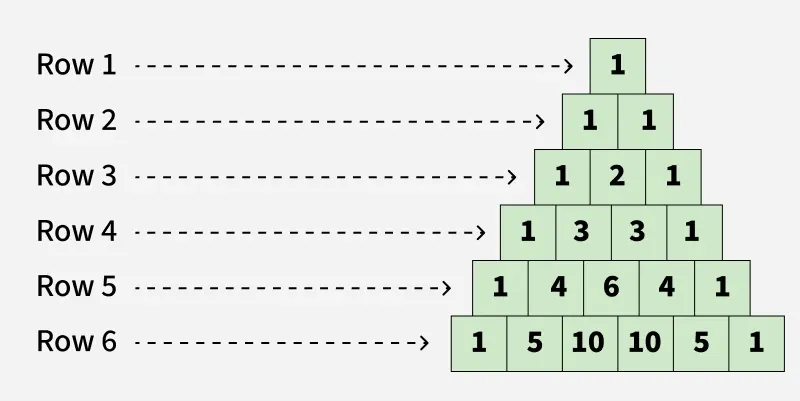

Table of Content
- [Naive Approach] Using Recursion - O(2^n) Time and O(n) Space
- [Better Approach] Using Recursion Level by Level - O(n^2) Time and O(n) Space
- [Expected Approach] Using Combinatorics - O(n) Time and O(n) Space
[Naive Approach] Using Recursion - O(2^n) Time and O(n) Space
The idea is to use the property that each element **i in the Pascal triangle is equal to the sum of two elements directly above it (i-1 and i), with the base condition that the first and last element of any row will be equal to 1.
C++ `
// C++ program to Find the nth row in // Pascal’s Triangle using Recursion #include <bits/stdc++.h> using namespace std;
// Function which recursively finds the // ith value of nth row. int findVal(int i, int n) {
// First and last value of each
// row will always be 1.
if (i == 1 || i == n) {
    return 1;
}

// Find the (i-1)th and ith
// value of previous row
return findVal(i-1, n-1) + findVal(i, n-1);
}
// Function to find the elements // of n'th row in Pascal's Triangle vector nthRowOfPascalTriangle(int n) { vector res;
for (int i=1; i<=n; i++) {
    int val = findVal(i, n);
    res.push_back(val);
}

return res;
}
int main() {
int n = 4;
vector<int> ans = nthRowOfPascalTriangle(n);

for(int i = 0; i < ans.size(); i++) {
    cout << ans[i] << " ";
}
cout << endl;
return 0;
}
Java
// Java program to Find the nth row in // Pascal’s Triangle using Recursion import java.util.*;
class GfG {
// Function which recursively finds the
// ith value of nth row.
static int findVal(int i, int n) {

    // First and last value of each
    // row will always be 1.
    if (i == 1 || i == n) {
        return 1;
    }

    // Find the (i-1)th and ith
    // value of previous row
    return findVal(i - 1, n - 1) + findVal(i, n - 1);
}

// Function to find the elements
// of n'th row in Pascal's Triangle
static ArrayList<Integer> nthRowOfPascalTriangle(int n) {
    ArrayList<Integer> res = new ArrayList<>();

    for (int i = 1; i <= n; i++) {
        int val = findVal(i, n);
        res.add(val);
    }

    return res;
}

public static void main(String[] args) {
    int n = 4;
    ArrayList<Integer> ans = nthRowOfPascalTriangle(n);

    for (int i = 0; i < ans.size(); i++) {
        System.out.print(ans.get(i) + " ");
    }
    System.out.println();
}
}
Python
Python program to Find the nth row in
Pascal’s Triangle using Recursion
Function which recursively finds the
ith value of nth row.
def findVal(i, n):
# First and last value of each
# row will always be 1.
if i == 1 or i == n:
    return 1

# Find the (i-1)th and ith
# value of previous row
return findVal(i - 1, n - 1) + findVal(i, n - 1)
Function to find the elements
of n'th row in Pascal's Triangle
def nthRowOfPascalTriangle(n): res = []
for i in range(1, n + 1):
    val = findVal(i, n)
    res.append(val)

return res
if name == "main": n = 4 ans = nthRowOfPascalTriangle(n)
for i in range(len(ans)):
    print(ans[i], end=" ")
print()
C#
// C# program to Find the nth row in // Pascal’s Triangle using Recursion using System; using System.Collections.Generic;
class GfG {
// Function which recursively finds the
// ith value of nth row.
static int findVal(int i, int n) {

    // First and last value of each
    // row will always be 1.
    if (i == 1 || i == n) {
        return 1;
    }

    // Find the (i-1)th and ith
    // value of previous row
    return findVal(i - 1, n - 1) + findVal(i, n - 1);
}

// Function to find the elements
// of n'th row in Pascal's Triangle
static List<int> nthRowOfPascalTriangle(int n) {
    List<int> res = new List<int>();

    for (int i = 1; i <= n; i++) {
        int val = findVal(i, n);
        res.Add(val);
    }

    return res;
}

static void Main(string[] args) {
    int n = 4;
    List<int> ans = nthRowOfPascalTriangle(n);

    for (int i = 0; i < ans.Count; i++) {
        Console.Write(ans[i] + " ");
    }
    Console.WriteLine();
}
}
JavaScript
// Function which recursively finds the // ith value of nth row. function findVal(i, n) {
// First and last value of each
// row will always be 1.
if (i === 1 || i === n) {
    return 1;
}

// Find the (i-1)th and ith
// value of previous row
return findVal(i - 1, n - 1) + findVal(i, n - 1);
}
// Function to find the elements // of n'th row in Pascal's Triangle function nthRowOfPascalTriangle(n) { let res = [];
for (let i = 1; i <= n; i++) {
    let val = findVal(i, n);
    res.push(val);
}

return res;
}
// Driver code let n = 4; let ans = nthRowOfPascalTriangle(n); console.log(ans.join(' '));
`
**[Better Approach] Using Recursion Level by Level - O(n^2) Time and O(n) Space
The idea is to recursively find the **n'th **row by recursively finding the previous row. Then use the previous row to calculate the values of **current row.
C++ `
// C++ program to Find the nth row in // Pascal’s Triangle using Recursion #include <bits/stdc++.h> using namespace std;
// Function to find the elements // of n'th row in Pascal's Triangle vector nthRowOfPascalTriangle(int n) { vector curr;
// 1st element of every row is 1
curr.push_back(1);

// Check if the row that has to
// be returned is the first row
if (n == 1) {
    return curr;
}

// Generate the previous row
vector<int> prev = nthRowOfPascalTriangle(n - 1);

for(int i = 1; i < prev.size(); i++) {

    // Generate the elements of the current
    // row with the help of the previous row
    int val = prev[i - 1] + prev[i];
    curr.push_back(val);
}
curr.push_back(1);

// Return the row
return curr;
}
int main() {
int n = 4;
vector<int> ans = nthRowOfPascalTriangle(n);

for(int i = 0; i < ans.size(); i++) {
    cout << ans[i] << " ";
}
cout << endl;
return 0;
}
Java
// Java program to Find the nth row in // Pascal’s Triangle using Recursion import java.util.*;
class GfG {
// Function to find the elements
// of n'th row in Pascal's Triangle
static ArrayList<Integer> nthRowOfPascalTriangle(int n) {
    ArrayList<Integer> curr = new ArrayList<>();

    // 1st element of every row is 1
    curr.add(1);

    // Check if the row that has to
    // be returned is the first row
    if (n == 1) {
        return curr;
    }

    // Generate the previous row
    ArrayList<Integer> prev = nthRowOfPascalTriangle(n - 1);

    for (int i = 1; i < prev.size(); i++) {

        // Generate the elements of the current
        // row with the help of the previous row
        int val = prev.get(i - 1) + prev.get(i);
        curr.add(val);
    }
    curr.add(1);

    // Return the row
    return curr;
}

public static void main(String[] args) {
    int n = 4;
    ArrayList<Integer> ans = nthRowOfPascalTriangle(n);

    for (int i = 0; i < ans.size(); i++) {
        System.out.print(ans.get(i) + " ");
    }
    System.out.println();
}
}
Python
Python program to Find the nth row in
Pascal’s Triangle using Recursion
Function to find the elements
of n'th row in Pascal's Triangle
def nthRowOfPascalTriangle(n): curr = []
# 1st element of every row is 1
curr.append(1)

# Check if the row that has to
# be returned is the first row
if n == 1:
    return curr

# Generate the previous row
prev = nthRowOfPascalTriangle(n - 1)

for i in range(1, len(prev)):

    # Generate the elements of the current
    # row with the help of the previous row
    val = prev[i - 1] + prev[i]
    curr.append(val)

curr.append(1)

# Return the row
return curr
if name == "main": n = 4 ans = nthRowOfPascalTriangle(n)
for val in ans:
    print(val, end=" ")
print()
C#
// C# program to Find the nth row in // Pascal’s Triangle using Recursion using System; using System.Collections.Generic;
class GfG {
// Function to find the elements
// of n'th row in Pascal's Triangle
static List<int> nthRowOfPascalTriangle(int n) {
    List<int> curr = new List<int>();

    // 1st element of every row is 1
    curr.Add(1);

    // Check if the row that has to
    // be returned is the first row
    if (n == 1) {
        return curr;
    }

    // Generate the previous row
    List<int> prev = nthRowOfPascalTriangle(n - 1);

    for (int i = 1; i < prev.Count; i++) {

        // Generate the elements of the current
        // row with the help of the previous row
        int val = prev[i - 1] + prev[i];
        curr.Add(val);
    }
    curr.Add(1);

    // Return the row
    return curr;
}

static void Main(string[] args) {
    int n = 4;
    List<int> ans = nthRowOfPascalTriangle(n);

    for (int i = 0; i < ans.Count; i++) {
        Console.Write(ans[i] + " ");
    }
    Console.WriteLine();
}
}
JavaScript
// JavaScript program to Find the nth row in // Pascal’s Triangle using Recursion
// Function to find the elements // of n'th row in Pascal's Triangle function nthRowOfPascalTriangle(n) { let curr = [];
// 1st element of every row is 1
curr.push(1);

// Check if the row that has to
// be returned is the first row
if (n === 1) {
    return curr;
}

// Generate the previous row
let prev = nthRowOfPascalTriangle(n - 1);

for (let i = 1; i < prev.length; i++) {

    // Generate the elements of the current
    // row with the help of the previous row
    let val = prev[i - 1] + prev[i];
    curr.push(val);
}
curr.push(1);

// Return the row
return curr;
}
let n = 4; let ans = nthRowOfPascalTriangle(n); console.log(ans.join(' '));
`
**[Expected Approach] Using Combinatorics - O(n) Time and O(n) Space
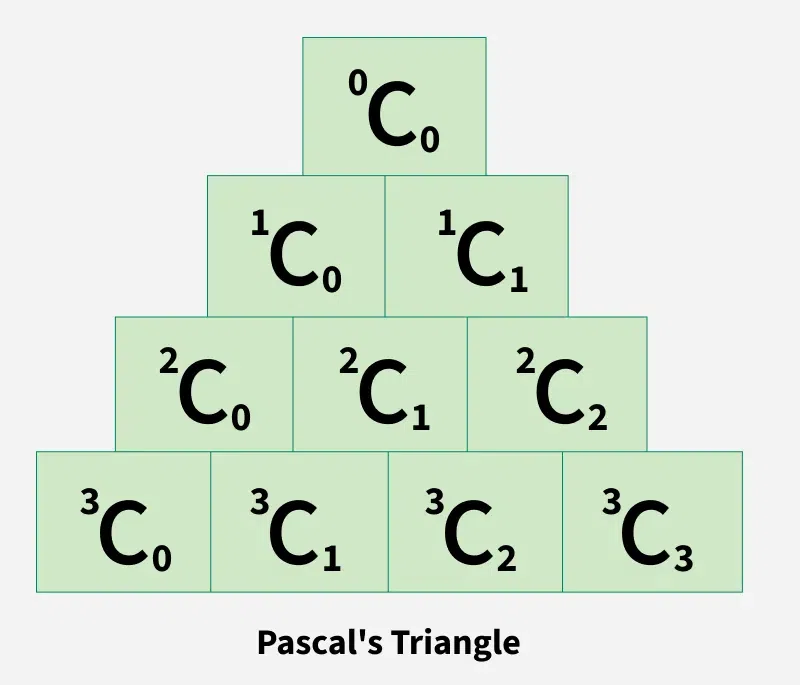
The idea is to use the mathematical relationship between consecutive elements in a Pascal's Triangle row, rather than computing the entire triangle. Since the **nth row consists of binomial coefficients **nC0, nC1, ..., nCn, we can calculate each element directly from the previous one using the formula: nCr = (nCr-1 * (n-r+1))/r. This approach starts with nC0 = 1 and efficiently computes each subsequent value
**Note: This approach uses 0-based indexing because the mathematical formula used for calculating binomial coefficients aligns with 0-based indexing.
Step by step approach:
- Start with first element of the row as 1 (nC0 = 1).
- For each subsequent element, use the formula nCr = (nCr-1 * (n-r+1))/r.
- Build the row progressively by calculating one element at a time.
- Adjust for 1-based indexing by decrementing n before calculations.
**How is the formula calculated?
- nCi = n! / (i! * (n-i)!) : ith element of nth row
- nCi+1 = n! / ((i+1)! * (n-(i+1))!) : (i+1)th element of nth row
- Dividing (i+1)th element by ith element: nCi+1 / nCi = [n! / ((i+1)! * (n-i-1)!)] / [n! / (i! * (n-i)!)]
- Simplifying: nCi+1 = nCi * (n-i) / (i+1) - This lets us compute each element from the previous one
C++ `
// C++ program to Find the nth row in Pascal’s // Triangle using efficient approach #include <bits/stdc++.h> using namespace std;
// Function to find the elements // of n'th row in Pascal's Triangle vector nthRowOfPascalTriangle(int n) {
// To follow 0 based indexing, decrement n
n--;

vector<int> res;

// nC0 = 1
int prev = 1;
res.push_back(prev);

for (int i = 1; i <= n; i++) {

    // nCr = (nCr-1 * (n - r + 1))/r
    int curr = (prev * (n - i + 1)) / i;
    res.push_back(curr);
    prev = curr;
}
return res;
}
int main() {
int n = 4;
vector<int> ans = nthRowOfPascalTriangle(n);

for(int i = 0; i < ans.size(); i++) {
    cout << ans[i] << " ";
}
cout << endl;
return 0;
}
Java
// Java program to Find the nth row in Pascal’s // Triangle using efficient approach import java.util.*;
class GfG {
// Function to find the elements
// of n'th row in Pascal's Triangle
static ArrayList<Integer> nthRowOfPascalTriangle(int n) {

    // To follow 0 based indexing, decrement n
    n--;

    ArrayList<Integer> res = new ArrayList<>();

    // nC0 = 1
    int prev = 1;
    res.add(prev);

    for (int i = 1; i <= n; i++) {

        // nCr = (nCr-1 * (n - r + 1))/r
        int curr = (prev * (n - i + 1)) / i;
        res.add(curr);
        prev = curr;
    }
    return res;
}

public static void main(String[] args) {
    int n = 4;
    ArrayList<Integer> ans = nthRowOfPascalTriangle(n);

    for (int i = 0; i < ans.size(); i++) {
        System.out.print(ans.get(i) + " ");
    }
    System.out.println();
}
}
Python
Python program to Find the nth row in Pascal’s
Triangle using efficient approach
Function to find the elements
of n'th row in Pascal's Triangle
def nthRowOfPascalTriangle(n):
# To follow 0 based indexing, decrement n
n -= 1

res = []

# nC0 = 1
prev = 1
res.append(prev)

for i in range(1, n + 1):

    # nCr = (nCr-1 * (n - r + 1))/r
    curr = (prev * (n - i + 1)) // i
    res.append(curr)
    prev = curr

return res
if name == "main": n = 4 ans = nthRowOfPascalTriangle(n)
for val in ans:
    print(val, end=" ")
print()
C#
// C# program to Find the nth row in Pascal’s // Triangle using efficient approach using System; using System.Collections.Generic;
class GfG {
// Function to find the elements
// of n'th row in Pascal's Triangle
static List<int> nthRowOfPascalTriangle(int n) {

    // To follow 0 based indexing, decrement n
    n--;

    List<int> res = new List<int>();

    // nC0 = 1
    int prev = 1;
    res.Add(prev);

    for (int i = 1; i <= n; i++) {

        // nCr = (nCr-1 * (n - r + 1))/r
        int curr = (prev * (n - i + 1)) / i;
        res.Add(curr);
        prev = curr;
    }
    return res;
}

static void Main(string[] args) {
    int n = 4;
    List<int> ans = nthRowOfPascalTriangle(n);

    for (int i = 0; i < ans.Count; i++) {
        Console.Write(ans[i] + " ");
    }
    Console.WriteLine();
}
}
JavaScript
// Function to find the elements // of n'th row in Pascal's Triangle function nthRowOfPascalTriangle(n) {
// To follow 0 based indexing, decrement n
n--;

let res = [];

// nC0 = 1
let prev = 1;
res.push(prev);

for (let i = 1; i <= n; i++) {

    // nCr = (nCr-1 * (n - r + 1))/r
    let curr = Math.floor((prev * (n - i + 1)) / i);
    res.push(curr);
    prev = curr;
}
return res;
}
let n = 4; let ans = nthRowOfPascalTriangle(n); console.log(ans.join(' '));
`