Program to Print Pascal's Triangle (original) (raw)
Last Updated : 23 Jul, 2025
Given an **integer n, the task is to find the first n rows of Pascal's triangle. Pascal's triangle is a triangular array of binomial coefficients.
**Examples:
**Example1: The below image shows the Pascal's Triangle for n=4
**Example2: The below image shows the Pascal's Triangle for n = 6
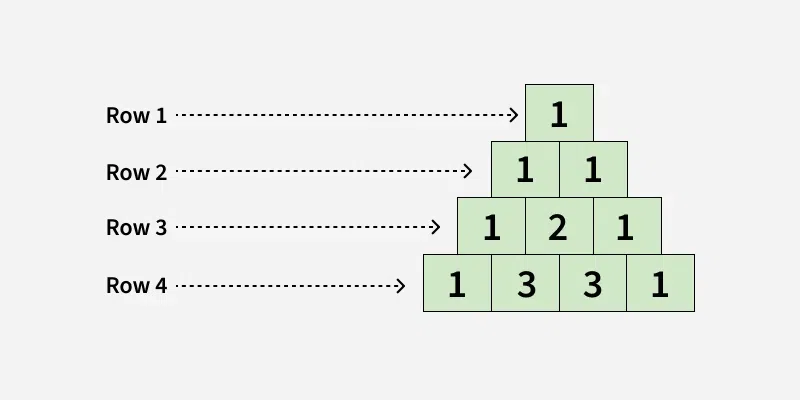
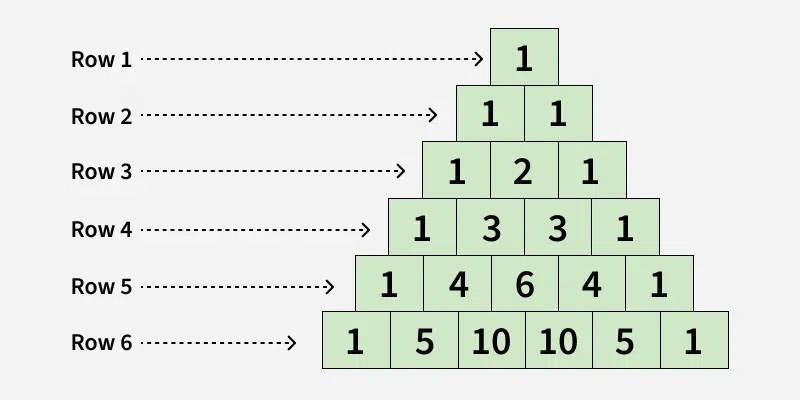
Table of Content
- [Naive Approach] Using Binomial Coefficient
- [Better Approach] Using Dynamic Programming
- [Expected Approach] Using Binomial Coefficient (Space Optimized)
[Naive Approach] Using Binomial Coefficient
The number of entries in every row is equal to row number (1-based). For example, the first row has "1", the second row has "1 1", the third row has "1 2 1",.. and so on. Every entry in a row is value of a Binomial Coefficient.
**Example of Binomial Coefficient:
(a+b)n = nC0*anb0 + nC1*an-1b1 + nC2*an-2b2 . . . . . . . . + nCn-1*a1bn-1 + nCn*a0bn where nCi is binomial coefficient.
Binomial coefficient
The value of **ith entry in row number is **n C i . The value can be calculated using following formula.
- **n C i = n! / (i! * (n-i)!) - ith element of nth row

Run a loop for each row of pascal's triangle i.e. 1 to **n. For each row, loop through its elements and calculate their **binomial coefficients as described in the approach.
C++ `
// Cpp program for Pascal's Triangle using Binomial // Coefficient in O(n^3) and O(1) Space #include #include using namespace std;
int binomialCoeff(int n, int k) { int res = 1; if (k > n - k) k = n - k; for (int i = 0; i < k; ++i) { res *= (n - i); res /= (i + 1); }
return res;}
// Function to print first n rows // of Pascal's Triangle vector<vector> printPascal(int n) { vector<vector> mat;
  // Iterate through every row and
// print entries in it
for (int row = 0; row < n; row++) {

    // Every row has number of
    // integers equal to row
    // number
    vector<int> arr;
    for (int i = 0; i <= row; i++)
        arr.push_back(binomialCoeff(row, i));

    mat.push_back(arr);
}
return mat;
}
int main() {
int n = 5;
vector<vector<int>> mat = printPascal(n);
for (int i = 0; i < mat.size(); i++) {
    for (int j = 0; j < mat[i].size(); j++) {
        cout << mat[i][j] << " ";
    }
    cout << endl;
}
return 0;
}
Java
// Java program for Pascal's Triangle using Binomial // Coefficient in O(n^3) and O(1) Space
import java.util.*;
class GfG {
static int binomialCoeff(int n, int k) {
    int res = 1;
    if (k > n - k)
        k = n - k;
    for (int i = 0; i < k; ++i) {
        res *= (n - i);
        res /= (i + 1);
    }
    return res;
}

// Function to print first n rows
// of Pascal's Triangle
static List<List<Integer>> printPascal(int n) {
    List<List<Integer>> mat = new ArrayList<>();

    // Iterate through every row and
    // print entries in it
    for (int row = 0; row < n; row++) {
        List<Integer> arr = new ArrayList<>();
        for (int i = 0; i <= row; i++)
            arr.add(binomialCoeff(row, i));
        mat.add(arr);
    }
    return mat;
}

public static void main(String[] args) {
    int n = 5;
    List<List<Integer>> mat = printPascal(n);
    for (int i = 0; i < mat.size(); i++) {
        for(int j = 0; j < mat.get(i).size(); j++) {
            System.out.print(mat.get(i).get(j) + " ");
        }
        System.out.println();
    }
}
}
Python
Python program for Pascal's Triangle using Binomial
Coefficient in O(n^3) and O(1) Space
def binomialCoeff(n, k): res = 1 if k > n - k: k = n - k for i in range(k): res *= (n - i) res //= (i + 1) return res
Function to print first n rows
of Pascal's Triangle
def printPascal(n): mat = []
# Iterate through every row and
# print entries in it
for row in range(n):
    arr = []
    for i in range(row + 1):
        arr.append(binomialCoeff(row, i))
    mat.append(arr)
return mat
n = 5 mat = printPascal(n) for i in range(len(mat)): for j in range(len(mat[i])): print(mat[i][j], end=" ") print()
C#
// C# program for Pascal's Triangle using Binomial // Coefficient in O(n^3) and O(1) Space
using System; using System.Collections.Generic;
class GfG { static int binomialCoeff(int n, int k) { int res = 1; if (k > n - k) k = n - k; for (int i = 0; i < k; ++i) { res *= (n - i); res /= (i + 1); } return res; }
// Function to print first n rows
// of Pascal's Triangle
static List<List<int>> printPascal(int n) {
    List<List<int>> mat = new List<List<int>>();

      // Iterate through every row and
    // print entries in it
    for (int row = 0; row < n; row++) {
        List<int> arr = new List<int>();
        for (int i = 0; i <= row; i++)
            arr.Add(binomialCoeff(row, i));
        mat.Add(arr);
    }
    return mat;
}

static void Main() {
    int n = 5;
    List<List<int>> mat = printPascal(n);
    for (int i = 0; i < mat.Count; i++) {
        for(int j = 0; j < mat[i].Count; j++) {
            Console.Write(mat[i][j] + " ");
        }
        Console.WriteLine();
    }
}
}
JavaScript
// JavaScript program for Pascal's Triangle using Binomial // Coefficient in O(n^3) and O(1) Space
function binomialCoeff(n, k) { let res = 1; if (k > n - k) k = n - k; for (let i = 0; i < k; ++i) { res *= (n - i); res /= (i + 1); } return res; }
// Function to print first n rows // of Pascal's Triangle function printPascal(n) { const mat = [];
// Iterate through every row and
// print entries in it
for (let row = 0; row < n; row++) {
    const arr = [];
    for (let i = 0; i <= row; i++)
        arr.push(binomialCoeff(row, i));
    mat.push(arr);
}
return mat;
}
const n = 5; const mat = printPascal(n); for (let i = 0; i < mat.length; i++) { let line = ""; for(let j = 0; j < mat[i].length; j++) { line += mat[i][j] + " "; } console.log(line); }
`
Output
1 1 1 1 2 1 1 3 3 1 1 4 6 4 1
**Time Complexity - O(n3)
**Auxiliary Space - O(1)
[Better Approach] Using Dynamic Programming
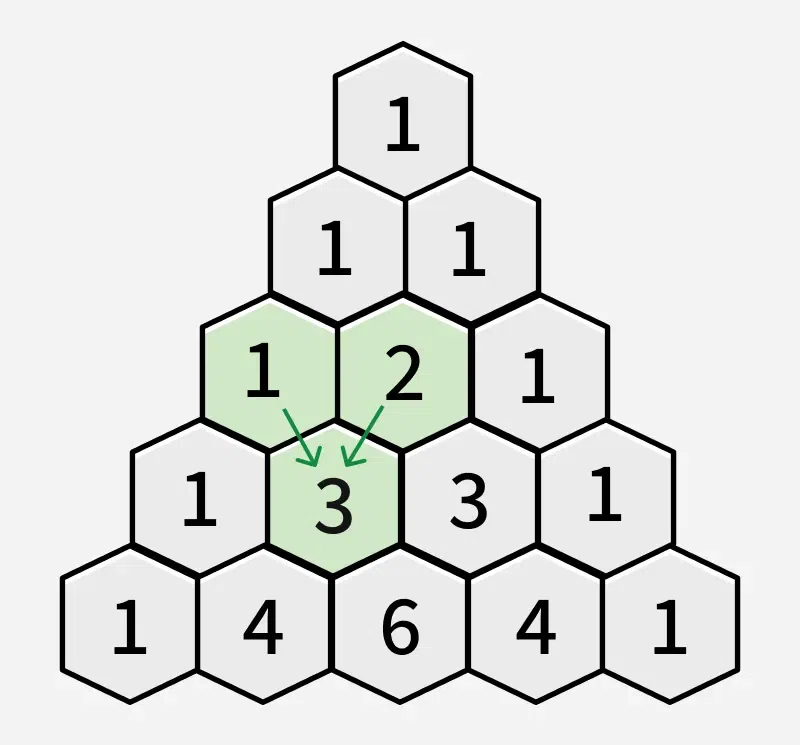
If we take a closer at the triangle, we observe that every entry is sum of the two values above it. So using dynamic programming we can createa 2D array that stores previously generated values. In order to generate a value in a line, we can use the previously stored values from array.
Pascal 's Triangle
**Cases:
- If row == 0 or row == i
- **arr[row][i] =1
- Else:
- **arr[row][i] = arr[row-1][i-1] + arr[row-1][i]
C++ `
// Cpp program for Pascal’s Triangle Using Dynamic // Programming in O(n^2) time and O(n^2) extra space
#include <bits/stdc++.h> using namespace std;
vector<vector> printPascal(int n) {
// An auxiliary array to store
// generated pascal triangle values
vector<vector<int>> mat;

// Iterate through every line and
// print integer(s) in it
for (int row = 0; row < n; row++) {

    // Every line has number of integers
    // equal to line number
      vector<int>arr;
    for (int i = 0; i <= row; i++) {

    // First and last values in every row are 1
    if (row == i || i == 0)
        arr.push_back(1);

    // Other values are sum of values just
    // above and left of above
    else
        arr.push_back(mat[row - 1][i - 1] +
                        mat[row - 1][i]);
    }
    mat.push_back(arr);
}
return mat; }
int main() { int n = 5; vector<vector> mat = printPascal(n); for (int i = 0; i < mat.size(); i++) { for (int j = 0; j < mat[i].size(); j++) { cout << mat[i][j] << " "; } cout << endl; } return 0; }
C
#include <stdio.h> #include <stdlib.h>
int** printPascal(int n) { // An auxiliary array to store // generated pascal triangle values int** mat = (int**)malloc(n * sizeof(int*)); for (int i = 0; i < n; i++) { mat[i] = (int*)malloc((i + 1) * sizeof(int)); }
// Iterate through every line and
// print integer(s) in it
for (int row = 0; row < n; row++) {
    // Every line has number of integers
    // equal to line number
    for (int i = 0; i <= row; i++) {
        // First and last values in every row are 1
        if (row == i || i == 0)
            mat[row][i] = 1;
        // Other values are sum of values just
        // above and left of above
        else
            mat[row][i] = mat[row - 1][i - 1] + mat[row - 1][i];
    }
}
return mat;
}
int main() { int n = 5; int** mat = printPascal(n); for (int i = 0; i < n; i++) { for (int j = 0; j <= i; j++) { printf("%d ", mat[i][j]); } printf("\n"); } return 0; }
Java
// Java program for Pascal’s Triangle Using Dynamic // Programming in O(n^2) time and O(n^2) extra space
import java.util.*;
class GfG {
static List<List<Integer>> printPascal(int n) {

    // An auxiliary array to store
    // generated pascal triangle values
    List<List<Integer>> mat = new ArrayList<>();

    // Iterate through every line and
    // print integer(s) in it
    for (int row = 0; row < n; row++) {

        // Every line has number of integers
        // equal to line number
        List<Integer> arr = new ArrayList<>();
        for (int i = 0; i <= row; i++) {

            // First and last values in every row are 1
            if (row == i || i == 0)
                arr.add(1);

            // Other values are sum of values just
            // above and left of above
            else
                arr.add(mat.get(row - 1).get(i - 1) +
                        mat.get(row - 1).get(i));
        }
        mat.add(arr);
    }
    return mat;
}

public static void main(String[] args) {
    int n = 5;
    List<List<Integer>> mat = printPascal(n);
    for (int i = 0; i < mat.size(); i++) {
        for(int j = 0; j < mat.get(i).size(); j++) {
                System.out.print(mat.get(i).get(j) + " ");
        }
        System.out.println();
    }
}
}
Python
Python program for Pascal’s Triangle Using Dynamic
Programming in O(n^2) time and O(n^2) extra space
def printPascal(n):
# An auxiliary array to store
# generated pascal triangle values
mat = []

# Iterate through every line and
# print integer(s) in it
for row in range(n):

    # Every line has number of integers
    # equal to line number
    arr = []
    for i in range(row + 1):

        # First and last values in every row are 1
        if row == i or i == 0:
            arr.append(1)

        # Other values are sum of values just
        # above and left of above
        else:
            arr.append(mat[row - 1][i - 1] + mat[row - 1][i])
    mat.append(arr)
return mat
n = 5 mat = printPascal(n) for i in range(len(mat)): for j in range(len(mat[i])): print(mat[i][j], end=" ") print()
C#
// C# program for Pascal’s Triangle Using Dynamic // Programming in O(n^2) time and O(n^2) extra space
using System; using System.Collections.Generic;
class GfG { static List<List> printPascal(int n) {
    // An auxiliary array to store
    // generated pascal triangle values
    List<List<int>> mat = new List<List<int>>();

    // Iterate through every line and
    // print integer(s) in it
    for (int row = 0; row < n; row++) {

        // Every line has number of integers
        // equal to line number
        List<int> arr = new List<int>();
        for (int i = 0; i <= row; i++) {

            // First and last values in every row are 1
            if (row == i || i == 0)
                arr.Add(1);

            // Other values are sum of values just
            // above and left of above
            else
                arr.Add(mat[row - 1][i - 1] + mat[row - 1][i]);
        }
        mat.Add(arr);
    }
    return mat;
}

static void Main() {
    int n = 5;
    List<List<int>> mat = printPascal(n);
    for (int i = 0; i < mat.Count; i++) {
        for(int j = 0; j < mat[i].Count; j++) {
                    Console.Write(mat[i][j] + " ");
        }
        Console.WriteLine();
    }
}
}
JavaScript
// JavaScript program for Pascal’s Triangle Using Dynamic // Programming in O(n^2) time and O(n^2) extra space
function printPascal(n) {
// An auxiliary array to store
// generated pascal triangle values
const mat = [];

// Iterate through every line and
// print integer(s) in it
for (let row = 0; row < n; row++) {

    // Every line has number of integers
    // equal to line number
    const arr = [];
    for (let i = 0; i <= row; i++) {

        // First and last values in every row are 1
        if (row === i || i === 0)
            arr.push(1);

        // Other values are sum of values just
        // above and left of above
        else
            arr.push(mat[row - 1][i - 1] + mat[row - 1][i]);
    }
    mat.push(arr);
}
return mat;
}
const n = 5; const mat = printPascal(n); for (let i = 0; i < mat.length; i++) { let line = ""; for(let j = 0; j < mat[i].length; j++) { line += mat[i][j] + " "; } console.log(line); }
`
Output
1 1 1 1 2 1 1 3 3 1 1 4 6 4 1
**Time Complexity - O(n2)
**Auxiliary Space - O(n2)
**Note: This method can be optimized to use O(n) extra space as we need values only from previous row. So we can create an **auxiliary array of size n and overwrite values. Following is another method uses only O(1) extra space.
[Expected Approach] Using Binomial Coefficient (Space Optimized)
This method is based on approach using Binomial Coefficient. We know that ith entry in a row (n) in Binomial Coefficient isn C iand all rows start with value 1. The idea is to calculate **n C i-1 using nCi . It can be calculated in O(1) time.
- nCi = n! / (i! * (n-i)!) - ****(Eq - 1)**
- nCi-1 = n! / ((i-1)! * (n-i+1)!) - ****(Eq - 2)**
- **On solving Eq- 1 further , we get nCi = n! / (n-i)! * i * (i-1)!) - ****(Eq - 3)**
- **On solving Eq- 2 further , we get nCi-1 = n! / ((n- i + 1) * (n-i)! * (i-1)! ) - ****(Eq - 4)**
- Now, **divide Eq - 3 by Eq - 4:
- nCi = nCi-1 * (n-i+1) / i , So nCi can be calculated from nCi-1 in O(1) time
C++ `
// C++ program for Pascal’s Triangle // in O(n^2) time and O(1) extra space #include <bits/stdc++.h> using namespace std;
// function for Pascal's Triangle void printPascal(int n) { for (int row = 1; row <= n; row++) {
      // nC0 = 1
    int c = 1;
    for (int i = 1; i <= row; i++) {

        // The first value in a row is always 1
          cout << c << " ";
        c = c * (row - i) / i;
    }
    cout << endl;
}
}
int main() { int n = 5; printPascal(n); return 0; }
C
// C program for Pascal’s Triangle #include <stdio.h>
// function for Pascal's Triangle void printPascal(int n) { for (int row = 1; row <= n; row++) { // nC0 = 1 int c = 1; for (int i = 1; i <= row; i++) { // The first value in a row is always 1 printf("%d ", c); c = c * (row - i) / i; } printf("\n"); } }
int main() { int n = 5; printPascal(n); return 0; }
Java
// Java program for Pascal’s Triangle // in O(n^2) time and O(1) extra space
import java.util.*;
class GfG {
// function for Pascal's Triangle
static void printPascal(int n) {
    for (int row = 1; row <= n; row++) {

        // nC0 = 1
        int c = 1;
        for (int i = 1; i <= row; i++) {

            // The first value in a row is always 1
            System.out.print(c + " ");
            c = c * (row - i) / i;
        }
        System.out.println();
    }
}

public static void main(String[] args) {
    int n = 5;
    printPascal(n);
}
}
Python
Python program for Pascal’s Triangle
in O(n^2) time and O(1) extra space
function for Pascal's Triangle
def printPascal(n): for row in range(1, n + 1):
    # nC0 = 1
    c = 1
    for i in range(1, row + 1):

        # The first value in a row is always 1
        print(c, end=" ")
        c = c * (row - i) // i
    print()
n = 5 printPascal(n)
C#
// C# program for Pascal’s Triangle // in O(n^2) time and O(1) extra space
using System; using System.Collections.Generic;
class GfG {
// function for Pascal's Triangle
static void printPascal(int n) {
    for (int row = 1; row <= n; row++) {

        // nC0 = 1
        int c = 1;
        for (int i = 1; i <= row; i++) {

            // The first value in a row
              // is always 1
            Console.Write(c + " ");
            c = c * (row - i) / i;
        }
        Console.WriteLine();
    }
}

static void Main() {
    int n = 5;
    printPascal(n);
}
}
JavaScript
// JavaScript program for Pascal’s Triangle // in O(n^2) time and O(1) extra space
function printPascal(n) { for (let row = 1; row <= n; row++) {
    // nC0 = 1
    let c = 1;
    let line = "";
    for (let i = 1; i <= row; i++) {

        // The first value in a row is always 1
        line += c + " ";
        c = Math.floor(c * (row - i) / i);
    }
    console.log(line);
}
}
const n = 5; printPascal(n);
`
Output
1 1 1 1 2 1 1 3 3 1 1 4 6 4 1
Time Complexity - O(n2)
Auxiliary Space - O(1)
**Related articles:
- Find just the one element of a pascal's triangle given row number and **column number in O(n) time.
- Find a **particular row of pascal's triangle given a row number in O(n) time is Find the Nth row in Pascal’s Triangle.