Flattening a Linked List (original) (raw)
Last Updated : 26 Aug, 2025
Given a linked list containing **n head nodes where every node in the linked list contains **two pointers:
- **next points to the next node in the list.
- **bottom pointer to a sub-linked list where the current node is the head. Each of the sub-linked lists nodes and the head
nodes are sorted in **ascending order based on their data .We need to flatten the linked list so that all the nodes appear in a single level while maintaining the sorted order.
**Examples:
**Input:
**Output: 5 -> 7 -> 8 -> 10 -> 19 -> 20 -> 22 -> 28 -> 40 -> 45
**Input:
**Output: 5-> 7-> 8-> 10-> 19-> 22-> 28-> 30-> 50
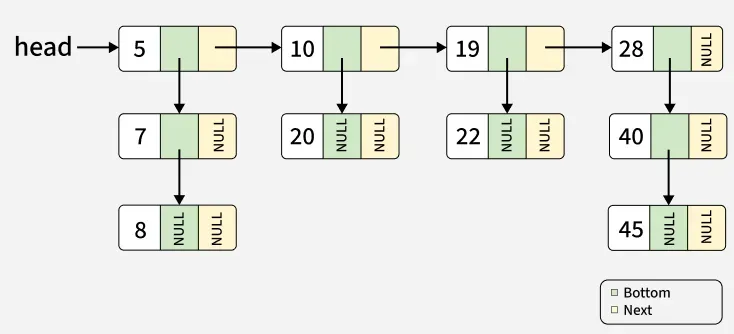
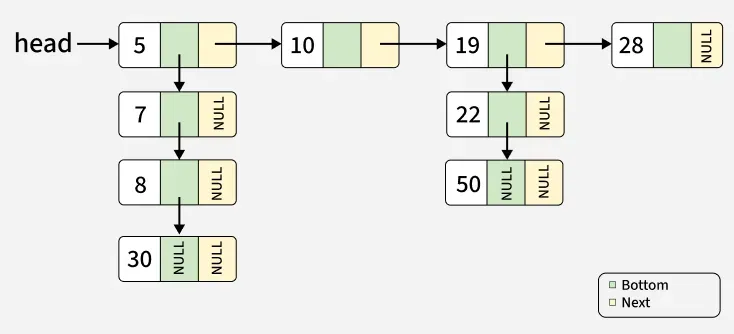

Table of Content
- [Approach 1] Using Sorting - O(n * m * log(n * m)) Time and O(n*m) Space
- [Approach 2] Using Recursion and Merging list - O(n * n * m) Time and O(n) Space
- [Approach 3] Using Priority Queues - O(n * m * log(n)) Time and O(n) Space
[Approach 1] Using Sorting - O(n * m * log(n * m)) Time and O(n*m) Space
The idea is to traverse the linked list and push values of all the nodes in an array. Now, we can sort the array in ascending order, and create a new linked list by traversing the sorted array.
**Follow the steps to solve the problem:
- Traverse the entire linked list using:
- Outer loop → move along the
nextpointer. - Inner loop → move along the
bottompointer. - Push every node's
datainto the array. - After traversal, **sort the array in ascending order.
- Now, create a new linked list using the sorted array:
- Return the
bottomof the dummy node — this is the **head of the flattened, sorted list. C++ `
// C++ program for flattening a Linked List
#include #include #include using namespace std;
class Node { public: int data; Node *next, *bottom;
Node(int newdata) {
    data = newdata;
    next = bottom = nullptr;
}
};
// function to flatten the linked list Node* flatten(Node* root) {
vector<int> values;

// Push values of all nodes into an array
while (root != nullptr) {

    // Push the head node of the sub-linked-list
    values.push_back(root->data);

    // Push all the nodes of the sub-linked-list
    Node* temp = root->bottom;
    while (temp != nullptr) {
        values.push_back(temp->data);
        temp = temp->bottom;
    }

    // Move to the next head node
    root = root->next;
}

// Sort the node values in ascending order
sort(values.begin(), values.end());

// Construct the new flattened linked list
Node* tail = nullptr;
Node* head = nullptr;
for (int i = 0; i < values.size(); i++) {
    Node* newNode = new Node(values[i]);

    // If this is the first node of the linked list,
    // make the node as head
    if (head == nullptr) {
        head = newNode;
    }
    else {
        tail->bottom = newNode;
    }
    tail = newNode;
}
return head;
}
void printList(Node* head) { Node* temp = head; while (temp != nullptr) { cout << temp->data; if(temp->bottom) cout<<" -> "; temp = temp->bottom; } cout << endl; }
int main() {
// Create a hard-coded linked list:
//   5 -> 10 -> 19 -> 28
//   |    |     |
//   V    V     V
//   7    20    22
//   |          |
//   V          V
//   8          50
//   |
//   V
//   30

Node* head = new Node(5);
head->bottom = new Node(7);
head->bottom->bottom = new Node(8);
head->bottom->bottom->bottom = new Node(30);

head->next = new Node(10);
head->next->bottom = new Node(20);

head->next->next = new Node(19);
head->next->next->bottom = new Node(22);
head->next->next->bottom->bottom = new Node(50);

head->next->next->next = new Node(28);

head = flatten(head);

printList(head);
return 0;
}
Java
// Java Program for flattening a linked list
import java.util.*;
class Node { int data; Node next, bottom;
Node(int newData) {
    data = newData;
    next = bottom = null;
}
}
class GfG {
// Function to flatten the linked list
static Node flatten(Node root) {
    List<Integer> values = new ArrayList<>();

    // Push values of all nodes into a list
    while (root != null) {
        // Push the head node of the sub-linked-list
        values.add(root.data);

        // Push all the nodes of the sub-linked-list
        Node temp = root.bottom;
        while (temp != null) {
            values.add(temp.data);
            temp = temp.bottom;
        }

        // Move to the next head node
        root = root.next;
    }

    // Sort the node values in ascending order
    Collections.sort(values);

    // Construct the new flattened linked list
    Node tail = null;
    Node head = null;
    for (int value : values) {
        Node newNode = new Node(value);

        // If this is the first node of the linked list,
        // make the node as head
        if (head == null)
            head = newNode;
        else
            tail.bottom = newNode;
        tail = newNode;
    }

    return head;
}

// Function to print the linked list
static void printList(Node head) {
    Node temp = head;
    while (temp != null) {
        System.out.print(temp.data);
        if(temp.bottom!=null)
        System.out.print(" -> ");
        temp = temp.bottom;
    }
    System.out.println();
}

public static void main(String[] args) {

    // Create a hard-coded linked list:
    // 5 -> 10 -> 19 -> 28
    // |    |     |
    // V    V     V
    // 7    20    22
    // |          |
    // V          V
    // 8          50
    // |
    // V
    // 30

    Node head = new Node(5);
    head.bottom = new Node(7);
    head.bottom.bottom = new Node(8);
    head.bottom.bottom.bottom = new Node(30);

    head.next = new Node(10);
    head.next.bottom = new Node(20);

    head.next.next = new Node(19);
    head.next.next.bottom = new Node(22);
    head.next.next.bottom.bottom = new Node(50);

    head.next.next.next = new Node(28);

    head = flatten(head);

    printList(head);
}
}
Python
Python program for flattening a Linked List
class Node: def init(self, new_data): self.data = new_data self.next = None self.bottom = None
Function to flatten the linked list
def flatten(root): values = []
# Push values of all nodes into an array
while root is not None:

    # Push the head node of the sub-linked-list
    values.append(root.data)

    # Push all the nodes of the sub-linked-list
    temp = root.bottom
    while temp is not None:
        values.append(temp.data)
        temp = temp.bottom

    # Move to the next head node
    root = root.next

# Sort the node values in ascending order
values.sort()

# Construct the new flattened linked list
tail = None
head = None
for value in values:
    newNode = Node(value)

    # If this is the first node of the linked list,
    # make the node as head
    if head is None:
        head = newNode
    else:
        tail.bottom = newNode
    tail = newNode

return head
def printList(node): while node is not None: print(f"{node.data}", end="") if node.next is not None: print(" -> ", end="") node = node.next print()
if name == "main":
# Create a hard-coded linked list:
# 5 -> 10 -> 19 -> 28
# |    |     |
# V    V     V
# 7    20    22
# |          |
# V          V
# 8          50
# |
# V
# 30
head = Node(5)
head.bottom = Node(7)
head.bottom.bottom = Node(8)
head.bottom.bottom.bottom = Node(30)

head.next = Node(10)
head.next.bottom = Node(20)

head.next.next = Node(19)
head.next.next.bottom = Node(22)
head.next.next.bottom.bottom = Node(50)

head.next.next.next = Node(28)

head = flatten(head)

printList(head)
C#
using System; using System.Collections.Generic; using System.Linq;
class Node { public int Data; public Node Next, Bottom;
public Node(int newData) {
    Data = newData;
    Next = Bottom = null;
}
}
class GfG {
  // Function to flatten the linked list
static Node Flatten(Node root) {
    List<int> values = new List<int>();

    // Push values of all nodes into a list
    while (root != null) {

          // Push the head node of the sub-linked-list
        values.Add(root.Data);

        // Push all the nodes of the sub-linked-list
        Node temp = root.Bottom;
        while (temp != null) {
            values.Add(temp.Data);
            temp = temp.Bottom;
        }

        // Move to the next head node
        root = root.Next;
    }

    // Sort the node values in ascending order
    values.Sort();

    // Construct the new flattened linked list
    Node tail = null;
    Node head = null;
    foreach(int value in values) {
        Node newNode = new Node(value);

        // If this is the first node of the linked list,
        // make the node as head
        if (head == null) {
            head = newNode;
        }
        else {
            tail.Bottom = newNode;
        }
        tail = newNode;
    }

    return head;
}

// Function to print the linked list
static void PrintList(Node head) {
    Node temp = head;
    while (temp != null) {
        Console.Write(temp.Data + "");
        if(temp.Bottom!=null)
        Console.Write(" -> ");
        temp = temp.Bottom;
    }
    Console.WriteLine();
}

static void Main() {

    /* Create a hard-coded linked list:
        5 -> 10 -> 19 -> 28
        |    |     |
        V    V     V
        7    20    22
        |          |
        V          V
        8          50
        |
        V
        30
    */
    Node head = new Node(5);
    head.Bottom = new Node(7);
    head.Bottom.Bottom = new Node(8);
    head.Bottom.Bottom.Bottom = new Node(30);

    head.Next = new Node(10);
    head.Next.Bottom = new Node(20);

    head.Next.Next = new Node(19);
    head.Next.Next.Bottom = new Node(22);
    head.Next.Next.Bottom.Bottom = new Node(50);

    head.Next.Next.Next = new Node(28);

    head = Flatten(head);
    PrintList(head);
}
}
JavaScript
// Javascript Program for flattening a linked list class Node { constructor(newData) { this.data = newData; this.next = null; this.bottom = null; } }
// Function to flatten the linked list function flatten(root) { let values = [];
// Push values of all nodes into an array
while (root !== null) {

    // Push the head node of the sub-linked-list
    values.push(root.data);

    // Push all the nodes of the sub-linked-list
    let temp = root.bottom;
    while (temp !== null) {
        values.push(temp.data);
        temp = temp.bottom;
    }

    // Move to the next head node
    root = root.next;
}

// Sort the node values in ascending order
values.sort((a, b) => a - b);

// Construct the new flattened linked list
let head = null;
let tail = null;
for (let value of values) {
    let newNode = new Node(value);

    // If this is the first node of the linked list,
    // make the node as head
    if (head === null)
        head = newNode;
    else
        tail.bottom = newNode;
    tail = newNode;
}
return head;
}
// Function to print the linked list function printList(node) { while (node !== null) { process.stdout.write(node.data.toString()); if (node.bottom !== null) { process.stdout.write(" -> "); } node = node.bottom; } }
/* Create a hard-coded linked list: 5 -> 10 -> 19 -> 28 | | | V V V 7 20 22 | | V V 8 50 | V 30 */ let head = new Node(5); head.bottom = new Node(7); head.bottom.bottom = new Node(8); head.bottom.bottom.bottom = new Node(30);
head.next = new Node(10); head.next.bottom = new Node(20);
head.next.next = new Node(19); head.next.next.bottom = new Node(22); head.next.next.bottom.bottom = new Node(50);
head.next.next.next = new Node(28);
head = flatten(head);
printList(head);
`
Output
5 -> 7 -> 8 -> 10 -> 19 -> 20 -> 22 -> 28 -> 30 -> 50
[Approach 2] Using Recursion and Merging list
The idea is similar to Merge two sorted linked lists.
**Follow the steps to solve the problem:
- Using recursion, we first go to the last head node .
- Then, we keep merging each linked list (connected via bottom pointers) with the result of the already flattened list in sorted order.
- Move one step back and keep merging the previous list with the merged result.
- Continue this process until the first list is merged.
- The final result is a single flattened and sorted list using bottom pointers. C++ `
// C++ program for flattening a Linked List
#include <bits/stdc++.h> using namespace std;
class Node { public: int data; Node *next, *bottom;
Node(int newdata) {
    data = newdata;
    next = bottom = nullptr;
}
};
// Utility function to merge two sorted linked lists // using their bottom pointers Node* merge(Node* head1, Node* head2) {
// A dummy first node to store the result list
Node dummy(-1);

// Tail points to the last result node to add new nodes
// to the result
Node* tail = &dummy;

// Iterate till either head1 or head2 does not reach NULL
while (head1 && head2) {

    if (head1->data <= head2->data) {

        // append head1 to the result
        tail->bottom = head1;
        head1 = head1->bottom;
    }
    else {

        // append head2 to the result
        tail->bottom = head2;
        head2 = head2->bottom;
    }

    // Move tail pointer to the next node
    tail = tail->bottom;
}

  // Append the remaining nodes of non-null linked list
if (!head1)
    tail->bottom = head2;
else
    tail->bottom = head1;
return (dummy.bottom);
}
// function to flatten the linked list Node* flatten(Node* root) {
// Base Cases
if (root == nullptr || root->next == nullptr)
    return root;

// Recur for next list
root->next = flatten(root->next);

// Now merge the current and next list
root = merge(root, root->next);

// Return the root
return root;
}
void printList(Node* head) { Node* temp = head; while (temp != nullptr) { cout << temp->data ; if(temp->bottom) cout<<" -> "; temp = temp->bottom; } cout << endl; }
int main() {
/* Create a hard-coded linked list:
    5 -> 10 -> 19 -> 28
    |    |     |
    V    V     V
    7    20    22
    |          |
    V          V
    8          50
    |
    V
    30
*/

Node* head = new Node(5);
head->bottom = new Node(7);
head->bottom->bottom = new Node(8);
head->bottom->bottom->bottom = new Node(30);

head->next = new Node(10);
head->next->bottom = new Node(20);

head->next->next = new Node(19);
head->next->next->bottom = new Node(22);
head->next->next->bottom->bottom = new Node(50);

head->next->next->next = new Node(28);

head = flatten(head);

printList(head);
return 0;
}
C
// C program for flattening a Linked List
#include <stdio.h>
struct Node { int data; struct Node *next, *bottom; };
// Utility function to merge two sorted linked lists using // their bottom pointers struct Node* merge(struct Node* head1, struct Node* head2) {
// A dummy first node to store the result list
struct Node dummy;
dummy.data = -1;
dummy.bottom = NULL;

// Tail points to the last result node to add new nodes
// to the result
struct Node* tail = &dummy;

// Iterate till either head1 or head2 does not reach
// NULL
while (head1 && head2) {

    if (head1->data <= head2->data) {

        // append head1 to the result
        tail->bottom = head1;
        head1 = head1->bottom;
    }
    else {

        // append head2 to the result
        tail->bottom = head2;
        head2 = head2->bottom;
    }

    // Move tail pointer to the next node
    tail = tail->bottom;
}

// Append the remaining nodes of non-null linked list
if (!head1)
    tail->bottom = head2;
else
    tail->bottom = head1;

return dummy.bottom;
}
// Function to flatten the linked list struct Node* flatten(struct Node* root) {
// Base Cases
if (root == NULL || root->next == NULL)
    return root;

// Recur for next list
root->next = flatten(root->next);

// Now merge the current and next list
root = merge(root, root->next);

// Return the root
return root;
}
void printList(struct Node* head) { struct Node* temp = head; while (temp != NULL) { printf("%d", temp->data); if(temp->bottom) printf(" -> "); temp = temp->bottom; } printf("\n"); }
// Function to create a new node struct Node* createNode(int newdata) { struct Node* newnode = (struct Node*)malloc(sizeof(struct Node)); newnode->data = newdata; newnode->next = NULL; newnode->bottom = NULL; return newnode; }
int main() {
/* Create a hard-coded linked list:
    5 -> 10 -> 19 -> 28
    |    |     |
    V    V     V
    7    20    22
    |          |
    V          V
    8          50
    |
    V
    30
*/

struct Node* head = createNode(5);
head->bottom = createNode(7);
head->bottom->bottom = createNode(8);
head->bottom->bottom->bottom = createNode(30);

head->next = createNode(10);
head->next->bottom = createNode(20);

head->next->next = createNode(19);
head->next->next->bottom = createNode(22);
head->next->next->bottom->bottom = createNode(50);

head->next->next->next = createNode(28);


head = flatten(head);

printList(head);

return 0;
}
Java
// Java program for flattening a Linked List
class Node { int data; Node next, bottom;
Node(int newData) {
    data = newData;
    next = bottom = null;
}
}
class GfG {
// Utility function to merge two sorted linked lists
// using their bottom pointers
static Node merge(Node head1, Node head2) {

    // A dummy first node to store the result list
    Node dummy = new Node(-1);

    // Tail points to the last result node to add new
    // nodes to the result
    Node tail = dummy;

    // Iterate till either head1 or head2 does not reach
    // null
    while (head1 != null && head2 != null) {
        if (head1.data <= head2.data) {

            // Append head1 to the result
            tail.bottom = head1;
            head1 = head1.bottom;
        }
        else {

            // Append head2 to the result
            tail.bottom = head2;
            head2 = head2.bottom;
        }

        // Move tail pointer to the next node
        tail = tail.bottom;
    }

    // Append the remaining nodes of the non-null list
    if (head1 != null)
        tail.bottom = head1;
    else
        tail.bottom = head2;

    return dummy.bottom;
}

// Function to flatten the linked list
static Node flatten(Node root) {

    // Base Cases
    if (root == null || root.next == null)
        return root;

    // Recur for next list
    root.next = flatten(root.next);

    // Now merge the current and next list
    root = merge(root, root.next);

    // Return the root
    return root;
}

static void printList(Node head) {
    Node temp = head;
    while (temp != null) {
        System.out.print(temp.data);
        if(temp.bottom!=null)
        {
            System.out.print(" -> ");
        }
        temp = temp.bottom;
    }
    System.out.println();
}

public static void main(String[] args) {

    /* Create a hard-coded linked list:
        5 -> 10 -> 19 -> 28
        |    |     |
        V    V     V
        7    20    22
        |          |
        V          V
        8          50
        |
        V
        30
    */

    Node head = new Node(5);
    head.bottom = new Node(7);
    head.bottom.bottom = new Node(8);
    head.bottom.bottom.bottom = new Node(30);

    head.next = new Node(10);
    head.next.bottom = new Node(20);

    head.next.next = new Node(19);
    head.next.next.bottom = new Node(22);
    head.next.next.bottom.bottom = new Node(50);

    head.next.next.next = new Node(28);

    head = flatten(head);

    printList(head);
}
}
Python
Python3 program for flattening a Linked List
class Node: def init(self, new_data): self.data = new_data self.next = None self.bottom = None
Utility function to merge two sorted linked lists
using their bottom pointers
def merge(head1, head2):
# A dummy first node to store the result list
dummy = Node(-1)
tail = dummy

# Iterate till either head1 or head2 does not reach None
while head1 and head2:
    if head1.data <= head2.data:

        # Append head1 to the result
        tail.bottom = head1
        head1 = head1.bottom
    else:

        # Append head2 to the result
        tail.bottom = head2
        head2 = head2.bottom

    # Move tail pointer to the next node
    tail = tail.bottom

# Append the remaining nodes of the non-null linked list
if head1:
    tail.bottom = head1
else:
    tail.bottom = head2

return dummy.bottom
Function to flatten the linked list
def flatten(root):
# Base Cases
if root is None or root.next is None:
    return root

# Recur for next list
root.next = flatten(root.next)

# Now merge the current and next list
root = merge(root, root.next)

# Return the root
return root
def printList(node): while node is not None: print(f"{node.data}", end="") if node.bottom is not None: print(" -> ", end="") node = node.bottom print()
if name == "main":
# Create a hard-coded linked list:
#     5 -> 10 -> 19 -> 28
#     |    |     |
#     V    V     V
#     7    20    22
#     |          |
#     V          V
#     8          50
#     |
#     V
#     30

head = Node(5)
head.bottom = Node(7)
head.bottom.bottom = Node(8)
head.bottom.bottom.bottom = Node(30)

head.next = Node(10)
head.next.bottom = Node(20)

head.next.next = Node(19)
head.next.next.bottom = Node(22)
head.next.next.bottom.bottom = Node(50)

head.next.next.next = Node(28)

head = flatten(head)

printList(head)
C#
// C# program for flattening a Linked List
using System;
class Node { public int Data; public Node Next; public Node Bottom;
public Node(int newData) {
    Data = newData;
    Next = null;
    Bottom = null;
}
}
class GfG {
// Utility function to merge two sorted linked lists
// using their bottom pointers
static Node Merge(Node head1, Node head2) {

    // A dummy first node to store the result list
    Node dummy = new Node(-1);

    // Tail points to the last result node to add new
    // nodes to the result
    Node tail = dummy;

    // Iterate till either head1 or head2 does not reach
    // null
    while (head1 != null && head2 != null) {
        if (head1.Data <= head2.Data) {

            // Append head1 to the result
            tail.Bottom = head1;
            head1 = head1.Bottom;
        }
        else {

            // Append head2 to the result
            tail.Bottom = head2;
            head2 = head2.Bottom;
        }

        // Move tail pointer to the next node
        tail = tail.Bottom;
    }

    // Append the remaining nodes of the
    // non-null linked list
    if (head1 == null)
        tail.Bottom = head2;
    else
        tail.Bottom = head1;

    return dummy.Bottom;
}

// Function to flatten the linked list
static Node Flatten(Node root) {

    // Base Cases
    if (root == null || root.Next == null)
        return root;

    // Recur for next list
    root.Next = Flatten(root.Next);

    // Now merge the current and next list
    root = Merge(root, root.Next);

    // Return the root
    return root;
}

static void PrintList(Node head) {
    Node temp = head;
    while (temp != null) {
        Console.Write(temp.Data + "");
        if(temp.Bottom!=null)
        Console.Write(" -> ");
        temp = temp.Bottom;
    }
    Console.WriteLine();
}

static void Main() {

    /* Create a hard-coded linked list:
        5 -> 10 -> 19 -> 28
        |    |     |
        V    V     V
        7    20    22
        |          |
        V          V
        8          50
        |
        V
        30
    */

    Node head = new Node(5);
    head.Bottom = new Node(7);
    head.Bottom.Bottom = new Node(8);
    head.Bottom.Bottom.Bottom = new Node(30);

    head.Next = new Node(10);
    head.Next.Bottom = new Node(20);

    head.Next.Next = new Node(19);
    head.Next.Next.Bottom = new Node(22);
    head.Next.Next.Bottom.Bottom = new Node(50);

    head.Next.Next.Next = new Node(28);

    head = Flatten(head);

    PrintList(head);
}
}
JavaScript
// Javascript program for flattening a Linked List
class Node { constructor(newData) { this.data = newData; this.next = null; this.bottom = null; } }
// Utility function to merge two sorted linked lists // using their bottom pointers function merge(head1, head2) {
// A dummy first node to store the result list
let dummy = new Node(-1);

// Tail points to the last result node to add new nodes to the result
let tail = dummy;

// Iterate till either head1 or head2 does not reach null
while (head1 !== null && head2 !== null) {
    if (head1.data <= head2.data) {

        // Append head1 to the result
        tail.bottom = head1;
        head1 = head1.bottom;
    } else {

        // Append head2 to the result
        tail.bottom = head2;
        head2 = head2.bottom;
    }

    // Move tail pointer to the next node
    tail = tail.bottom;
}

// Append the remaining nodes of non-null linked list
if (head1 === null)
    tail.bottom = head2;
else
    tail.bottom = head1;

return dummy.bottom;
}
// Function to flatten the linked list function flatten(root) {
// Base Cases
if (root === null || root.next === null) {
    return root;
}

// Recur for next list
root.next = flatten(root.next);

// Now merge the current and next list
root = merge(root, root.next);

// Return the root
return root;
}
function printList(node) { while (node !== null) { process.stdout.write(node.data.toString()); if (node.bottom !== null) { process.stdout.write(" -> "); } node = node.bottom; } }
/* Create a hard-coded linked list: 5 -> 10 -> 19 -> 28 | | | V V V 7 20 22 | | V V 8 50 | V 30 */
let head = new Node(5); head.bottom = new Node(7); head.bottom.bottom = new Node(8); head.bottom.bottom.bottom = new Node(30);
head.next = new Node(10); head.next.bottom = new Node(20);
head.next.next = new Node(19); head.next.next.bottom = new Node(22); head.next.next.bottom.bottom = new Node(50);
head.next.next.next = new Node(28);
head = flatten(head); printList(head);
`
Output
5 -> 7 -> 8 -> 10 -> 19 -> 20 -> 22 -> 28 -> 30 -> 50
**Time Complexity: O(n * n * m) - where n is the no of nodes in the main linked list and m is the no of nodes in a single sub-linked list.
- After adding the first 2 lists, the time taken will be O(m+m) = O(2m).
- Then we will merge another list to above merged list -> time = O(2m + m) = O(3m).
- We will keep merging lists to previously merged lists until all lists are merged.
- Total time taken will be O(2m + 3m + 4m + .... n*m) = (2 + 3 + 4 + ... + n) * m = **O(n * n * m)
**Auxiliary Space: O(n), the recursive functions will use a recursive stack of a size equivalent to a total number of nodes in the main linked list.
[Approach 3] Using Priority Queues - O(n * m * log(n)) Time and O(n) Space
The idea is to use a Min Heap, push all the head nodes into it, and always extract the node with the minimum value from the top.
**Follow the steps to solve the problem:
- Create a min-heap with custom comparator.
- Push all head nodes to heap.
- Use a dummy node to build the result.
- While heap is not empty:
- Pop smallest node.
- Add it to result.
- If it has a bottom node, push that into heap.
- Return dummy node. C++ `
#include <bits/stdc++.h> using namespace std;
class Node { public: int data; Node *next, *bottom;
Node(int newdata) {
    data = newdata;
    next = bottom = nullptr;
}
};
// comparator function for priority queue struct mycomp { bool operator()(Node* a, Node* b) { return a->data > b->data; } };
// function to flatten the given linked list Node* flatten(Node* root) {
priority_queue<Node*, vector<Node*>, mycomp> pq;

Node* head = nullptr;
Node* tail = nullptr;

// pushing main link nodes into priority_queue
while (root != nullptr) {
    pq.push(root);
    root = root->next;
}

// Extracting the minimum node
// while priority queue is not empty
while (!pq.empty()) {

    // extracting min
    auto minNode = pq.top();
    pq.pop();

    if (head == nullptr) {
        head = minNode;
        tail = minNode;
    }
    else {
        tail->bottom = minNode;
        tail = tail->bottom;
    }

    // If we have another node at the bottom of the
    // popped node, push that node into the priority
    // queue
    if (minNode->bottom) {
        pq.push(minNode->bottom);
        minNode->bottom = nullptr;
    }
}

  return head;
}
void printList(Node* head) { Node* temp = head; while (temp != nullptr) { cout << temp->data ; if(temp->bottom) cout<<" -> "; temp = temp->bottom; } cout << endl; }
int main() {
/* Create a hard-coded linked list:
    5 -> 10 -> 19 -> 28
    |    |     |
    V    V     V
    7    20    22
    |          |
    V          V
    8          50
    |
    V
    30
*/

Node* head = new Node(5);
head->bottom = new Node(7);
head->bottom->bottom = new Node(8);
head->bottom->bottom->bottom = new Node(30);

head->next = new Node(10);
head->next->bottom = new Node(20);

head->next->next = new Node(19);
head->next->next->bottom = new Node(22);
head->next->next->bottom->bottom = new Node(50);

head->next->next->next = new Node(28);

head = flatten(head);

printList(head);
return 0;
}
Java
// Java program for flattening a Linked List
import java.util.PriorityQueue;
class Node { int data; Node next, bottom;
Node(int newData) {
    data = newData;
    next = bottom = null;
}
}
// Comparator class for the priority queue class NodeComparator implements java.util.Comparator { @Override public int compare(Node a, Node b) { return Integer.compare(a.data, b.data); } }
// Function to flatten the linked list class GfG {
static Node flatten(Node root) {

    // Create a priority queue with custom comparator
    PriorityQueue<Node> pq = new PriorityQueue<>(new NodeComparator());

    Node head = null;
    Node tail = null;

    // Pushing main link nodes into the priority_queue.
    while (root != null) {
        pq.add(root);
        root = root.next;
    }

    // Extracting the minimum node while the priority
      // queue is not empty
    while (!pq.isEmpty()) {

        // Extracting min
        Node minNode = pq.poll();

        if (head == null) {
            head = minNode;
            tail = minNode;
        } else {
            tail.bottom = minNode;
            tail = tail.bottom;
        }

        // If we have another node at the bottom of the
        // popped node, push that node into the priority queue
        if (minNode.bottom != null) {
            pq.add(minNode.bottom);
            minNode.bottom = null;
        }
    }

    return head;
}

// Function to print the linked list
static void printList(Node head) {
    Node temp = head;
    while (temp != null) {
        System.out.print(temp.data);
        if(temp.bottom!=null)
        {
            System.out.print(" -> ");
        }
        temp = temp.bottom;
    }
    System.out.println();
}

public static void main(String[] args) {

    /* Create a hard-coded linked list:
        5 -> 10 -> 19 -> 28
        |    |     |
        V    V     V
        7    20    22
        |          |
        V          V
        8          50
        |
        V
        30
    */

    Node head = new Node(5);
    head.bottom = new Node(7);
    head.bottom.bottom = new Node(8);
    head.bottom.bottom.bottom = new Node(30);

    head.next = new Node(10);
    head.next.bottom = new Node(20);

    head.next.next = new Node(19);
    head.next.next.bottom = new Node(22);
    head.next.next.bottom.bottom = new Node(50);

    head.next.next.next = new Node(28);

    head = flatten(head);
    printList(head);
}
}
Python
Python program for flattening a Linked List
from heapq import heappush, heappop
class Node: def init(self, data): self.data = data self.next = self.bottom = None
Utility function to insert a node at beginning
of the linked list
def push(head, data):
# 1 & 2: Allocate the Node & Put in the data
newNode = Node(data)

# Make next of newNode as head
newNode.bottom = head

# Move the head to point to newNode
head = newNode

# Return to link it back
return head
def printList(node): while node is not None: print(f"{node.data}", end="") if node.bottom is not None: print(" -> ", end="") node = node.bottom print()
Class to compare two node objects
class Cmp: def init(self, node): self.node = node
def __lt__(self, other):
    return self.node.data < other.node.data
def flatten(root): pq = [] head = None tail = None
# Pushing main link nodes into priority_queue
while root:
    heappush(pq, Cmp(root))
    root = root.next

# Extracting the minimum node while the priority
# queue is not empty
while pq:
    minNode = heappop(pq).node

    if head is None:
        head = minNode
        tail = minNode
    else:
        tail.bottom = minNode
        tail = tail.bottom

    # If we have another node at the bottom of the popped
    # node, push that node into the priority queue
    if minNode.bottom:
        heappush(pq, Cmp(minNode.bottom))
        minNode.bottom = None

return head
if name == 'main': head = Node(5) head.bottom = Node(7) head.bottom.bottom = Node(8) head.bottom.bottom.bottom = Node(30)
head.next = Node(10)
head.next.bottom = Node(20)

head.next.next = Node(19)
head.next.next.bottom = Node(22)
head.next.next.bottom.bottom = Node(50)

head.next.next.next = Node(28)

head = flatten(head)

printList(head)
C#
// C# implementation for above approach
using System; using System.Collections.Generic;
public class Node { public int Data; public Node Next; public Node Bottom;
public Node(int newData) {
    Data = newData;
    Next = null;
    Bottom = null;
}
}
// Comparator class for the priority queue public class NodeComparer : IComparer { public int Compare(Node a, Node b) { return a.Data.CompareTo(b.Data); } }
class GfG { static Node Flatten(Node root) {
    // Priority queue (min-heap) using a sorted list for
    // simplicity
    SortedList<int, Node> pq
        = new SortedList<int, Node>();
    Node head = null;
    Node tail = null;

    // Push main link nodes into the priority queue
    while (root != null) {
        pq.Add(root.Data, root);
        root = root.Next;
    }

    // Extracting the minimum node while priority queue
    // is not empty
    while (pq.Count > 0) {

        // Extracting min
        Node minNode = pq.Values[0];
        pq.RemoveAt(0);

        if (head == null) {
            head = minNode;
            tail = minNode;
        }
        else {
            tail.Bottom = minNode;
            tail = tail.Bottom;
        }

        // If we have another node at the bottom of the
        // popped node, push that node into the priority
        // queue
        if (minNode.Bottom != null) {
            pq.Add(minNode.Bottom.Data, minNode.Bottom);
            minNode.Bottom = null;
        }
    }

    return head;
}

static void PrintList(Node head) {
    Node temp = head;
    while (temp != null) {
        Console.Write(temp.Data + "");
        if(temp.Bottom!=null)
        Console.Write(" -> ");
        temp = temp.Bottom;
    }
    Console.WriteLine();
}

static void Main() {

    /*
        Create a hard-coded linked list:
        5 -> 10 -> 19 -> 28
        |    |     |
        V    V     V
        7    20    22
        |          |
        V          V
        8          50
        |
        V
        30
    */

    Node head = new Node(5);
    head.Bottom = new Node(7);
    head.Bottom.Bottom = new Node(8);
    head.Bottom.Bottom.Bottom = new Node(30);

    head.Next = new Node(10);
    head.Next.Bottom = new Node(20);

    head.Next.Next = new Node(19);
    head.Next.Next.Bottom = new Node(22);
    head.Next.Next.Bottom.Bottom = new Node(50);

    head.Next.Next.Next = new Node(28);

    head = Flatten(head);
    PrintList(head);
}
}
JavaScript
// Javascript implementation for above approach
class Node { constructor(data) { this.data = data; this.next = null; this.bottom = null; } }
// Comparator function for the priority queue class MinHeap { constructor() { this.heap = []; }
push(node) {
    this.heap.push(node);
    this._heapifyUp(this.heap.length - 1);
}

pop() {
    if (this.size() === 0)
        return null;
    const root = this.heap[0];
    const last = this.heap.pop();
    if (this.size() > 0) {
        this.heap[0] = last;
        this._heapifyDown(0);
    }
    return root;
}

size() { return this.heap.length; }

_heapifyUp(index) {
    const parentIndex = Math.floor((index - 1) / 2);
    if (index > 0
        && this.heap[index].data
               < this.heap[parentIndex].data) {
        [this.heap[index], this.heap[parentIndex]] = [
            this.heap[parentIndex], this.heap[index]
        ];
        this._heapifyUp(parentIndex);
    }
}

_heapifyDown(index) {
    const leftChildIndex = 2 * index + 1;
    const rightChildIndex = 2 * index + 2;
    let smallest = index;

    if (leftChildIndex < this.size()
        && this.heap[leftChildIndex].data
               < this.heap[smallest].data) {
        smallest = leftChildIndex;
    }
    if (rightChildIndex < this.size()
        && this.heap[rightChildIndex].data
               < this.heap[smallest].data) {
        smallest = rightChildIndex;
    }
    if (smallest !== index) {
        [this.heap[index], this.heap[smallest]] =
            [ this.heap[smallest], this.heap[index] ];
        this._heapifyDown(smallest);
    }
}
}
function flatten(root) { const pq = new MinHeap(); let head = null; let tail = null;
// Push main linked list nodes into the priority queue
while (root !== null) {
    pq.push(root);
    root = root.next;
}

// Extracting the minimum node while priority queue is
// not empty
while (pq.size() > 0) {
    const minNode = pq.pop();

    if (head === null) {
        head = minNode;
        tail = minNode;
    }
    else {
        tail.bottom = minNode;
        tail = tail.bottom;
    }

    // If we have another node at the bottom of the
    // popped node, push that node into the priority
    // queue
    if (minNode.bottom !== null) {
        pq.push(minNode.bottom);
        minNode.bottom = null;
    }
}

return head;
}
function printList(node) { while (node !== null) { process.stdout.write(node.data.toString()); if (node.bottom !== null) { process.stdout.write(" -> "); } node = node.bottom; } }
/* Create a hard-coded linked list: 5 -> 10 -> 19 -> 28 | | | V V V 7 20 22 | | V V 8 50 | V 30 */ // Driver Code let head = new Node(5); head.bottom = new Node(7); head.bottom.bottom = new Node(8); head.bottom.bottom.bottom = new Node(30);
head.next = new Node(10); head.next.bottom = new Node(20);
head.next.next = new Node(19); head.next.next.bottom = new Node(22); head.next.next.bottom.bottom = new Node(50);
head.next.next.next = new Node(28);
head = flatten(head);
printList(head);
`
Output
5 -> 7 -> 8 -> 10 -> 19 -> 20 -> 22 -> 28 -> 30 -> 50