Merge K sorted linked lists (original) (raw)
Given **k sorted linked lists of different sizes, we need to merge them into a single list while maintaining their sorted order.
**Examples:
**Input:
**Output:
**Explanation: Merged lists in a sorted order where every element is greater than the previous element.
**Input:
**Output:
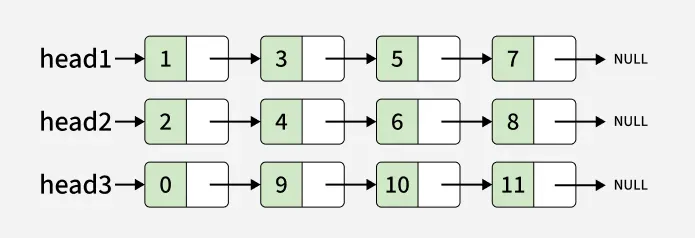

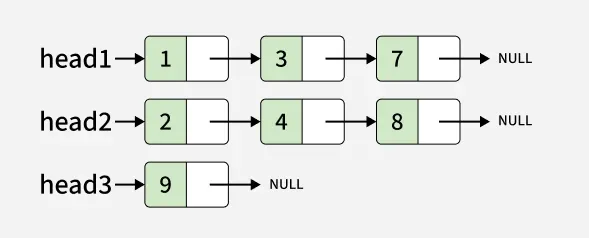

Table of Content
- [Naive Approach - 1] - By Merging List One by One
- [Naive Approach - 2] - By repeatedly selecting the minimum node
- [Expected Approach - 1] - Using Min Heap (Works better for unequal sized lists)
- [Expected Approach - 2] - Using Divide and Conquer (Works better for equal sized lists)
[Naive Approach - 1] - By Merging List One by One
The idea is to initialize the result as empty. Now one by one merge every linked list into the resultant list using the idea of merging two sorted linked lists. We always consider the result as first list and other list as second. At the end, we return result.
C++ `
#include #include using namespace std;
class Node { public: int data; Node* next; Node(int x) { data = x; next = nullptr; } };
// Function to merge only 2 lists Node* mergeTwo(Node* head1, Node* head2) {
// Create a dummy node to simplify
// the merging process
Node* dummy = new Node(-1);
Node* curr = dummy;

// Iterate through both linked lists
while (head1 != nullptr && head2 != nullptr) {

    // Add the smaller node to the merged list
    if (head1->data <= head2->data) {
        curr->next = head1;
        head1 = head1->next;
    } else {
        curr->next = head2;
        head2 = head2->next;
    }
    curr = curr->next;
}

// If any list is left, append it to
// the merged list
if (head1 != nullptr) {
    curr->next = head1;
} else {
    curr->next = head2;
}

// Return the merged list starting
// from the next of dummy node
return dummy->next;
}
// Function to merge K sorted linked lists Node* mergeKLists(vector<Node*>& arr) {
// Initialize result as empty
Node *res = nullptr;

// One by one merge all lists with
// res and keep updating res
for (Node *node : arr)
    res = mergeTwo(res, node);

return res;
}
void printList(Node* node) { while (node != nullptr) { cout << node->data; if(node->next) cout<<" -> "; node = node->next; } }
int main() { int k = 3;
vector<Node*> arr(k);

arr[0] = new Node(1);
arr[0]->next = new Node(3);
arr[0]->next->next = new Node(5);
arr[0]->next->next->next = new Node(7);

arr[1] = new Node(2);
arr[1]->next = new Node(4);
arr[1]->next->next = new Node(6);
arr[1]->next->next->next = new Node(8);

arr[2] = new Node(0);
arr[2]->next = new Node(9);
arr[2]->next->next = new Node(10);
arr[2]->next->next->next = new Node(11);

Node* head = mergeKLists(arr);

printList(head);

return 0;
}
C
#include <stdio.h> #include <stdlib.h>
struct Node { int data; struct Node* next; };
struct Node* createNode(int data);
// Function to merge only 2 lists struct Node* mergeTwo(struct Node* head1, struct Node* head2) {
// Create a dummy node to simplify
// the merging process
struct Node* dummy = createNode(-1);
struct Node* curr = dummy;

// Iterate through both linked lists
while (head1 != NULL && head2 != NULL) {

    // Add the smaller node to the merged list
    if (head1->data <= head2->data) {
        curr->next = head1;
        head1 = head1->next;
    } else {
        curr->next = head2;
        head2 = head2->next;
    }
    curr = curr->next;
}

// If any list is left, append it to
// the merged list
if (head1 != NULL) {
    curr->next = head1;
} else {
    curr->next = head2;
}

// Return the merged list starting
// from the next of dummy node
struct Node* merged = dummy->next;
free(dummy);
return merged;
}
// Function to merge K sorted linked lists struct Node* mergeKLists(struct Node** arr, int k) {
// Initialize result as empty
struct Node* res = NULL;

// One by one merge all lists with
// res and keep updating res
for (int i = 0; i < k; i++)
    res = mergeTwo(res, arr[i]);

return res;
}
void printList(struct Node* node) { while (node != NULL) { printf("%d", node->data); if(node->next) printf(" -> "); node = node->next; } }
struct Node* createNode(int data) { struct Node* newNode = (struct Node*)malloc(sizeof(struct Node)); newNode->data = data; newNode->next = NULL; return newNode; }
int main() { int k = 3; struct Node* arr[k];
arr[0] = createNode(1);
arr[0]->next = createNode(3);
arr[0]->next->next = createNode(5);
arr[0]->next->next->next = createNode(7);

arr[1] = createNode(2);
arr[1]->next = createNode(4);
arr[1]->next->next = createNode(6);
arr[1]->next->next->next = createNode(8);

arr[2] = createNode(0);
arr[2]->next = createNode(9);
arr[2]->next->next = createNode(10);
arr[2]->next->next->next = createNode(11);

struct Node* head = mergeKLists(arr, k);

printList(head);

return 0;
}
Java
import java.util.List; import java.util.ArrayList;
class Node { int data; Node next;
Node(int x) {
    data = x;
    next = null;
}
}
class GfG {
// Function to merge only 2 lists
static Node mergeTwo(Node head1, Node head2) {

    // Create a dummy node to simplify
    // the merging process
    Node dummy = new Node(-1);
    Node curr = dummy;

    // Iterate through both linked lists
    while (head1 != null && head2 != null) {

        // Add the smaller node to the merged list
        if (head1.data <= head2.data) {
            curr.next = head1;
            head1 = head1.next;
        } else {
            curr.next = head2;
            head2 = head2.next;
        }
        curr = curr.next;
    }

    // If any list is left, append it to
    // the merged list
    if (head1 != null) {
        curr.next = head1;
    } else {
        curr.next = head2;
    }

    // Return the merged list starting
    // from the next of dummy node
    return dummy.next;
}

// Function to merge K sorted linked lists
static Node mergeKLists(List<Node> arr) {

    // Initialize result as empty
    Node res = null;

    // One by one merge all lists with
    // res and keep updating res
    for (Node node : arr)
        res = mergeTwo(res, node);

    return res;
}

static void printList(Node node) {
    while (node != null) {
        System.out.print(node.data);
        if(node.next!=null)
        System.out.print(" -> ");
        node = node.next;
    }
}

public static void main(String[] args) {
    List<Node> arr = new ArrayList<>();

    arr.add(new Node(1));
    arr.get(0).next = new Node(3);
    arr.get(0).next.next = new Node(5);
    arr.get(0).next.next.next = new Node(7);

    arr.add(new Node(2));
    arr.get(1).next = new Node(4);
    arr.get(1).next.next = new Node(6);
    arr.get(1).next.next.next = new Node(8);

    arr.add(new Node(0));
    arr.get(2).next = new Node(9);
    arr.get(2).next.next = new Node(10);
    arr.get(2).next.next.next = new Node(11);

    Node head = mergeKLists(arr);

    printList(head);
}
}
Python
class Node: def init(self, x): self.data = x self.next = None
Function to merge only 2 lists
def mergeTwo(head1, head2):
# Create a dummy node to simplify
# the merging process
dummy = Node(-1)
curr = dummy

# Iterate through both linked lists
while head1 is not None and head2 is not None:

    # Add the smaller node to the merged list
    if head1.data <= head2.data:
        curr.next = head1
        head1 = head1.next
    else:
        curr.next = head2
        head2 = head2.next
    curr = curr.next

# If any list is left, append it to
# the merged list
if head1 is not None:
    curr.next = head1
else:
    curr.next = head2

# Return the merged list starting
# from the next of dummy node
return dummy.next
Function to merge K sorted linked lists
def mergeKLists(arr):
# Initialize result as empty
res = None

# One by one merge all lists with
# res and keep updating res
for node in arr:
    res = mergeTwo(res, node)

return res
def printList(node): while node is not None: print(f"{node.data}", end="") if node.next is not None: print(" -> ", end="") node = node.next print()
if name == "main": arr = []
node1 = Node(1)
node1.next = Node(3)
node1.next.next = Node(5)
node1.next.next.next = Node(7)
arr.append(node1)

node2 = Node(2)
node2.next = Node(4)
node2.next.next = Node(6)
node2.next.next.next = Node(8)
arr.append(node2)

node3 = Node(0)
node3.next = Node(9)
node3.next.next = Node(10)
node3.next.next.next = Node(11)
arr.append(node3)

head = mergeKLists(arr)
printList(head)
C#
using System; using System.Collections.Generic;
class Node { public int data; public Node next;
public Node(int x) {
    data = x;
    next = null;
}
}
class GfG { static Node mergeTwo(Node head1, Node head2) {
    // Create a dummy node to simplify
    // the merging process
    Node dummy = new Node(-1);
    Node curr = dummy;

    // Iterate through both linked lists
    while (head1 != null && head2 != null) {

        // Add the smaller node to the merged list
        if (head1.data <= head2.data) {
            curr.next = head1;
            head1 = head1.next;
        } else {
            curr.next = head2;
            head2 = head2.next;
        }
        curr = curr.next;
    }

    // If any list is left, append it to
    // the merged list
    if (head1 != null) {
        curr.next = head1;
    } else {
        curr.next = head2;
    }

    // Return the merged list starting
    // from the next of dummy node
    return dummy.next;
}

static Node mergeKLists(List<Node> arr) {

    // Initialize result as empty
    Node res = null;

    // One by one merge all lists with
    // res and keep updating res
    foreach (Node node in arr)
        res = mergeTwo(res, node);

    return res;
}
static void printList(Node head) { Node temp = head; while (temp != null) { Console.Write(temp.data + ""); if(temp.next!=null) Console.Write(" -> "); temp = temp.next; } Console.WriteLine(); }
static void Main(string[] args) {
    List<Node> arr = new List<Node>();

    Node node1 = new Node(1);
    node1.next = new Node(3);
    node1.next.next = new Node(5);
    node1.next.next.next = new Node(7);
    arr.Add(node1);

    Node node2 = new Node(2);
    node2.next = new Node(4);
    node2.next.next = new Node(6);
    node2.next.next.next = new Node(8);
    arr.Add(node2);

    Node node3 = new Node(0);
    node3.next = new Node(9);
    node3.next.next = new Node(10);
    node3.next.next.next = new Node(11);
    arr.Add(node3);

    Node head = mergeKLists(arr);
    printList(head);
}
}
JavaScript
class Node { constructor(x) { this.data = x; this.next = null; } }
// Function to merge only 2 lists function mergeTwo(head1, head2) {
// Create a dummy node to simplify
// the merging process
let dummy = new Node(-1);
let curr = dummy;

// Iterate through both linked lists
while (head1 !== null && head2 !== null) {

    // Add the smaller node to the merged list
    if (head1.data <= head2.data) {
        curr.next = head1;
        head1 = head1.next;
    } else {
        curr.next = head2;
        head2 = head2.next;
    }
    curr = curr.next;
}

// If any list is left, append it to
// the merged list
if (head1 !== null) {
    curr.next = head1;
} else {
    curr.next = head2;
}

// Return the merged list starting
// from the next of dummy node
return dummy.next;
}
// Function to merge K sorted linked lists function mergeKLists(arr) {
// Initialize result as empty
let res = null;

// One by one merge all lists with
// res and keep updating res
for (let node of arr)
    res = mergeTwo(res, node);

return res;
}
function printList(node) { while (node !== null) { console.log(node.data + " "); node = node.next; } } // Driver Code let arr = [];
let node1 = new Node(1); node1.next = new Node(3); node1.next.next = new Node(5); node1.next.next.next = new Node(7); arr.push(node1);
let node2 = new Node(2); node2.next = new Node(4); node2.next.next = new Node(6); node2.next.next.next = new Node(8); arr.push(node2);
let node3 = new Node(0); node3.next = new Node(9); node3.next.next = new Node(10); node3.next.next.next = new Node(11); arr.push(node3);
let head = mergeKLists(arr); printList(head);
`
Output
0 -> 1 -> 2 -> 3 -> 4 -> 5 -> 6 -> 7 -> 8 -> 9 -> 10 -> 11
**Time complexity: O(n*k*k), For simplicity, let us assume that every list is of equal size **n. In the worst case. we take n + 2n + 3n ..... + k * n time. The sum of this series is n * k * (k + 1) / 2 which is O(n * k * k).
**Auxiliary Space: O(1).
[Naive Approach - 2] - By repeatedly selecting the minimum node
The idea is to iterate through all the **k head nodes and **append the head node with **minimum value to the resultant list. Increment the head to next node. Repeat this process until all nodes are processed.
Step by step approach:
- Initialize a **dummy head for the resultant list.
- Find the node with the **smallest value in all the **k lists.
- Increment the current pointer to the next node of the list where the smallest node is found.
- Append the node with smallest value to the resultant list.
- Repeat these steps till all nodes have been used. C++ `
#include #include using namespace std;
class Node { public: int data; Node* next; Node(int x) { data = x; next = nullptr; } };
// Function to get node with minimum value Node* getMinNode(vector<Node*> &arr) {
Node* mini = nullptr;
int index = -1;

for (int i=0; i<arr.size(); i++) {

    // If current list is processed
    if (arr[i]==nullptr) continue;

    // If min node is not set or
    // current head has smaller value.
    if (mini==nullptr || arr[i]->data<mini->data) {
        index = i;
        mini = arr[i];
    }
}

// Increment the head node
if (index!=-1) arr[index] = arr[index]->next;

return mini;
}
// Function to merge K sorted linked lists Node* mergeKLists(vector<Node*>& arr) {
// Create a dummy node to simplify
// the merging process
Node* dummy = new Node(-1);
Node* tail = dummy;

Node* mini = getMinNode(arr);

// Process all nodes.
while (mini != nullptr) {

    // Append min node to the result.
    tail->next = mini;
    tail = mini;

    // Find the next min node
    mini = getMinNode(arr);
}

// Return the merged list starting
// from the next of dummy node
return dummy->next;
}
void printList(Node* node) { while (node != nullptr) { cout << node->data; if(node->next) cout<<" -> "; node = node->next; } }
int main() { int k = 3;
vector<Node*> arr(k);

arr[0] = new Node(1);
arr[0]->next = new Node(3);
arr[0]->next->next = new Node(5);
arr[0]->next->next->next = new Node(7);

arr[1] = new Node(2);
arr[1]->next = new Node(4);
arr[1]->next->next = new Node(6);
arr[1]->next->next->next = new Node(8);

arr[2] = new Node(0);
arr[2]->next = new Node(9);
arr[2]->next->next = new Node(10);
arr[2]->next->next->next = new Node(11);

Node* head = mergeKLists(arr);

printList(head);

return 0;
}
Java
import java.util.List; import java.util.ArrayList;
class Node { int data; Node next;
Node(int x) {
    data = x;
    next = null;
}
}
class GfG {
// Function to get node with minimum value
static Node getMinNode(List<Node> arr) {
    Node mini = null;
    int index = -1;

    for (int i = 0; i < arr.size(); i++) {

        // If current list is processed
        if (arr.get(i) == null) continue;

        // If min node is not set or
        // current head has smaller value.
        if (mini == null || arr.get(i).data < mini.data) {
            index = i;
            mini = arr.get(i);
        }
    }

    // Increment the head node
    if (index != -1) arr.set(index, arr.get(index).next);

    return mini;
}

// Function to merge K sorted linked lists
static Node mergeKLists(List<Node> arr) {
    Node dummy = new Node(-1);
    Node tail = dummy;

    Node mini = getMinNode(arr);

    // Process all nodes.
    while (mini != null) {

        // Append min node to the result.
        tail.next = mini;
        tail = mini;

        // Find the next min node
        mini = getMinNode(arr);
    }

    return dummy.next;
}

static void printList(Node node) {
    while (node != null) {
        System.out.print(node.data);
        if(node.next!=null)
        {
            System.out.print(" -> ");
        }
        node = node.next;
    }
}

public static void main(String[] args) {
    List<Node> arr = new ArrayList<>();
    arr.add(new Node(1));
    arr.get(0).next = new Node(3);
    arr.get(0).next.next = new Node(5);
    arr.get(0).next.next.next = new Node(7);

    arr.add(new Node(2));
    arr.get(1).next = new Node(4);
    arr.get(1).next.next = new Node(6);
    arr.get(1).next.next.next = new Node(8);

    arr.add(new Node(0));
    arr.get(2).next = new Node(9);
    arr.get(2).next.next = new Node(10);
    arr.get(2).next.next.next = new Node(11);

    Node head = mergeKLists(arr);
    printList(head);
}
}
Python
class Node: def init(self, x): self.data = x self.next = None
Function to get node with minimum value
def getMinNode(arr): mini = None index = -1
for i in range(len(arr)):

    # If current list is processed
    if arr[i] is None:
        continue

    # If min node is not set or
    # current head has smaller value.
    if mini is None or arr[i].data < mini.data:
        index = i
        mini = arr[i]

# Increment the head node
if index != -1:
    arr[index] = arr[index].next

return mini
Function to merge K sorted linked lists
def mergeKLists(arr): dummy = Node(-1) tail = dummy
mini = getMinNode(arr)

# Process all nodes.
while mini:

    # Append min node to the result.
    tail.next = mini
    tail = mini

    # Find the next min node
    mini = getMinNode(arr)

return dummy.next
def printList(node): while node is not None: print(f"{node.data}", end="") if node.next is not None: print(" -> ", end="") node = node.next print()
if name == "main": arr = [None] * 3
arr[0] = Node(1)
arr[0].next = Node(3)
arr[0].next.next = Node(5)
arr[0].next.next.next = Node(7)

arr[1] = Node(2)
arr[1].next = Node(4)
arr[1].next.next = Node(6)
arr[1].next.next.next = Node(8)

arr[2] = Node(0)
arr[2].next = Node(9)
arr[2].next.next = Node(10)
arr[2].next.next.next = Node(11)

head = mergeKLists(arr)
printList(head)
C#
using System; using System.Collections.Generic;
class Node { public int data; public Node next;
public Node(int x) {
    data = x;
    next = null;
}
}
class GfG {
// Function to get node with minimum value
static Node getMinNode(List<Node> arr) {
    Node mini = null;
    int index = -1;

    for (int i = 0; i < arr.Count; i++) {
        // If current list is processed
        if (arr[i] == null) continue;

        // If min node is not set or
        // current head has smaller value.
        if (mini == null || arr[i].data < mini.data) {
            index = i;
            mini = arr[i];
        }
    }

    // Increment the head node
    if (index != -1) arr[index] = arr[index].next;

    return mini;
}

// Function to merge K sorted linked lists
static Node mergeKLists(List<Node> arr) {
    Node dummy = new Node(-1);
    Node tail = dummy;

    Node mini = getMinNode(arr);

    // Process all nodes.
    while (mini != null) {

        // Append min node to the result.
        tail.next = mini;
        tail = mini;

        // Find the next min node
        mini = getMinNode(arr);
    }

    return dummy.next;
}

static void printList(Node head) {
    Node temp = head;
    while (temp != null) {
        Console.Write(temp.data + "");
        if(temp.next!=null)
        Console.Write(" -> ");
        temp = temp.next;
    }
    Console.WriteLine();
}

static void Main() {
    List<Node> arr = new List<Node>();

    arr.Add(new Node(1));
    arr[0].next = new Node(3);
    arr[0].next.next = new Node(5);
    arr[0].next.next.next = new Node(7);

    arr.Add(new Node(2));
    arr[1].next = new Node(4);
    arr[1].next.next = new Node(6);
    arr[1].next.next.next = new Node(8);

    arr.Add(new Node(0));
    arr[2].next = new Node(9);
    arr[2].next.next = new Node(10);
    arr[2].next.next.next = new Node(11);

    Node head = mergeKLists(arr);
    printList(head);
}
}
JavaScript
class Node { constructor(x) { this.data = x; this.next = null; } }
// Function to get node with minimum value function getMinNode(arr) { let mini = null; let index = -1;
for (let i = 0; i < arr.length; i++) {

    // If current list is processed
    if (arr[i] === null) continue;

    // If min node is not set or
    // current head has smaller value.
    if (mini === null || arr[i].data < mini.data) {
        index = i;
        mini = arr[i];
    }
}

// Increment the head node
if (index !== -1) arr[index] = arr[index].next;

return mini;
}
// Function to merge K sorted linked lists function mergeKLists(arr) { let dummy = new Node(-1); let tail = dummy;
let mini = getMinNode(arr);

// Process all nodes.
while (mini !== null) {

    // Append min node to the result.
    tail.next = mini;
    tail = mini;

    // Find the next min node
    mini = getMinNode(arr);
}

return dummy.next;
}
function printList(node) { while (node !== null) { process.stdout.write(node.data.toString()); if (node.next !== null) { process.stdout.write(" -> "); } node = node.next; } }
let arr = [];
arr.push(new Node(1)); arr[0].next = new Node(3); arr[0].next.next = new Node(5); arr[0].next.next.next = new Node(7);
arr.push(new Node(2)); arr[1].next = new Node(4); arr[1].next.next = new Node(6); arr[1].next.next.next = new Node(8);
arr.push(new Node(0)); arr[2].next = new Node(9); arr[2].next.next = new Node(10); arr[2].next.next.next = new Node(11);
let head = mergeKLists(arr); printList(head);
`
Output
0 -> 1 -> 2 -> 3 -> 4 -> 5 -> 6 -> 7 -> 8 -> 9 -> 10 -> 11
**Time complexity: O(n * k2), There are n*k nodes in total (assuming every list has O(n) nodes) and to find the smallest node it takes k times so for the n*k nodes it will take n*k*k time.
**Auxiliary Space: O(1)
[Expected Approach - 1] -Using Min Heap (Works better for unequal sized lists)
This solution is mainly an optimization over the previous approach. Instead of linearly traversing the array to find the minimum, we use min heap data structure and reduce the time complexity of this operation to O(Log k).
For a more detailed solution and code, refer to article Merge k sorted linked lists Using Min Heap.
**Time Complexity: O(n * k * log k) if we have k lists of size O(n) each. We can also say O(n * Log k) where n is the total number of nodes.
**Auxiliary Space: O(k)
[ExpectedApproach- 2]-Using DivideandConquer(Works better for equal sized lists)
The idea is to use divide and conquer by recursively splitting the k lists into two halves until we have pairs of lists to merge, then merge these pairs using a two-way merge procedure (similar to merge sort's merge step), and continue this process back up through the recursion tree until all lists are merged into a single sorted list.
Step by step approach:
- Split **k lists into two parts: **lists[0...mid] and lists[mid+1...end].
- Recursively merge the left half of lists to get first sorted list.
- Recursively merge the right half of lists to get second sorted list.
- Merge the above two sorted lists using two-pointer approach.
- Return the final merged sorted list. C++ `
#include #include using namespace std;
class Node { public: int data; Node* next; Node(int x) { data = x; next = nullptr; } };
// Function to merge two sorted lists. Node* mergeTwo(Node* head1, Node* head2) {
// Create a dummy node to simplify
// the merging process
Node* dummy = new Node(-1);
Node* curr = dummy;

// Iterate through both linked lists
while (head1 != nullptr && head2 != nullptr) {

    // Add the smaller node to the merged list
    if (head1->data <= head2->data) {
        curr->next = head1;
        head1 = head1->next;
    } else {
        curr->next = head2;
        head2 = head2->next;
    }
    curr = curr->next;
}

// If any list is left, append it to
// the merged list
if (head1 != nullptr) {
    curr->next = head1;
} else {
    curr->next = head2;
}

// Return the merged list starting
// from the next of dummy node
return dummy->next;
}
Node* mergeListsRecur(int i, int j, vector<Node*> &arr) {
// If single list is left
if (i == j) return arr[i];

// Find the middle of lists
int mid = i + (j-i)/2;

// Merge lists from i to mid
Node* head1 = mergeListsRecur(i, mid, arr);

// Merge lists from mid+1 to j
Node* head2 = mergeListsRecur(mid+1, j, arr);

// Merge the above 2 lists
Node* head = mergeTwo(head1, head2);

return head;
}
// Function to merge K sorted linked lists Node* mergeKLists(vector<Node*>& arr) {
// Base case for 0 lists
if (arr.size()==0) return nullptr;

return mergeListsRecur(0, arr.size()-1, arr);
}
void printList(Node* node) { while (node != nullptr) { cout << node->data; if(node->next) cout<<" -> "; node = node->next; } }
int main() { int k = 3;
vector<Node*> arr(k);

arr[0] = new Node(1);
arr[0]->next = new Node(3);
arr[0]->next->next = new Node(5);
arr[0]->next->next->next = new Node(7);

arr[1] = new Node(2);
arr[1]->next = new Node(4);
arr[1]->next->next = new Node(6);
arr[1]->next->next->next = new Node(8);

arr[2] = new Node(0);
arr[2]->next = new Node(9);
arr[2]->next->next = new Node(10);
arr[2]->next->next->next = new Node(11);

Node* head = mergeKLists(arr);

printList(head);

return 0;
}
Java
import java.util.List;
class Node { int data; Node next;
Node(int x) {
    data = x;
    next = null;
}
}
class GfG {
// Function to merge two sorted lists.
static Node mergeTwo(Node head1, Node head2) {

    // Create a dummy node to simplify
    // the merging process
    Node dummy = new Node(-1);
    Node curr = dummy;

    // Iterate through both linked lists
    while (head1 != null && head2 != null) {

        // Add the smaller node to the merged list
        if (head1.data <= head2.data) {
            curr.next = head1;
            head1 = head1.next;
        } else {
            curr.next = head2;
            head2 = head2.next;
        }
        curr = curr.next;
    }

    // If any list is left, append it to
    // the merged list
    if (head1 != null) {
        curr.next = head1;
    } else {
        curr.next = head2;
    }

    // Return the merged list starting
    // from the next of dummy node
    return dummy.next;
}

static Node mergeListsRecur(int i, int j, List<Node> arr) {

    // If single list is left
    if (i == j) return arr.get(i);

    // Find the middle of lists
    int mid = i + (j - i) / 2;

    // Merge lists from i to mid
    Node head1 = mergeListsRecur(i, mid, arr);

    // Merge lists from mid+1 to j
    Node head2 = mergeListsRecur(mid + 1, j, arr);

    // Merge the above 2 lists
    Node head = mergeTwo(head1, head2);

    return head;
}

// Function to merge K sorted linked lists
static Node mergeKLists(List<Node> arr) {

    // Base case for 0 lists
    if (arr.size() == 0) return null;

    return mergeListsRecur(0, arr.size() - 1, arr);
}

static void printList(Node node) {
    while (node != null) {
        System.out.print(node.data);
        if(node.next!=null)
        {
            System.out.print(" -> ");
        }
        node = node.next;
    }
}

public static void main(String[] args) {
    int k = 3;

    List<Node> arr = new java.util.ArrayList<>();

    arr.add(new Node(1));
    arr.get(0).next = new Node(3);
    arr.get(0).next.next = new Node(5);
    arr.get(0).next.next.next = new Node(7);

    arr.add(new Node(2));
    arr.get(1).next = new Node(4);
    arr.get(1).next.next = new Node(6);
    arr.get(1).next.next.next = new Node(8);

    arr.add(new Node(0));
    arr.get(2).next = new Node(9);
    arr.get(2).next.next = new Node(10);
    arr.get(2).next.next.next = new Node(11);

    Node head = mergeKLists(arr);

    printList(head);
}
}
Python
class Node: def init(self, x): self.data = x self.next = None
Function to merge two sorted lists.
def mergeTwo(head1, head2):
# Create a dummy node to simplify
# the merging process
dummy = Node(-1)
curr = dummy

# Iterate through both linked lists
while head1 is not None and head2 is not None:

    # Add the smaller node to the merged list
    if head1.data <= head2.data:
        curr.next = head1
        head1 = head1.next
    else:
        curr.next = head2
        head2 = head2.next
    curr = curr.next

# If any list is left, append it to
# the merged list
if head1 is not None:
    curr.next = head1
else:
    curr.next = head2

# Return the merged list starting
# from the next of dummy node
return dummy.next
def mergeListsRecur(i, j, arr):
# If single list is left
if i == j:
    return arr[i]

# Find the middle of lists
mid = i + (j - i) // 2

# Merge lists from i to mid
head1 = mergeListsRecur(i, mid, arr)

# Merge lists from mid+1 to j
head2 = mergeListsRecur(mid + 1, j, arr)

# Merge the above 2 lists
head = mergeTwo(head1, head2)

return head
Function to merge K sorted linked lists
def mergeKLists(arr):
# Base case for 0 lists
if len(arr) == 0:
    return None

return mergeListsRecur(0, len(arr) - 1, arr)
def printList(node): while node is not None: print(f"{node.data}", end="") if node.next is not None: print(" -> ", end="") node = node.next print()
if name == "main": k = 3
arr = [None] * k

arr[0] = Node(1)
arr[0].next = Node(3)
arr[0].next.next = Node(5)
arr[0].next.next.next = Node(7)

arr[1] = Node(2)
arr[1].next = Node(4)
arr[1].next.next = Node(6)
arr[1].next.next.next = Node(8)

arr[2] = Node(0)
arr[2].next = Node(9)
arr[2].next.next = Node(10)
arr[2].next.next.next = Node(11)

head = mergeKLists(arr)

printList(head)
C#
using System; using System.Collections.Generic;
class Node { public int data; public Node next;
public Node(int x) {
    data = x;
    next = null;
}
}
class GfG {
// Function to merge two sorted lists.
static Node mergeTwo(Node head1, Node head2) {

    // Create a dummy node to simplify
    // the merging process
    Node dummy = new Node(-1);
    Node curr = dummy;

    // Iterate through both linked lists
    while (head1 != null && head2 != null) {

        // Add the smaller node to the merged list
        if (head1.data <= head2.data) {
            curr.next = head1;
            head1 = head1.next;
        } else {
            curr.next = head2;
            head2 = head2.next;
        }
        curr = curr.next;
    }

    // If any list is left, append it to
    // the merged list
    if (head1 != null) {
        curr.next = head1;
    } else {
        curr.next = head2;
    }

    // Return the merged list starting
    // from the next of dummy node
    return dummy.next;
}

static Node mergeListsRecur(int i, int j, List<Node> arr) {

    // If single list is left
    if (i == j) return arr[i];

    // Find the middle of lists
    int mid = i + (j - i) / 2;

    // Merge lists from i to mid
    Node head1 = mergeListsRecur(i, mid, arr);

    // Merge lists from mid+1 to j
    Node head2 = mergeListsRecur(mid + 1, j, arr);

    // Merge the above 2 lists
    Node head = mergeTwo(head1, head2);

    return head;
}

// Function to merge K sorted linked lists
static Node mergeKLists(List<Node> arr) {

    // Base case for 0 lists
    if (arr.Count == 0) return null;

    return mergeListsRecur(0, arr.Count - 1, arr);
}
static void printList(Node head) { Node temp = head; while (temp != null) { Console.Write(temp.data + ""); if(temp.next!=null) Console.Write(" -> "); temp = temp.next; } Console.WriteLine(); }
static void Main(string[] args) {

    List<Node> arr = new List<Node>();

    arr.Add(new Node(1));
    arr[0].next = new Node(3);
    arr[0].next.next = new Node(5);
    arr[0].next.next.next = new Node(7);

    arr.Add(new Node(2));
    arr[1].next = new Node(4);
    arr[1].next.next = new Node(6);
    arr[1].next.next.next = new Node(8);

    arr.Add(new Node(0));
    arr[2].next = new Node(9);
    arr[2].next.next = new Node(10);
    arr[2].next.next.next = new Node(11);

    Node head = mergeKLists(arr);

    printList(head);
}
}
JavaScript
class Node { constructor(x) { this.data = x; this.next = null; } }
// Function to merge two sorted lists. function mergeTwo(head1, head2) {
// Create a dummy node to simplify
// the merging process
let dummy = new Node(-1);
let curr = dummy;

// Iterate through both linked lists
while (head1 !== null && head2 !== null) {

    // Add the smaller node to the merged list
    if (head1.data <= head2.data) {
        curr.next = head1;
        head1 = head1.next;
    } else {
        curr.next = head2;
        head2 = head2.next;
    }
    curr = curr.next;
}

// If any list is left, append it to
// the merged list
if (head1 !== null) {
    curr.next = head1;
} else {
    curr.next = head2;
}

// Return the merged list starting
// from the next of dummy node
return dummy.next;
}
function mergeListsRecur(i, j, arr) {
// If single list is left
if (i === j) return arr[i];

// Find the middle of lists
let mid = i + Math.floor((j - i) / 2);

// Merge lists from i to mid
let head1 = mergeListsRecur(i, mid, arr);

// Merge lists from mid+1 to j
let head2 = mergeListsRecur(mid + 1, j, arr);

// Merge the above 2 lists
return mergeTwo(head1, head2);
}
// Function to merge K sorted linked lists function mergeKLists(arr) {
// Base case for 0 lists
if (arr.length === 0) return null;

return mergeListsRecur(0, arr.length - 1, arr);
}
function printList(node) { while (node !== null) { process.stdout.write(node.data.toString()); if (node.next !== null) { process.stdout.write(" -> "); } node = node.next; } }
// Driver Code let k = 3;
let arr = [];
arr[0] = new Node(1); arr[0].next = new Node(3); arr[0].next.next = new Node(5); arr[0].next.next.next = new Node(7);
arr[1] = new Node(2); arr[1].next = new Node(4); arr[1].next.next = new Node(6); arr[1].next.next.next = new Node(8);
arr[2] = new Node(0); arr[2].next = new Node(9); arr[2].next.next = new Node(10); arr[2].next.next.next = new Node(11);
let head = mergeKLists(arr);
printList(head);
`
Output
0 -> 1 -> 2 -> 3 -> 4 -> 5 -> 6 -> 7 -> 8 -> 9 -> 10 -> 11
**Time Complexity: O(n * k * log k), where n is the number of nodes in the longest list.
**Auxiliary Space: O(log k), used for recursion.