Probability of Euler's Totient Function in a range [L, R] to be divisible by M (original) (raw)
Last Updated : 15 Jul, 2025
Given three integers L, R, and M, the task is to find the probability of Euler's Totient Function of a number in the range [L, R] is divisible by M.
Euler’s Totient function is the count of numbers in {1, 2, 3, …, N} that are relatively prime to N, i.e., the numbers whose GCD (Greatest Common Divisor) with N is 1.
Examples:
Input: L = 1, R = 5, M = 2
Output: 0.6
Explanation:
Euler's Totient Function for N = 1, 2, 3, 4 and 5 is {1, 1, 2, 2, 4} respectively.
Count of Euler's Totient Function divisible by M(= 2) is 3.
Therefore, the required probability is 3/5 = 0.6Input: L = 1, R = 7, M = 4
Output: 0.142
Explanation:
Euler's Totient Function for N = 1, 2, 3, ....7 is {1, 1, 2, 2, 4, 2, 6} respectively.
Count of Euler's Totient Function divisible by M(= 4) is 1.
Therefore, the required probability is 1/7 = 0.142
Approach: The idea is to pre-compute Euler's Totient Function and iterate over the given range and count the numbers divisible by M to calculate the probability.
For the computation of the Euler's Totient Function, use the Euler’s Product Formula :
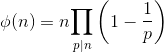
where pi is the prime factor of N.

For every prime factor i of N ( L <= n <= R), perform the following steps:
- Subtract all multiples of i from [1, N].
- Update N by repeatedly dividing it by i.
- If the reduced N is more than 1, then remove all multiples of N from result.
For the computation of the prime factors, use Sieve of Eratosthenes method. The probability in the given range will be count/(L - R + 1).
Below is the implementation of the above approach:
C++ `
// C++ Program to implement // the above approach #include <bits/stdc++.h> using namespace std; #define size 1000001
// Seieve of Erotosthenes // to compute all primes void seiveOfEratosthenes(int* prime) { prime[0] = 1, prime[1] = 0;
for (int i = 2; i * i < 1000001; i++) {

    // If prime
    if (prime[i] == 0) {
        for (int j = i * i; j < 1000001;
             j += i) {

            // Mark all its multiples
            // as non-prime
            prime[j] = 1;
        }
    }
}
}
// Function to find the probability of // Euler's Totient Function in a given range float probabiltyEuler(int* prime, int L, int R, int M) { int* arr = new int[size]{ 0 }; int* eulerTotient = new int[size]{ 0 }; int count = 0;
// Initializing two arrays
// with values from L to R
// for Euler's totient
for (int i = L; i <= R; i++) {

    // Indexing from 0
    eulerTotient[i - L] = i;
    arr[i - L] = i;
}

for (int i = 2; i < 1000001; i++) {

    // If the current number is prime
    if (prime[i] == 0) {

        // Checking if i is prime factor
        // of numbers in range L to R
        for (int j = (L / i) * i; j <= R;
             j += i) {

            if (j - L >= 0) {

                // Update all the numbers
                // which has prime factor i
                eulerTotient[j - L]
                    = eulerTotient[j - L]
                      / i * (i - 1);

                while (arr[j - L] % i == 0) {
                    arr[j - L] /= i;
                }
            }
        }
    }
}

// If number in range has a
// prime factor > sqrt(number)
for (int i = L; i <= R; i++) {
    if (arr[i - L] > 1) {
        eulerTotient[i - L]
            = (eulerTotient[i - L] / arr[i - L])
              * (arr[i - L] - 1);
    }
}

for (int i = L; i <= R; i++) {

    // Count those which are divisible by M
    if ((eulerTotient[i - L] % M) == 0) {
        count++;
    }
}

// Return the result
return (1.0 * count / (R + 1 - L));
}
// Driver Code int main() { int* prime = new int[size]{ 0 };
seiveOfEratosthenes(prime);

int L = 1, R = 7, M = 3;

cout << probabiltyEuler(prime, L, R, M);

return 0;
}
Java
// Java Program to implement // the above approach import java.util.*; class GFG{
static final int size = 1000001;
// Seieve of Erotosthenes // to compute all primes static void seiveOfEratosthenes(int []prime) { prime[0] = 1; prime[1] = 0;
for (int i = 2; i * i < 1000001; i++)
{

    // If prime
    if (prime[i] == 0)
    {
        for (int j = i * i; j < 1000001; j += i)
        {

            // Mark all its multiples
            // as non-prime
            prime[j] = 1;
        }
    }
}
}
// Function to find the probability of // Euler's Totient Function in a given range static float probabiltyEuler(int []prime, int L, int R, int M) { int[] arr = new int[size]; int []eulerTotient = new int[size]; int count = 0;
// Initializing two arrays
// with values from L to R
// for Euler's totient
for (int i = L; i <= R; i++)
{

    // Indexing from 0
    eulerTotient[i - L] = i;
    arr[i - L] = i;
}

for (int i = 2; i < 1000001; i++)
{

    // If the current number is prime
    if (prime[i] == 0)
    {

        // Checking if i is prime factor
        // of numbers in range L to R
        for (int j = (L / i) * i; j <= R; j += i)
        {
            if (j - L >= 0)
            {

                // Update all the numbers
                // which has prime factor i
                eulerTotient[j - L] = eulerTotient[j - L] /
                                                i * (i - 1);

                while (arr[j - L] % i == 0)
                {
                    arr[j - L] /= i;
                }
            }
        }
    }
}

// If number in range has a
// prime factor > Math.sqrt(number)
for (int i = L; i <= R; i++)
{
    if (arr[i - L] > 1)
    {
        eulerTotient[i - L] = (eulerTotient[i - L] / arr[i - L]) *
                                                      (arr[i - L] - 1);
    }
}

for (int i = L; i <= R; i++)
{

    // Count those which are divisible by M
    if ((eulerTotient[i - L] % M) == 0)
    {
        count++;
    }
}

// Return the result
return (float) (1.0 * count / (R + 1 - L));
}
// Driver Code public static void main(String[] args) { int []prime = new int[size];
seiveOfEratosthenes(prime);

int L = 1, R = 7, M = 3;

System.out.print(probabiltyEuler(prime, L, R, M));
} }
// This code is contributed by sapnasingh4991
Python3
Python3 program to implement
the above approach
size = 1000001
Seieve of Erotosthenes
to compute all primes
def seiveOfEratosthenes(prime):
prime[0] = 1
prime[1] = 0

i = 2
while(i * i < 1000001):

    # If prime
    if (prime[i] == 0):
        j = i * i

        while(j < 1000001):

            # Mark all its multiples
            # as non-prime
            prime[j] = 1
            j = j + i

    i += 1
Function to find the probability of
Euler's Totient Function in a given range
def probabiltyEuler(prime, L, R, M):
arr = [0] * size
eulerTotient = [0] * size
count = 0

# Initializing two arrays
# with values from L to R
# for Euler's totient
for i in range(L, R + 1):

    # Indexing from 0
    eulerTotient[i - L] = i
    arr[i - L] = i

for i in range(2, 1000001):

    # If the current number is prime
    if (prime[i] == 0):

        # Checking if i is prime factor
        # of numbers in range L to R
        for j in range((L // i) * i, R + 1, i):

            if (j - L >= 0):

                # Update all the numbers
                # which has prime factor i
                eulerTotient[j - L] = (eulerTotient[j - L] //
                                               i * (i - 1))

                while (arr[j - L] % i == 0):
                    arr[j - L] =  arr[j - L] // i

# If number in range has a
# prime factor > Math.sqrt(number)
for i in range(L, R + 1):
    if (arr[i - L] > 1):
        eulerTotient[i - L] = ((eulerTotient[i - L] //
                                         arr[i - L]) *
                                   (arr[i - L] - 1))

for i in range(L, R + 1):

    # Count those which are divisible by M
    if ((eulerTotient[i - L] % M) == 0):
        count += 1

# Return the result
return (float)(1.0 * count / (R + 1 - L))
Driver code
prime = [0] * size
seiveOfEratosthenes(prime)
L, R, M = 1, 7, 3
print(probabiltyEuler(prime, L, R, M))
This code is contributed by divyeshrabadiya07
C#
// C# Program to implement // the above approach using System; class GFG{
static readonly int size = 1000001;
// Seieve of Erotosthenes // to compute all primes static void seiveOfEratosthenes(int []prime) { prime[0] = 1; prime[1] = 0;
for (int i = 2; i * i < 1000001; i++)
{

    // If prime
    if (prime[i] == 0)
    {
        for (int j = i * i; j < 1000001; j += i)
        {

            // Mark all its multiples
            // as non-prime
            prime[j] = 1;
        }
    }
}
}
// Function to find the probability of // Euler's Totient Function in a given range static float probabiltyEuler(int []prime, int L, int R, int M) { int[] arr = new int[size]; int []eulerTotient = new int[size]; int count = 0;
// Initializing two arrays
// with values from L to R
// for Euler's totient
for (int i = L; i <= R; i++)
{

    // Indexing from 0
    eulerTotient[i - L] = i;
    arr[i - L] = i;
}

for (int i = 2; i < 1000001; i++)
{

    // If the current number is prime
    if (prime[i] == 0)
    {

        // Checking if i is prime factor
        // of numbers in range L to R
        for (int j = (L / i) * i; j <= R; j += i)
        {
            if (j - L >= 0)
            {

                // Update all the numbers
                // which has prime factor i
                eulerTotient[j - L] = eulerTotient[j - L] /
                                                   i * (i - 1);

                while (arr[j - L] % i == 0)
                {
                    arr[j - L] /= i;
                }
            }
        }
    }
}

// If number in range has a
// prime factor > Math.Sqrt(number)
for (int i = L; i <= R; i++)
{
    if (arr[i - L] > 1)
    {
        eulerTotient[i - L] = (eulerTotient[i - L] / arr[i - L]) *
                                                    (arr[i - L] - 1);
    }
}

for (int i = L; i <= R; i++)
{

    // Count those which are divisible by M
    if ((eulerTotient[i - L] % M) == 0)
    {
        count++;
    }
}

// Return the result
return (float) (1.0 * count / (R + 1 - L));
}
// Driver Code public static void Main(String[] args) { int []prime = new int[size];
seiveOfEratosthenes(prime);

int L = 1, R = 7, M = 3;

Console.Write(probabiltyEuler(prime, L, R, M));
} }
// This code is contributed by sapnasingh4991
JavaScript
`
Time Complexity : O(Nlog(N))
Auxiliary Space: O(size), where size denotes the number upto which Sieve is calculated.