Search an Element in Doubly Circular Linked List (original) (raw)
Last Updated : 11 Jul, 2025
Pre-requisite: Convert an Array to a Circular Doubly Linked List, Doubly Circular Linked List
Given a doubly circular linked list. The task is to find the position of an element in the list.
Image Representation:
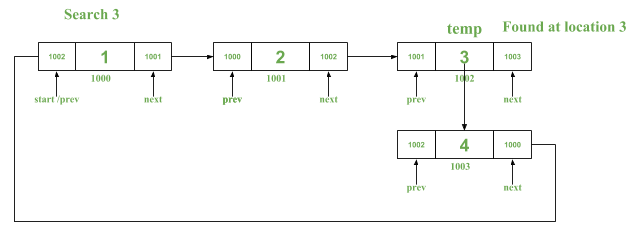
Algorithm:
- Declare a temp pointer, and initialize it to the head of the list.
- Iterate the loop until temp reaches the start address (last node in the list, as it is in a circular fashion), and check for the n element, whether present or not.
- If it is present, raise a flag, increment count, and break the loop.
- At the last, as the last node is not visited yet check for the n element if present does step 3.
The below program illustrates the above approach:
C++ `
// C++ program to illustrate inserting a Node in // a Circular Doubly Linked list in begging, end // and middle #include <bits/stdc++.h> using namespace std;
// Structure of a Node struct Node { int data; struct Node *next; struct Node *prev; };
// Function to insert a node at the end void insertNode(struct Node** start, int value) { // If the list is empty, create a single node // circular and doubly list if (start == NULL) { struct Node new_node = new Node; new_node->data = value; new_node->next = new_node->prev = new_node; *start = new_node; return; }
// If list is not empty

/* Find last node */
Node *last = (*start)->prev;

// Create Node dynamically
struct Node* new_node = new Node;
new_node->data = value;

// Start is going to be next of new_node
new_node->next = *start;

// Make new node previous of start
(*start)->prev = new_node;

// Make last previous of new node
new_node->prev = last;

// Make new node next of old last
last->next = new_node;
}
// Function to display the // circular doubly linked list void displayList(struct Node* start) { struct Node *temp = start;
while (temp->next != start)
{
    printf("%d ", temp->data);
    temp = temp->next;
}
printf("%d ", temp->data);
}
// Function to search the particular element // from the list int searchList(struct Node* start, int search) { // Declare the temp variable struct Node *temp = start;
// Declare other control
// variable for the searching
int count=0,flag=0,value;

// If start is NULL return -1
if(temp == NULL)
    return -1;
else
{
    // Move the temp pointer until,
    // temp->next doesn't move
    // start address (Circular Fashion)
    while(temp->next != start)
    {
        // Increment count for location
        count++;
        // If it is found raise the
        // flag and break the loop
        if(temp->data == search)
        {
            flag = 1;
            count--;
            break;
        }
        // Increment temp pointer
        temp = temp->next;
    }
    // Check whether last element in the
    // list content the value if contain,
    // raise a flag and increment count
    if(temp->data == search)
    {
        count++;
        flag = 1;
    }

    // If flag is true, then element
    // found, else not
    if(flag == 1)
        cout<<"\n"<<search <<" found at location "<<
                                        count<<endl;
    else
        cout<<"\n"<<search <<" not found"<<endl;
}
}
// Driver code int main() { /* Start with the empty list / struct Node start = NULL;
// Insert 4. So linked list becomes 4->NULL
insertNode(&start, 4);

// Insert 5. So linked list becomes 4->5
insertNode(&start, 5);

// Insert 7. So linked list
// becomes 4->5->7
insertNode(&start, 7);

// Insert 8. So linked list
// becomes 4->5->7->8
insertNode(&start, 8);

// Insert 6. So linked list
// becomes 4->5->7->8->6
insertNode(&start, 6);

printf("Created circular doubly linked list is: ");
displayList(start);

searchList(start, 5);

return 0;
}
Java
// Java program to illustrate inserting
// a Node in a Circular Doubly Linked list
// in begging, end and middle
class GFG
{
// Structure of a Node static class Node { int data; Node next; Node prev; };
// Function to insert a node at the end static Node insertNode(Node start, int value) { // If the list is empty, create a single node // circular and doubly list if (start == null) { Node new_node = new Node(); new_node.data = value; new_node.next = new_node.prev = new_node; start = new_node; return new_node; }
// If list is not empty

// Find last node /
Node last = (start).prev;

// Create Node dynamically
Node new_node = new Node();
new_node.data = value;

// Start is going to be next of new_node
new_node.next = start;

// Make new node previous of start
(start).prev = new_node;

// Make last previous of new node
new_node.prev = last;

// Make new node next of old last
last.next = new_node;

return start;
}
// Function to display the // circular doubly linked list static void displayList(Node start) { Node temp = start;
while (temp.next != start)
{
    System.out.printf("%d ", temp.data);
    temp = temp.next;
}
System.out.printf("%d ", temp.data);
}
// Function to search the particular element // from the list static int searchList(Node start, int search) { // Declare the temp variable Node temp = start;
// Declare other control
// variable for the searching
int count = 0, flag = 0, value;

// If start is null return -1
if(temp == null)
    return -1;
else
{
    // Move the temp pointer until,
    // temp.next doesn't move
    // start address (Circular Fashion)
    while(temp.next != start)
    {
        // Increment count for location
        count++;

        // If it is found raise the
        // flag and break the loop
        if(temp.data == search)
        {
            flag = 1;
            count--;
            break;
        }

        // Increment temp pointer
        temp = temp.next;
    }

    // Check whether last element in the
    // list content the value if contain,
    // raise a flag and increment count
    if(temp.data == search)
    {
        count++;
        flag = 1;
    }

    // If flag is true, then element
    // found, else not
    if(flag == 1)
        System.out.println("\n"+search +" found at location "+
                                        count);
    else
        System.out.println("\n"+search +" not found");
}
return -1;
}
// Driver code public static void main(String args[]) { // Start with the empty list / Node start = null;
// Insert 4. So linked list becomes 4.null
start= insertNode(start, 4);

// Insert 5. So linked list becomes 4.5
start= insertNode(start, 5);

// Insert 7. So linked list
// becomes 4.5.7
start= insertNode(start, 7);

// Insert 8. So linked list
// becomes 4.5.7.8
start= insertNode(start, 8);

// Insert 6. So linked list
// becomes 4.5.7.8.6
start= insertNode(start, 6);

System.out.printf("Created circular doubly linked list is: ");
displayList(start);

searchList(start, 5);
} }
// This code is contributed by Arnab Kundu
Python3
Python3 program to illustrate inserting a Node in
a Circular Doubly Linked list in begging, end
and middle
import math
Structure of a Node
class Node: def init(self, data): self.data = data self.next = None
Function to insert a node at the end
def insertNode(start, value):
# If the list is empty, create a single node
# circular and doubly list
if (start == None) :
    new_node = Node(value)
    new_node.data = value
    new_node.next = new_node
    new_node.prev = new_node
    start = new_node
    return new_node

# If list is not empty

# Find last node */
last = start.prev

# Create Node dynamically
new_node = Node(value)
new_node.data = value

# Start is going to be next of new_node
new_node.next = start

# Make new node previous of start
(start).prev = new_node

# Make last previous of new node
new_node.prev = last

# Make new node next of old last
last.next = new_node
return start
Function to display the
circular doubly linked list
def displayList(start): temp = start
while (temp.next != start):
    print(temp.data, end = " ")
    temp = temp.next

print(temp.data)
Function to search the particular element
from the list
def searchList(start, search):
# Declare the temp variable
temp = start

# Declare other control
# variable for the searching
count = 0
flag = 0
value = 0

# If start is None return -1
if(temp == None):
    return -1
else:

    # Move the temp pointer until,
    # temp.next doesn't move
    # start address (Circular Fashion)
    while(temp.next != start):

        # Increment count for location
        count = count + 1

        # If it is found raise the
        # flag and break the loop
        if(temp.data == search):
            flag = 1
            count = count - 1
            break

        # Increment temp pointer
        temp = temp.next

    # Check whether last element in the
    # list content the value if contain,
    # raise a flag and increment count
    if(temp.data == search):
        count = count + 1
        flag = 1

    # If flag is true, then element
    # found, else not
    if(flag == 1):
        print(search,"found at location ", count)
    else:
        print(search, " not found")

return -1
Driver code
if name=='main':
# Start with the empty list */
start = None

# Insert 4. So linked list becomes 4.None
start = insertNode(start, 4)

# Insert 5. So linked list becomes 4.5
start = insertNode(start, 5)

# Insert 7. So linked list
# becomes 4.5.7
start = insertNode(start, 7)

# Insert 8. So linked list
# becomes 4.5.7.8
start = insertNode(start, 8)

# Insert 6. So linked list
# becomes 4.5.7.8.6
start = insertNode(start, 6)

print("Created circular doubly linked list is: ",
                                        end = "")
displayList(start)

searchList(start, 5)
This article contributed by Srathore
C#
// C# Program to Reverse a List using Data Swapping using System;
class GFG {
// Structure of a Node
public class Node
{
    public int data;
    public Node next;
    public Node prev;
};

// Function to insert a node at the end
static Node insertNode(Node start, int value)
{
    // If the list is empty, create a single node
    // circular and doubly list
    Node new_node = new Node();
    if (start == null)
    {

        new_node.data = value;
        new_node.next = new_node.prev = new_node;
        start = new_node;
        return new_node;
    }

    // If list is not empty

    // Find last node /
    Node last = (start).prev;

    // Create Node dynamically
    new_node = new Node();
    new_node.data = value;

    // Start is going to be next of new_node
    new_node.next = start;

    // Make new node previous of start
    (start).prev = new_node;

    // Make last previous of new node
    new_node.prev = last;

    // Make new node next of old last
    last.next = new_node;

    return start;
}

// Function to display the
// circular doubly linked list
static void displayList(Node start)
{
    Node temp = start;

    while (temp.next != start)
    {
        Console.Write("{0} ", temp.data);
        temp = temp.next;
    }
    Console.Write("{0} ", temp.data);
}

// Function to search the particular element
// from the list
static int searchList(Node start, int search)
{
    // Declare the temp variable
    Node temp = start;

    // Declare other control
    // variable for the searching
    int count = 0, flag = 0, value;

    // If start is null return -1
    if(temp == null)
        return -1;
    else
    {
        // Move the temp pointer until,
        // temp.next doesn't move
        // start address (Circular Fashion)
        while(temp.next != start)
        {
            // Increment count for location
            count++;

            // If it is found raise the
            // flag and break the loop
            if(temp.data == search)
            {
                flag = 1;
                count--;
                break;
            }

            // Increment temp pointer
            temp = temp.next;
        }

        // Check whether last element in the
        // list content the value if contain,
        // raise a flag and increment count
        if(temp.data == search)
        {
            count++;
            flag = 1;
        }

        // If flag is true, then element
        // found, else not
        if(flag == 1)
            Console.WriteLine("\n"+search +" found at location "+
                                            count);
        else
            Console.WriteLine("\n"+search +" not found");
    }
    return -1;
}

// Driver code
public static void Main(String []args)
{
    // Start with the empty list /
    Node start = null;

    // Insert 4. So linked list becomes 4.null
    start= insertNode(start, 4);

    // Insert 5. So linked list becomes 4.5
    start= insertNode(start, 5);

    // Insert 7. So linked list
    // becomes 4.5.7
    start= insertNode(start, 7);

    // Insert 8. So linked list
    // becomes 4.5.7.8
    start= insertNode(start, 8);

    // Insert 6. So linked list
    // becomes 4.5.7.8.6
    start= insertNode(start, 6);

    Console.Write("Created circular doubly linked list is: ");
    displayList(start);

    searchList(start, 5);
}
}
// This code has been contributed by 29AjayKumar
JavaScript
`
Output:
Created circular doubly linked list is: 4 5 7 8 6 5 found at location 2
Time Complexity: O(n), as we are using a loop to traverse n times. Where n is the number of nodes in the linked list.
Auxiliary Space: O(1), as we are not using any extra space.