Periodic Signals (original) (raw)
Last Updated : 23 Jul, 2025
Periodic signals are a type of electrical signals which repeat their behavior after a certain interval of time known as time period. It is also know as a cyclic function and the part of function which repeats is called a cycle. For example, a sine wave, in which the signal has a unique behavior from t=0s to t=2π s .After this we observe that the waveform begins to repeat . This means that sine wave is a periodic signal with a time period of 2π seconds.
Periodic Signal Graph
If we plot the graph representing the magnitude of periodic signal with time ,the graph of periodic signal looks like this:

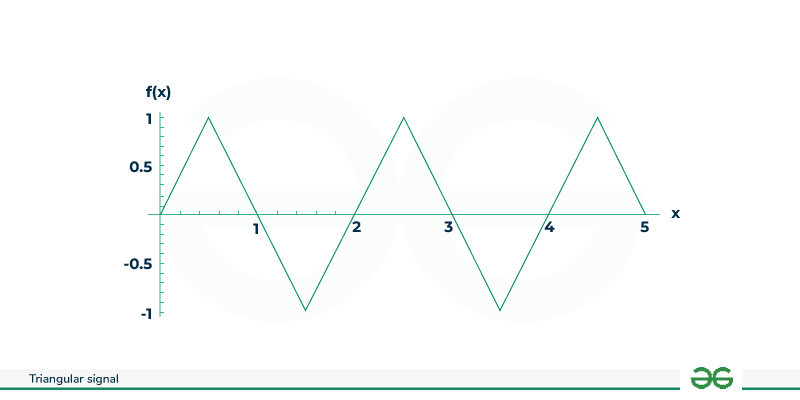
Triangular Waves
As we observe, we can see that a triangular signal is an example of a periodic signal. We see that the signal repeats after a fixed interval of time i.e after T seconds hence it is a periodic signal.
If we carefully observe the shape of graph we see that the graph shows a unique behaviour for first T seconds . It rises linearly for the first half of the cycle and then decreases linearly for another half of the cycle. After this interval a cycle is completed and the graph begins repeating its behaviour in cycles of T seconds.
Fourier Series
It is important to study about general formulas of Fourier series before expressing a periodic signal using Fourier series.
Fourier Series is an expansion of periodic signal in terms of infinite sums of sines and cosines.
The Fourier Series summation is used to represent any period function . All real periodic signals satisfy the Dirichlet conditions and can be represented by an infinite trigonometric .The general representation is
A periodic signal can be represented using Trigonometric Fourier Series as
s(t)= a0/2+ ∑(ancos(ωn.t)+ bnsin(ωn.t)) where an,bn are Fourier coefficients and can be derived using
- an= 2/T ∫ s(t) .cos(ωnt) ????t
- bn= 2/T ∫ s(t) .sin(ωnt) ????t
- a0= 2/T ∫ s(t) .????t
The angular frequency can be written as
ωn=Δωn=( 2????/T).n
Mathematical Expression of Periodic Signal
Let there be a periodic signal y(t) of continuous time t , which repeats with a period T seconds. It means that the value of signal after a time interval which is multiple of time period T will be same as the value of signal at time t.
Then we can say,
y(t+nT)= y(t)
where n is an arbitrary integer
This representation of periodic signals helps us to calculate and plot and measure certain important parameters related to the signal.
Signal Analysis
Signal analysis involves studying the property of signal to extract useful information from it. This generally involves understanding their frequency content, amplitude, phase, and other characteristics.
Let's understand this through example. Consider the signal below and its analysis
y(t)= A cos(2π.f.t+π/4)
where:
- A is the amplitude,
- f is the frequency in Hertz (Hz),
- t is time, and
- ϕ is the phase angle.
**Frequency Analysis
Frequency is used to tell the number of cycles a signal completes in one second.
In case the frequency of signal is 1 Hz the above signal becomes
y(t)= A cos(2π.t+π/4)
The relation between time period and frequency is
T=1/f
**Amplitude Analysis
Since amplitude is the maximum displacement from origin, Amplitude of this signal is A
**Phase Analysis
ϕ is used to represent the starting phase of the signal a time t=0.
In this signal ϕ= π/4 meaning signal starts with an initial phase of π/4
**Fourier Analysis
To represent the signal in frequency domain, we will do a Fourier analysis.
For a sine signal
X(f)= 1/2j × [ δ(f−1) − δ(f+1)]
Here, X(f) is Fourier transform and δ is dirac-delta function
Types of Periodic Signals
There are various types of periodic signals, each having a different graphical representation:
- Sinusoidal Wave
- Square Wave
- Triangular Wave
- Sawtooth Wave
**Sinusoidal Wave
It is a type of waveform which repeats after constant interval of time and has shape in the form of sine wave as shown below. It is the most common signal used in communication circuits of electronic industry.

Sinusoidal Wave
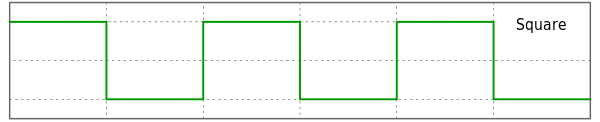
**Square Wave
It is a type of waveform which repeats after constant interval of time and has shape in the form of uniform squares as shown below. It is the most common signal used in design and analysis circuits of electronic industry.
**Triangular Wave
It is a type of waveform which repeats after constant interval of time and has shape in the form of uniform triangles as shown below. It is the most common signal used in DC-CD convertor circuits of electronic industry.
Triangular Wave
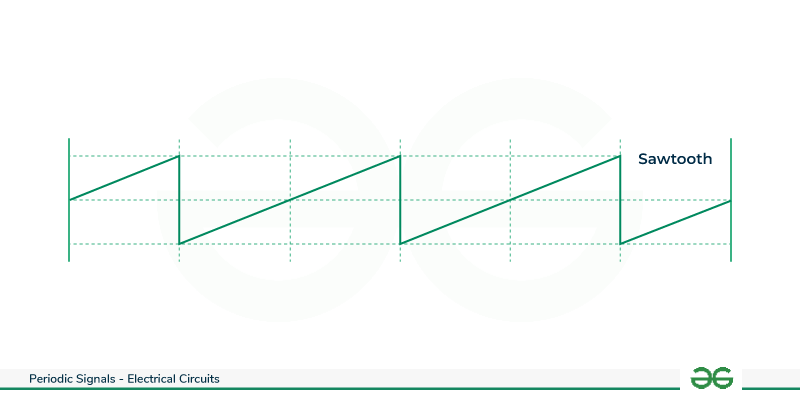
**Sawtooth Wave
It is a type of waveform which repeats after constant interval of time and has shape in the form of a sawtooth. It is the most common signal used to create sounds with subtractive analog and virtual analog music synthesizers.
Sawtooth-Wave
Difference Between Periodic Signal and Non Periodic Signal
The difference between period and aperiodic signals:
| Periodic Signal | Non-periodic Signals |
|---|---|
| They have a definite pattern | They have an indefinite pattern |
| They repeat after a certain interval of time | They don't repeat after a certain interval of time |
| They have discrete and harmonically related frequency | They can have a continuous and non-harmonic frequency |
| They can be mathematically represented using Fourier Series | It is not possible to represent them through Fourier series due to lack of periodicity |
| This include sine waves or regular rectangular pulses | This include random signals arising from unpredictable disturbances of all kinds. |
Properties of Periodic Signal
Here are some properties of periodic signal:
- One important property of periodic signals is their periodicity .Periodic signals have this property since they show a repeating pattern after a constant interval of time called Time period.
- Another important property if Periodic Signals is Amplitude of periodic signals. It is the maximum absolute value of the signal. which represents magnitude or strength of the signal.
- We can define Frequency of periodic signals as number of cycles per unit time. It is the reciprocal of time period and is denoted in Hertz.
- Orientation or shape or form of a periodic signal is another important property. Common periodic waveforms include sine waves, square waves, sawtooth waves, and triangular waves.
Advantages of Periodic Signals
The advantages of periodic signals are stated below:
- Periodic signals are bandwidth-efficient as compared to non-periodic signals. Frequency modulated and Amplitude modulated signals generally use periodic signals due to their low bandwidth requirement.
- It is easier to analyse periodic signals over aperiodic signals due to their easier mathematical representation. Tools like Fourier series can be easily used for dealing with periodic signals.
- Periodic signals are efficiently transferred as compared to aperiodic signals. Due to their repetitive nature , simple modulation techniques can be used for transmission and storage of information.
Disadvantages of Periodic Signals
The limitations of periodic signal are stated below:
- These signals become complex in case of non-linear systems where we can't apply normal and simple techniques associated with periodic signals.
- Periodic signals lack the application in real-life world since most signals in everyday life are not periodic rather they have some irregularities and have non-repeating behaviour in their patterns.
- Periodic signals are sensitive to noise . This means that addition of noise might disrupt the original wave affection the accuracy and transmission of the signals.
Applications of Periodic Signals
Periodic signal is used in various applications like:
- Periodic signals are abundantly used in communication system. Signals like sine wave are fundamental signals used in various modulation techniques.
- Periodic signals are widely used in audio processing. This is because musical notes, speech signals have to exhibit periodic properties.
- Periodic signals are used in control theory where systems are often modelled and analysed using sine signals.
- Periodic signals are essentially used in signal processing. Periodic signals are analyse using tools like Fourier series to understand various signals.
Solved Examples
**Find the Fundamental Frequency of signal v(t)=30sin(100t)+10cos(300t)+6sin(500t+????/4)
We have : ω1=100rads ω2=300rads ω3=500rads
The respective time periods are
T1= 2π/100 T2=2π/300 T3=2π/500
So the fundamental time period(T)= L.C.M( T1,T2,T3)
On calculating T=2π/100
So fundamental Frequency= 2π/T= 100 rad/s
Conclusion
As we have seen that periodic signals play an important role in modern electronics. We have already discussed the cyclic nature of these signals along with other properties. As we discuss the uses of this signal we realize it is used in modulating signals and as an input signal to various circuits in communication system for various purposes. These applications signify the need to find appropriate methods to generate periodic signals. There are different methods to generate these signals and they have been stated to the readers. There are various examples of periodic signals each used for a different use.