Introduction to Waves (original) (raw)
Last Updated : 23 Feb, 2026
A wave is a disturbance in a medium that transports energy without causing net particle movement. Elastic deformation, pressure variations, electric or magnetic intensity, electric potential, or temperature variations are all examples.
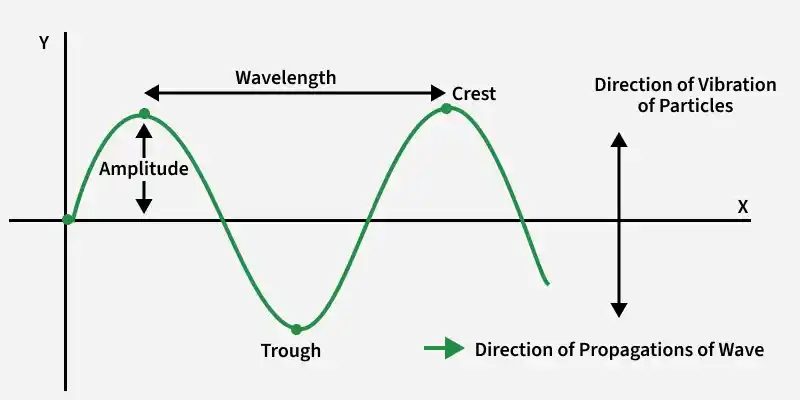
Key Characteristics
- The particles of the medium vibrate about their mean positions and are not permanently displaced in the direction of wave propagation.
- Each successive particle of the medium executes a motion similar to that of the preceding particle, either parallel or perpendicular to the direction of wave travel.
- During wave motion, only energy is transferred, but not a piece of the medium.
- The particles of the medium do not move along with the wave; they simply vibrate around their normal positions as the wave passes and carries energy forward.
Types of Waves
1. Transverse Waves:
Transverse waves are those in which the medium moves at an angle to the direction of the wave.
Examples: Water waves (ripples of gravity waves, not sound through water), Light waves, S-wave earthquake waves, Stringed instruments, torsion waves
The highest point of a transverse wave is called a crest, while the lowest point is called a trough.
2. Longitudinal Wave:
The movement of the particles in the medium in a longitudinal wave is in the same dimension as the wave's movement direction.
Examples: Sound waves, P-type earthquake waves, compression waves
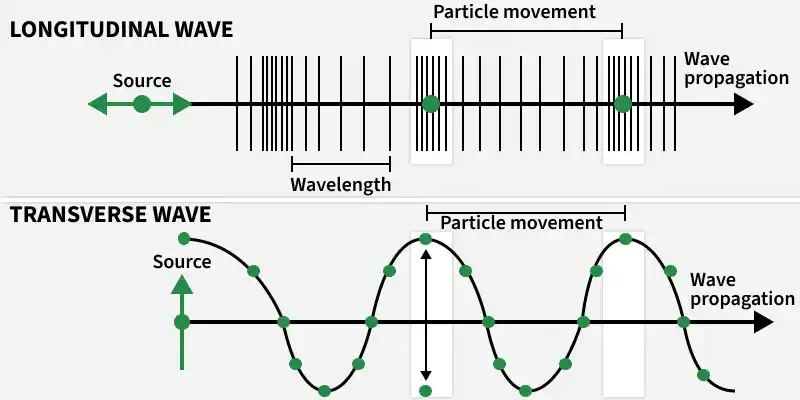
Parts of longitudinal waves:
- __Compression-_The particles are close together in this case.
- __Rarefaction-_Where the particles are dispersed
3. Electromagnetic Waves:
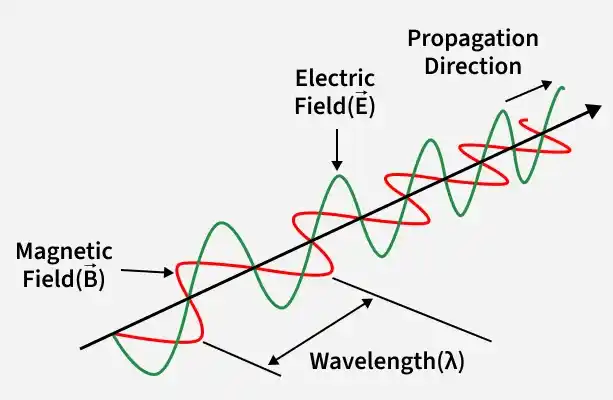
These are waves that are produced and propagated without the use of a material medium, i.e., they can pass through a vacuum and any other material medium. Examples: visible light, ultra-violet light, radio waves, microwaves
4. Mechanical waves:
Only a material medium can produce or propagate mechanical waves. Newton's equations of motion apply to these waves. Examples: waves on water surface, waves on strings, sound waves
Mechanical waves are of two types:
- **Transverse wave motion: The particles of the medium vibrate at right angles to the wave's propagation direction in transverse waves. Transverse waves include string waves, surface water waves, and electromagnetic waves. The disturbance that travels in electromagnetic waves (which include light waves) is caused by the oscillation of electric and magnetic fields at right angles to the wave's travel direction.
- **Longitudinal wave motion— Particles in the medium vibrate back and forth around their mean location along the energy propagation direction in these sorts of waves. They're also known as pressure waves. Longitudinal mechanical waves are sound waves.
5. Matter waves:
These waves are linked to the movement of matter particles. Examples: electrons, protons, neutrons.
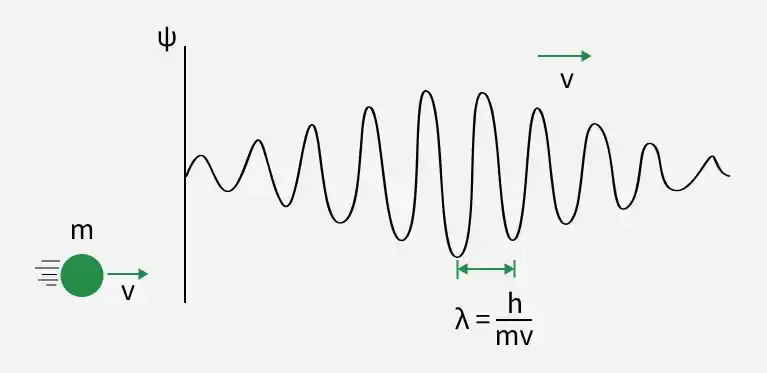
Matter Wave
**Read- Types of Waves
Formula for Speed of Wave
It's the entire distance a wave travels in a particular amount of time. The formula for calculating wave speed is as follows:
\text{Wave Speed} = \frac{\text{Distance Covered}}{\text{Time Taken}}
Properties of Waves
The following are the primary characteristics of waves:
- **Amplitude: A wave is a form of energy transmission. The amplitude of a wave is its height, which is commonly measured in meters. It is proportional to the quantity of energy transported by a wave.
- **Wavelength: A wavelength is the distance between identical locations in adjacent cycles of thebsdk
- crests of a wave. In addition, it is measured in meters.
- **Period: A wave's period is the amount of time it takes a particle on a medium to complete one complete vibrational cycle. Because the period is a unit of time, it is measured in seconds or minutes.
- **Frequency: The number of waves passing a spot in a certain amount of time is referred to as the frequency of a wave. The hertz (Hz) unit of frequency measures one wave every second.
The frequency's reciprocal is the period, and vice versa.
Period=1 / Frequency
OR
Frequency = 1 / Period
- **Speed—The speed of an object refers to how quickly it moves and is usually stated as the distance traveled divided by the time it takes to travel. The distance traveled by a specific point on the wave (crest) in a given amount of time is referred to as the wave's speed. A wave's speed is thus measured in meters per second, or m/s.
**Check: Properties of Waves
Wave Behaviour
**Reflection****:** Reflection occurs when a wave strikes a barrier and bounces back into the same medium. The angle of incidence is equal to the angle of reflection. **Example: sound waves reflecting from a wall produce an echo, and light waves reflecting from a mirror form images.
**Refraction: Refraction is the bending of a wave when it passes from one medium to another due to a change in its speed. The amount of bending depends on the difference in wave speeds in the two media. This is why a straw appears bent in water and why light bends while entering the Earth’s atmosphere.
**Diffraction: Diffraction is the bending and spreading of waves around obstacles or through narrow openings. This explains why sound waves can bend around corners and why light spreads out after passing through a narrow slit.
**Interference: Interference occurs when two or more waves overlap. When crests meet crests, constructive interference occurs, increasing amplitude. When a crest meets a trough, destructive interference occurs, reducing or cancelling the wave.
Standing Wave
- Standing waves result from the interference of two waves traveling in opposite directions with the same frequency and amplitude.
- Instead of propagating, the energy of these waves becomes confined within a specific region, forming a stationary pattern of oscillation.
- Standing waves have points of minimal displacement called nodes and points of maximal displacement called antinodes.
- They are observed in various physical systems, including vibrating strings, acoustic resonance in pipes, and electromagnetic waves in transmission lines.
- Standing waves play a crucial role in phenomena such as musical instrument vibrations, sound resonance, and the behavior of electromagnetic waves in antennas.
**Related Article:
Solved Problems
**Problem 1: In a specific medium, a wave travels at 900 meters per second. Calculate the wavelength of a specific point in the medium if 3000 waves pass through it in 2 minutes.
**Solution: The speed of a wave in medium v = 900 ms-1
Freq. of wave = no. of waves passing per sec (n) = 3000 waves/2 min = 3000 / 2 × 60 = 25 s
Wave length (λ) = ?
v = n × (λ)
λ = v/n
= 900/25
= 36 m
**Problem 2: The bottom of a ship in the sea shoots SONAR waves straight down into the saltwater. After 3.5 s, the signal reflects off the deep bottom bedrock and returns to the ship. When the ship reaches 100 km, it transmits another signal, which is received after 2 s. Calculate the depth of the sea in each example, as well as the height difference between the two.
**Solution: Velocity of SONAR waves in water C = 1500 ms-1
Time taken by be wave after reflection from the bottom of sea
2t = 3.5s
t =1.75s
Distance covered (d) = ?
C = d/t => d = c.t = 1500 × 1.75 - 2625 m
After moving 100km
The time taken by the wave = 2t = 2s
T = 2/2 = 1s
d =?
d = 1500 × l
= 1500
The difference between these two heights = 2625 - 1500
= 1125m
**Question 3: A SONAR pulse is sent vertically downward in seawater at a speed of 1500 m/s. The echo is received after 4 seconds. Find the depth of the sea.
**Solution: Total time = 4 s
Time for one way
t = \frac{4}{2} = 2s
Depth
d = v × t = 1500 × 2 = 3000 m
Unsolved Problems
**Question 1: A wave travels with a speed of 500 m/s and has a frequency of 250 Hz. Find its wavelength.
**Question 2: A wave produces 1800 vibrations in 30 seconds. Calculate its frequency and time period.
**Question 3: A wave has a wavelength of 2 m and a frequency of 400 Hz. Find the wave speed.
**Question 4: A sound wave travels 1200 m in 4 seconds. Calculate the speed of the wave. If its frequency is 300 Hz, find its wavelength.
**Question 5: A SONAR signal is sent from a ship, and the echo is received after 3 seconds. If the speed of sound in seawater is 1500 m/s, find the depth of the sea.