Effects of Feedback in Control System (original) (raw)
Last Updated : 11 Mar, 2026
Feedback is an important concept in electronics and electrical engineering. It is used to reduce the error between the reference input and the system output. The reduction of system error is merely one of the many important effects that feedback may have on a system. Feedback also affects the performance of features such as security, bandwidth, gain, impact, and sensitivity. Feedback plays an important role in improving the performance of the control systems.
Feedback in a Control System
Feedback is an important concept in engineering management and plays an important role in monitoring and controlling desired behaviour in many processes and devices. Feedback is a process of collecting information about the system output and using this information to adjust the output, thus creating a closed-loop control system. This loop provides continuous monitoring and control to ensure the system operates within limits and achieves its intended objectives.
Components of Feedback
- **Reference Input /Command Input: The input applied to the whole system is called the Reference input.
- **Input: This input process transforms the form of the input into the form utilized by the controller.
- **Output: This measures the response of the output and transforms it into the form used by the controller.
- **Feedback Path: It is the return way to the summing intersection from the output response. It comprises of a feedback component which gives back the output response to the error detector.
- **Error Detector: The error detector obtains the calculated signal from the output response and compares it with the reference input. It gives the error signal by the difference of two signals, also known as the actuating signal.
- **Controller: It controls the output response depending on the signal received from the error detector.
The return of the output or part of the output to the input side and being used as part of the input to the system is called feedback. Feedback plays an important role in order to improve the performance of the control system.
Types Of Feedback
- Positive Feedback.
- Negative Feedback.
Positive Feedback
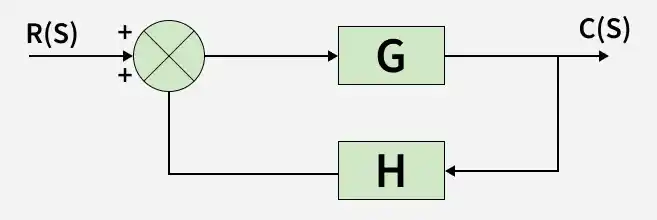
Positive Feedback
Evaluate changes to the feedback control system accordingly.
T = \frac{G}{1 - GH}
Where,
- T represents the transfer function or the overall gain of positive feedback control systems.
- G represents the open-loop gain, which is a function of frequency.
- H represents the gain of the feedback path, which is a function of frequency.
Negative Feedback
Negative feedback reduces the error between the input data R(s) and the output. Given block diagram shows the negative feedback control systems.
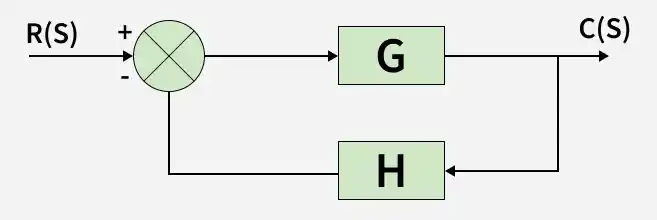
Negative Feedback
Consider the transfer function of Negative Feedback Control System is :
T = \frac{G}{1 + GH}
Where,
- T is the transfer function or overall gain of positive feedback control systems.
- G is the open loop gain, which is function of frequency.
- H is the gain of feedback path which is function of frequency.
Effects of Feedback in Control System
Feedback in a control system helps ensure that the system operates according to the desired objective. The output is continuously compared with the reference or expected output, and any difference between them is used to adjust the system. Through this process, errors can be corrected, disturbances can be compensated, and system stability can be maintained. Feedback also improves the accuracy, reliability, and overall performance of the system. As a result, feedback becomes an essential element for the effective and efficient operation of control systems.
Effects of Feedback in Control System is measured by the factors like :
- Gain
- Stability
- Sensitivity
- Noise
1. Effect of Feedback on Overall Gain
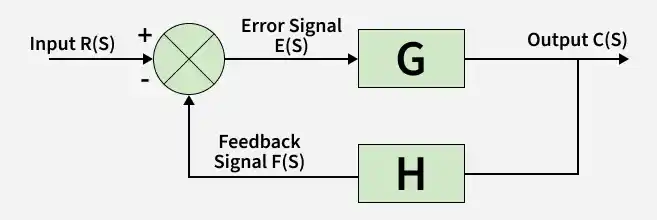
Effect of Feedback on Overall Gain
Feedback affects the Gain G of a non-feedback system by a factor \frac{1}{1 + GH}. The system is said to have negative feedback, since a disadvantage sign is assigned to the feedback signal. The volume GH may itself include a negative feedback, since a disadvantage sign is assigned to the feedback signal. The volume GH may itself include a negative sign, so the general effect of feedback is that it may increase or drop the gain. In a practical control system, G and H are functions of frequency, so the magnitude of( 1 GH) may be lesser than 1 in one frequency range but lower than 1 in another. thus, feedback could increase the system gain in one frequency range but drop it in another. So Transfer Function with Feedback is
T(s) = \frac{C(s)}{R(s)} = \frac{G}{1 + GH}
So Effect can be studied from Transfer Function
- If H is adding also 1 + GH will get increase so Transfer Function will drop.
- If H is dwindling also 1 + GH will get drop so Transfer Function will increase.
- So by changing H, we can change Transfer Function.
2. Effect of Feedback on Stability
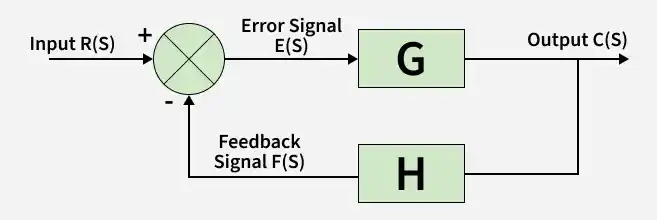
Effect of Feedback on Stability
A system is said to be stable, if its output is under control, Otherwise it is said to be unstable.
Stability describes the ability of a system to operate in a controlled and predictable manner. A stable system produces a bounded output for a given bounded input and continues to follow the desired command without diverging over time. In simple terms, when system behaviour becomes uncontrollable or the output grows without limit, the system is considered unstable.
Equation:
M = \frac{G}{1 + GH}
If GH = -1 the output of the system is infinite for any finite input and the system is said to be unstable.
3. Effect of Feedback on Sensitivity
Effect of Feedback on Sensitivity
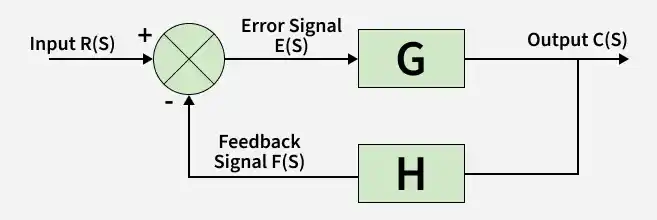
Sensitivity often are important in the design of control systems. Generally speaking, a good control system should be responsive to changes, but also responsive to commands. Let us investigate what effect of feedback has on the sensitivity to parameter variations.
So the Transfer Function with feedback is:
T(s) = \frac{C(s)}{R(s)} = \frac{G}{1 + GH}
Sensitivity is defined as percentage change in transfer function to percentage change in gain of the system.
S = \frac{\% \Delta T(s)}{\% \Delta G(s)}
Here,
- T(s) is Transfer Function of the system
- G(s) is Gain of the system
S^T_G = \frac{\frac{dT}{T} \times 100}{\frac{dG}{G} \times 100}
S^T_G = \frac{dT}{dG} \cdot \frac{G}{T}
Sensitivity is defined as change in output w.r.t input whereas in terms of function it as defined as change in transfer function w.r.t to change in gain of the system.
So effect can be studied from Transfer Function
- If H is increasing then (1+GH) will get increase so sensitivity(S) will decrease.
- If H is decreasing then (1+GH) will get decrease so sensitivity(S) will increase.
- So Sensitivity and feedback gain is reciprocal to each other.
4. Effect of Feedback on Noise
Effect of Feedback on Noise
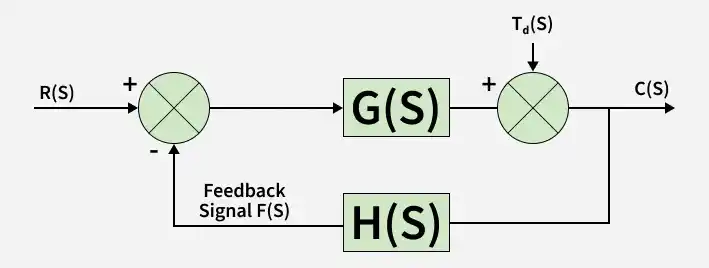
Feedback reduces the impact of noise and affects physical activity.
In general, Feedback also has effects on performance parameters such as bandwidth, impedance, transient response and frequency response,
- Increases accuracy
- Increases the bandwidth
- Stabilizes the unstable system
\frac{C(s)}{T_d(s)} = \frac{1}{G(s) \cdot H(s)}
C(s) = \frac{T_d(s)}{G(s)H(s)}
where,
C(s) is the system output
R(s) is the reference input
G(s) is the open-loop gain of the system
H(s) is the feedback of the system
Td(s) is the External noise or disturbance
Now, we can realize the effect of Td(s) on output,
- To decrease the effect of T_d(s) on output.
- Increase G(s) \cdot H(s) or Increase G(s) or Increase H(s).
Advantages
- Many unwanted distractions and noise from outside can be stopped.
- System performance changes due to mitigation.
- The regular error of the system may be small.
- The transient behavior of the process can be easily manipulated.
- Compare the feedback to the situation that needs to be fixed.
Disadvantages
- The system is complicated by the increased number of components, such as sensors and errors detectors.
- The overall gain of the system is reduced and must be compensated for in the design.
- All improvements to the system are discounted and must be paid for at the time of construction.
- The system may not be stable (it may oscillate or depart greatly from the desired output), even through the comparable open-loop system is stable.
- There must be an error parameter to compare two cases.
- If there is change in an output, it will affect the system input.
Applications of Effects of Feedback in Control System
- **Manufacturing and Production Processes: For Manufacturing and production processes, Control systems are utilized to enhance production processes in factories and other manufacturing facilities.
- **Building and Home Automation: For Automation, Control systems are utilized to manage numerous systems in buildings, such as lighting, air conditioning, and security.
- **Transportation Systems: Control systems are utilized to manage numerous features of transportation systems, such as control systems such as traffic ,railway and aircraft signaling.
- **Power Generation and Distribution: Control systems are utilized to track and manage power generation and distribution systems, such as power plants control system and electric grids control system.
- **Medical Equipment: Control systems are utilized to self-operate and manage numerous varieties of medical equipment, such as control system with dialysis machines, and X-ray machines.
- **Agricultural and Farming: Control systems are utilized to self-operate and improve numerous farming and agricultural processes, such as fertilization, and crop harvesting.
- **Military and Defense Systems: Control systems are utilized to self-operate and control numerous military and defense systems, such as missile defense systems, drones, etc.
- **Robotics: Control systems are utilized to design, manage, and control the motion and behavior of robots.