Introduction to 8051 Microcontroller (original) (raw)
Last Updated : 15 Jul, 2025
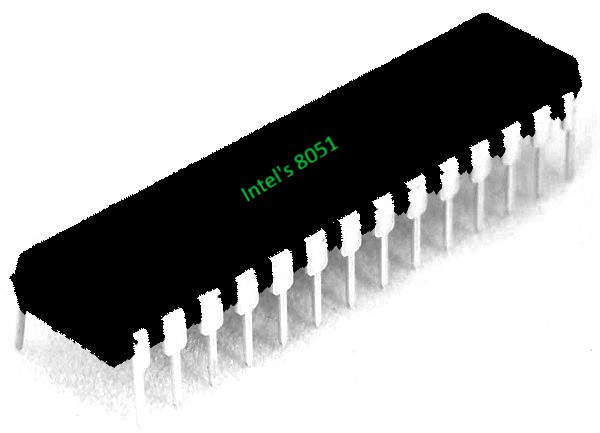
8051 is one of the first and most popular microcontrollers also known as MCS-51. Intel introduced it in the year 1981. Initially, it came out as an N-type metal-oxide-semiconductor (NMOS) based microcontroller, but later versions were based on complementary metal-oxide-semiconductor(CMOS) technology. These microcontrollers were named 80C51, where C in the name tells that it is based on CMOS technology. It is an 8-bit microcontroller which means the data bus is 8-bit. Therefore, it can process 8 bits at a time. It is used in a wide variety of embedded systems like robotics, remote controls, the automotive industry, telecom applications, power tools, etc.
 **System on a Chip
It is referred to as a System on a Chip (SoC) microcontroller because it is a chip circuit/integrated circuit that holds many components of a computer together on a single chip. These components include a CPU, memory, input-output ports(I/O ports), timers, and secondary storage.
**Features of 8051 Microcontroller
There are some key features of 8051 that work as a foundation for students to learn microcontrollers.
8051 μc family member -
8051 μc have some family members 8052 microcontroller & 8031 microcontroller. **8052μc has 8K bytes of on-chip program ROM instead of 4K bytes, and 128 bytes of RAM. and **8031μc has 0K bytes of on-chip program ROM, and 128 bytes of RAM.
Block Diagram of 8051 μc
**1. Oscillator and Timing
Oscillator: This circuit provides the microcontroller with a clock signal. All of the microcontroller's actions are synchronized by means of the clock signal.
Timing: In order to control the timing of activities within the microcontroller and guarantee that each instruction is performed at the appropriate moment, the timing circuit collaborates with the oscillator.
**2. 4096 Byte Program Memory
Program Memory (ROM): The program code is kept in this type of non-volatile memory. Typically, the on-chip ROM of an 8051 microcontroller is 4KB (4096 bytes).
**3. 128 Byte RAM
While the microcontroller is in operation, temporary data is stored in Random Access Memory (RAM), a form of volatile memory. The 8051 has 128 bytes of inbuilt RAM.
**4. Two 16-bit Timers
Timers: Timer 0 and Timer 1 are the two 16-bit timers on the 8051. These clocks may be used for counting events, monitoring time intervals, and creating time delays, among other things.
**5. 64 Byte Bus Expansion Control
The microcontroller may interact with external memory or peripherals thanks to bus expansion control. It facilitates the extension of control signals for external devices and the accessible memory area.
**6. Programmable I/O
Programmable Input/Output Ports: The four I/O ports (Ports 0 through 3) of the 8051 microcontroller may be configured to carry out a range of input and output operations.
**7. Programmable Serial Port
Serial Port (UART): Serial communication is made possible via the Universal Asynchronous Receiver/Transmitter (UART). It can send and receive data concurrently while operating in full duplex mode.
**8. Synchronous Shifter
Data is shifted in and out of the microcontroller in synchrony using a synchronous shifter. It is frequently employed in communication protocols when exact time is necessary.
**9. 8051 CPU
Central Processing Unit (CPU): The microcontroller's central processing unit (CPU) is responsible for carrying out instructions read from program memory. It controls the other parts, handles data flow inside the microcontroller, and executes arithmetic and logic operations.
Together, these parts provide the 8051 microcontroller its versatility and strength as an embedded system application tool.
Block Diagram of 8051 μc -

Block-Structure Diagram
Application of 8051 Microcontroller
- **Automation: The 8051 microcontroller is widely used in automotive applications.
They are widely used in hybrid vehicles to control engine options. In addition, functions such as cruise control and anti-brake mechanism have been further enhanced thanks to the integration of a microcontroller. - **Medical Devices: Convenient medical devices such as blood glucose and blood pressure monitors contain microcontrollers that display measurements.
- **Energy management: Competent measurement systems support energy consumption calculations in home and industrial environments. These measuring systems are prepared by integrating a microcontroller.
- **Touch Screen: Many microcontroller vendors incorporate touch functionality into their designs. Portable devices such as media players, and gaming devices.
**Uses of 8051 Microcontroller :
Here are some of the most common uses of the 8051 microcontroller:
- **Embedded Systems: The 8051 microcontroller is commonly used in embedded systems, such as home automation systems, security systems, and industrial control systems. Its low cost, small size, and ease of programming make it an ideal choice for these applications.
- **Automotive Systems: The 8051 microcontroller is used in automotive systems, such as engine control units, anti-lock braking systems, and airbag systems, to control various functions and ensure safe and efficient operation.
- **Robotics: The 8051 microcontroller is used in robotics applications to control the movement and operation of robots. It is commonly used to control the motors, sensors, and other peripherals of the robot.
- **Consumer Electronics: The 8051 microcontroller is used in a variety of consumer electronics products, such as digital cameras, gaming systems, and audio players. It is commonly used to control the user interface, display, and other peripherals of these devices.
- **Communication Systems: The 8051 microcontroller is used in communication systems, such as modems, routers, and switches, to control the data transfer and communication protocols.
- **Medical Devices: The 8051 microcontroller is used in medical devices, such as insulin pumps, heart monitors, and blood glucose meters, to control various functions and provide accurate and reliable results.
- **Industrial Control Systems: The 8051 microcontroller is used in industrial control systems, such as process control systems and manufacturing equipment, to control and monitor various processes and operations.
**Issues in 8051 Microcontroller
Here are some of the common issues in the 8051 microcontroller:
- **Limited Memory: The 8051 microcontroller has limited program memory and data memory. The program memory is typically 4 KB or 8 KB, and the data memory is typically 128 bytes or 256 bytes. This limitation can be an issue when developing complex applications that require more memory.
- **Limited Processing Power: The 8051 microcontroller has limited processing power compared to modern microcontrollers. Its clock speed is typically between 12 MHz and 24 MHz, and its instruction set is limited. This limitation can be an issue when developing complex applications that require high processing power.
- **Limited Peripheral Support: The 8051 microcontroller has limited support for peripherals compared to modern microcontrollers. It has a limited number of input/output pins, and its communication interfaces are limited. This limitation can be an issue when developing applications that require a large number of peripherals.
- **Limited Development Tools: The development tools for the 8051 microcontroller are limited compared to modern microcontrollers. The available compilers, debuggers, and simulators are not as advanced as those available for modern microcontrollers. This limitation can be an issue when developing complex applications that require advanced development tools.
- **Limited Security Features: The 8051 microcontroller has limited security features compared to modern microcontrollers. It does not have hardware security features, such as memory protection and encryption, which can be an issue in applications that require high security.
Conclusion
An extremely reliable and flexible part that is frequently utilized in embedded systems is the 8051 microcontroller. Its extensive design consists of 128 bytes of RAM for short-term data storage, 4096 bytes of program memory for code storage, and an oscillator and timing circuit for synchronization. For accurate time management and event counting, two 16-bit timers are included, and a 64-byte bus extension control makes it easier to connect to additional peripherals and memory. The programmable serial port, with its full-duplex UART, guarantees effective serial connection, while the programmable I/O ports provide versatility in integrating with different devices. The synchronous shifter improves data transfer operations' precision. The CPU of the 8051 microcontroller is at its core; it coordinates the actions of all these parts to effectively carry out complicated commands. The 8051 microcontroller is a great option for a variety of applications, ranging from straightforward embedded projects to intricate industrial automation systems, thanks to these qualities. Comprehending every component of the 8051 block diagram offers valuable understanding of its operation and potential, enabling designers to successfully utilize its capabilities in their designs.