Applications of Propositional Logic (original) (raw)
Last Updated : 4 Jun, 2026
The area of mathematical logic that deals with propositions is called Propositional Logic or Propositional Calculus (also known as _sentential logic). It examines the truth values of propositions and the logical relationships between them using logical connectives such as AND and OR.
Let us look at this vast variety of applications in detail.
1) Translating English Sentences into Logical Statements
Like any other human language, English sentences can be ambiguous. This ambiguity might lead to uninformed decision-making and other fatal errors. To remove this ambiguity, we can translate these English sentences into logical expressions with the help of Propositional Logic.
**Note: that sometimes this may include making a few assumptions based on the sentence's intended meaning.
**Example: Given a sentence, "_You can purchase this book if you have 20or20 or 20or10 and a discount coupon." Now, this is a bit complex to be understood at once. So we translate this into a logical expression that will make it simple to understand.
Let _a, _b, _c, and _d representthe sentences:
- a: "_You can purchase this book.",
- b: "_You have $20.",
- c: "_You have $10.",
- d: "_You have a discount coupon."
Then the given sentence can be translated to (b ∨ (c ∧ d) -> a), which simply means that "if you either have 20or20 or 20or10, along with a discount coupon, then you can purchase the book."
2) System Specifications
When developing/manufacturing a system (software or Hardware), the developers/manufacturers have to meet certain needs and specifications, which are usually stated in English. But as English sentences can be ambiguous, developers/engineers translate these system specifications into logical expressions to state specifications rigorously and unambiguously.
**Example: Let _a, b, c, and _d represent the sentences.
- a: "_The computer is within the local network.",
- b: "_The computer has a valid login ID."
- c: "_The computer is under the use of the administrator," and
- d: "The Internet is accessible to the computer."
So the complex sentence, "_If the computer is within the local network or it is not within the local network but has a valid login ID or it is under the use of an administrator, then the Internet is accessible to the computer," can be expressed as:
(_a ∨ (¬a ∧ b) ∨ c) -> d.
3) Logical Puzzles
Puzzles that are solved using reasoning and logic are called logical puzzles. They can be used for brain exercises, recreational purposes, and testing a person's reasoning capabilities. Solving such puzzles is generally tricky, but it can be done easily using propositional logic. Some of the famous logic puzzles are _the _muddy children puzzle, _Smullyan's puzzles about knights and knaves, etc.
_**Problem Statement:_There is an island that has two kinds of inhabitants, knights, who always tell the truth, and their opposites, knaves, who always lie. You encounter two people, A and B. Determine what A and B are if A says, "B is a knave," and B says, "Both of us are of the same type."
**Solution****:**
Let _p and _q be the statements that _A is a knight and _B is a knight, respectively, so _¬p and _¬q are the statements that _A is a knave and _B is a knave, respectively. Let's assume _A is a knight, i.e., _p is true. So _A is telling the truth, which means _¬q is true. Now as _B is a knave whatever it is saying is a lie, i.e., _(p ∧ q) ∨ (¬p ∧ ¬q) is false, which simply means if either of them is a knave then the other one is a knight or vice-versa. Now, as per the assumption, this statement is true. So we can conclude that _A is a knight and _B is a knave.
4) Boolean Searches
Another important application of propositional logic is Boolean searches. These searches use techniques from propositional logic. Logical connectives are used extensively in searches of large collections of information, such as indexes of Web Pages.
In Boolean searches:
- The connective AND is used to find records that contain both of the two terms.
- The connective OR is used to find records that have either one or both of the terms.
- The connective NOT, also written as AND NOT, is used when we need to exclude a particular search term.
**Example: Some web search engines support web page searching that uses Boolean techniques.
- If we want to look for web pages about hiking in the West Alps, then we can look for pages matching WEST _AND ALPS _AND HIKING.
- If we want web pages about hiking in the Alps, but not in the West Alps, then we can search for pages matching the record HIKING _AND ALPS AND NOT(WEST AND ALPS).
5) Logic/Computer Circuits
Logic gates, or circuits, are electronic devices that implement Boolean functions, i.e., they do a logic operation on one or more bits of input and give a bit as an output. They are the basic building blocks of any digital system. The relationship between the input and output is based on a certain propositional logic.
**Example: Logic gates are named as AND gate, OR gate, NOT gate, etc., based on the names of logical connectives AND, OR, NOT, etc. The output truth values for the given input bits for these gates are the same as those returned by the logical connectives.
6) Inference and Decision Making
Propositional Logic is widely used in the making of rules of inference and decision-making. These rules of inferences can then be used to build arguments. When several premises are given, it is hard to tell if a given argument is valid. Thus, we use these rules of inference to validate an argument and make a decision.
**Example: We can prove that the following premises build up a valid argument using the rule of inference.
"_If today is Tuesday, I have a test in English or Science. If my English Professor is absent, then I will not have a test in English. Today is Tuesday, and my English Professor is absent. Therefore, I have a test in Science."
- T: Today is Tuesday
- E: I have a test in English
- S: I have a test in Science
- A: My English Professor is absent
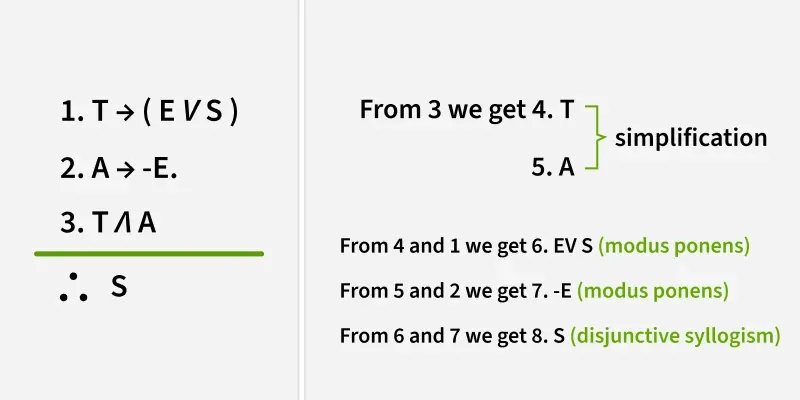
Hence, the argument stated is valid.
7) Artificial Intelligence - Fuzzy Logic
AI algorithms make use of fuzzy logic. In fuzzy logic, there is no logic for the absolute truth and absolute false value. But in fuzzy logic, there is an intermediate value too present, which is partially true and partially false.
**For Example: The truth value 0.6 can be assigned to the statement "Fred is happy," because Fred is happy slightly more than most of the time, and the truth value 0.5 can be assigned to the statement "Percy is happy" because Percy is happy half of the time.