Elements of POSET (original) (raw)
Last Updated : 19 Aug, 2025
A Partially Ordered Set (POSET) is a fundamental concept in mathematics and computer science, providing a structured way to analyze and compare elements within a set.
**POSET works on the principle of Partial Ordering Relation. A relation **R is said to be a **Partial Ordered Relation when it can satisfy the following properties:
- R is Reflexive, i.e., if set A = {1, 2, 3}, then **R = {(1, 1), (2, 2), (3, 3)} is a Reflexive relation.
- R is Anti-symmetric, i.e., if R contains (1, 2), then (2, 1) is not allowed.
- R is Transitive, i.e., if R contains (1, 2), (2, 3), then it should contain (1, 3) to make it **Transitive.
POSET: If A set 'A' following a Partial Ordering Relation 'R' then it is known as POSET. It is denoted by **[A; R].
**Note: Unlike Asymmetry, Anti-Symmetry allows reflexive elements like (a, a) or (b, b) in a Relation.
In a POSET, not every pair of elements needs to be comparable, making it a versatile tool for representing hierarchical relationships and dependencies.
The elements of a POSET include several key types, such as maximal and minimal elements.
- A maximal element is not less than any other element in the set.
- A minimal element is not greater than any other element.
Additionally, POSETs can have the greatest and least elements, which are unique elements that are greater than or less than all others, respectively.
Some of the common elements of POSET are:
- Maximal Element
- Minimal Element
- Maximum Element (Greatest)
- Minimum Element (Least)
- Upper Bound
- Lower Bound
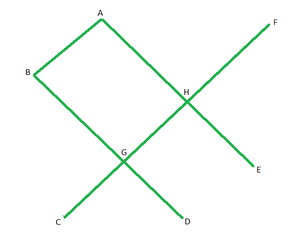
Elements of POSET
**Maximal Element
If in a POSET/Lattice, an element is not related to any other element. Or, in simple words, it is an element with no **outgoing (upward) edge. In the above diagram, **A, B, and F are Maximal elements.
**Minimal Element
If in a POSET/Lattice, no element is related to an element. Or, in simple words, it is an element with no **incoming (downward) edge. In the above diagram, **C, D, and E are Minimal elements.
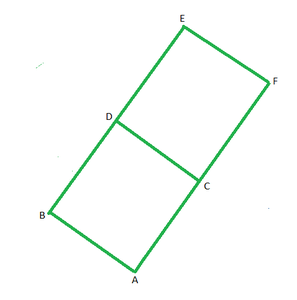
**Maximum Element (Greatest)
If in a POSET/Lattice, it is a **Maximal element, and every element is related to it, i.e., every element of the lattice should be connected to this element. In the above diagram, **E and **F are Maximal elements, but E is the only Maximum element.
**Minimum Element (Least)
If in a POSET/Lattice, it is a **Minimal element and is related to every other element, i.e., it should be connected to every element of the lattice. In the above diagram, A and B are Minimal elements, but A is the only Minimum element.
**Note:
- Every Maximum element is a Maximal element but every Maximal element is not a Maximum element.
- Every Minimum element is a Minimal element but every Minimal element is not a Minimum element.
Upper Bound
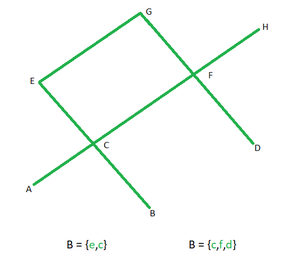
Let's assume B is a subset of set A. An element x ∈ A is in the upper bound of B if (y, x) ∈ POSET, where ∀ y ∈ B. Or we can say that it is an element to which every element of a subset is related.
- B = {E, C}: Upper Bound- {G, E} (E can itself be an upper bound because Partial order follows **Reflexive property)
- B = {C, F, D}: Upper Bound- {G, H, F}
Lower Bound
If B is a subset of set A, an element x ∈ A is in the lower bound of B if (x, y) ∈ POSET, where ∀ y ∈ B. Or we can say that it is an element that is related /connected to every element of subset B.
- B = {E, C}: Lower Bound- {A, B, C} ( C can itself be a lower bound because Partial order follows Reflexive property)
- B = {C, F, D}: Lower Bound- { ∅ }
Least Upper Bound
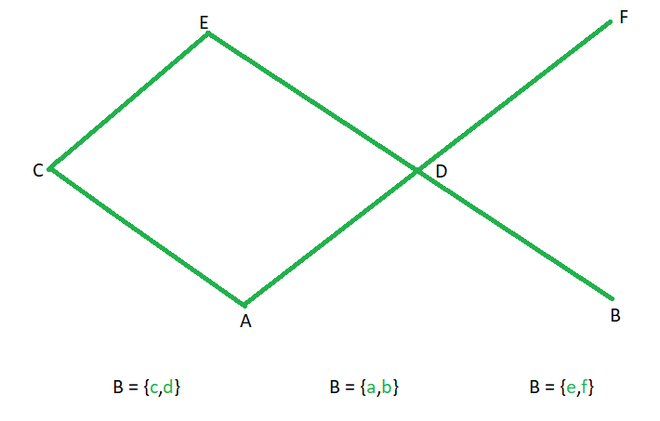
Least Upper Bound of a subset S within a POSET is the smallest element in the set that is greater than or equal to every element of S. It is also known as the **Join. The Minimum (Least) element in Upper Bound.
- B = {C, D} : Least Upper Bound- { E }
- B = {A, B} : Least Upper Bound- { D }
- B = {E, F} : Least Upper Bound- { ∅ }
Greatest Lower Bound
Greatest Lower Bound of a subset SSS in a POSET is the largest element in the set that is less than or equal to every element of S. It is also known as Meet. The Maximum (Greatest) element in the Lower Bound.
- B = {C, D} : Least Upper Bound- { A }
- B = {A, B} : Least Upper Bound- { ∅ }
- B = {E, F} : Least Upper Bound- { D }
Solved Examples
**Example 1: For a set A = {1, 2, 3}, check if the following relations are POSET?
- R1 = {(1, 1), (2, 2), (3, 3)}
- R2 = {(1, 1), (2, 2), (3, 3), (1, 2), (2, 1)}
- R3 = { }
Solution:
Explanation: To prove a **Partial Order Relation, check **Reflexivity, Anti-Symmetry and **Transitivity.
(1, 1) (1, 2) (1, 3) (2, 1) (2, 2) (2, 3) (3, 1) (3, 2) (3, 3) **For Relation R 1
- Reflexive: Since (1, 1) (2, 2) (3, 3) are present so it is Reflexive.
- Anti-symmetry: It allows reflexive pairs, so it is Anti-symmetric.
- Transitive: Reflexive pairs are always Transitive.
**For Relation R 2
- Reflexive: Since (1, 1) (2, 2) (3, 3) are present so it is Reflexive.
- Anti-symmetry: For (1, 2) there is (2, 1) so not Anti-symmetric.
- Transitive: There are no such pairs (a, b) (b, c) such that (a, c) is not present.
For Relation R 3
- Reflexive: NULL sets doesn't contain either of (1, 1) (2, 2) (3, 3).
Therefore, **R 1 is a POSET, but R 2 and R 3 are not.
**Example 2: Identifying elements in a POSET
Consider the POSET (P, ≤) where P = {1, 2, 3, 4} and ≤ is the "divides" relation.
**Solution:
Minimal elements: 1 (as it divides no other number except itself)
Maximal elements: 2, 3, 4 (as no number in the set divides them except themselves)
Least element: 1 (as it divides all other numbers)
Greatest element: None (as no number divides all others)
**Example 3: Hasse Diagram
Draw the Hasse diagram for the POSET ({1, 2, 3, 4, 6, 12}, |) where | denotes "divides".
**Solution:
The Hasse diagram would look like this:
12
/
6 4
| |
3 2
\ /
1
**Example 4: Comparable and Incomparable Elements
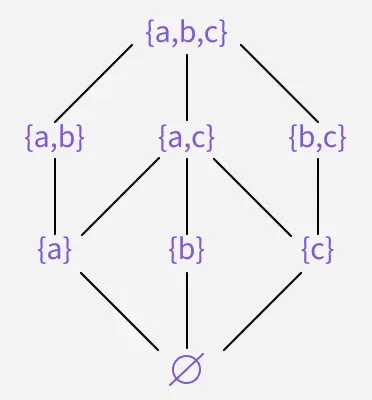
In the POSET (P(A), ⊆) where A = {a, b, c} and P(A) is the power set of A, identify comparable and incomparable pairs.
**Solution:
Comparable pairs: (∅, {a}), (∅, {b}), (∅, {c}), ({a}, {a,b}), ({b}, {a,b}), etc.
Incomparable pairs: ({a}, {b}), ({a}, {c}), ({b}, {c}), ({a,b}, {a,c}), etc.
**Example 5: Upper and Lower Bounds
In the POSET ({1, 2, 3, 4, 5, 6}, ≤), find the upper and lower bounds of the subset {2, 3, 5}.
**Solution:
Upper bounds: 5, 6
Lower bounds: 1, 2
Least upper bound (supremum): 5
Greatest lower bound (infimum): 2
**Example 6: Chains and Antichains
In the POSET (P({a, b, c}), ⊆), identify a maximal chain and a maximal antichain.
**Solution:
A maximal chain: ∅ ⊂ {a} ⊂ {a,b} ⊂ {a,b,c}
A maximal antichain: {{a}, {b}, {c}}
**Example 7: Lattice Verification
Determine if the POSET ({1, 2, 3, 6, 12, 18}, |), where | denotes "divides," is a lattice.
Solution:
To be a lattice, every pair of elements must have a least upper bound (LUB) and greatest lower bound (GLB).
Let's check a few pairs:
For 2 and 3: LUB = 6, GLB = 1
For 6 and 12: LUB = 12, GLB = 6
For 2 and 18: LUB = 18, GLB = 2p
**Example 8: Dual POSET
Given the POSET P = ({a, b, c, d}, R) where R = {(a, b), (a, c), (b, d), (c, d)}, find its dual POSET.
**Solution:
The dual POSET P* = ({a, b, c, d}, R*) where R* is the reverse of all relations in R.
R* = {(b, a), (c, a), (d, b), (d, c)}
The Hasse diagram of P: The Hasse diagram of P*:
a d
/ \ /
b c b c
\ / \ /
d a
**Example 9: Linear Extension
Find a linear extension of the POSET ({1, 2, 3, 4}, R) where R = {(1, 2), (1, 3), (2, 4), (3, 4)}.
**Solution:
A linear extension is a total order that respects the partial order.
One possible linear extension is: 1 < 2 < 3 < 4
Another valid linear extension is: 1 < 3 < 2 < 4
**Example 10: Complement in a Boolean Algebra
In the Boolean algebra of subsets of {1, 2, 3}, find the complement of {1, 3}.
**Solution:
The universe U = {1, 2, 3}
The complement of {1, 3} is U \ {1, 3} = {2}
**Example 11: Join and Meet in a Lattice
In the lattice of divisors of 30, find:
- 6 ∨ 10 (join)
- 6 ∧ 10 (meet)
**Solution:
Divisors of 30: {1, 2, 3, 5, 6, 10, 15, 30}
- 6 ∨ 10 = LUB(6, 10) = 30
- 6 ∧ 10 = GLB(6, 10) = 2