Types of Sets in Discrete Mathematics (original) (raw)
Last Updated : 23 Jul, 2025
A set in discrete mathematics is a collection of distinct objects, considered as an object in its own right. Sets are fundamental objects in mathematics, used to define various concepts and structures. In this article, we will discuss Types of Sets in Discrete Structure or Discrete Mathematics. Also, we will cover the examples. Let's discuss one by one.
Table of Content
- Partially Ordered Set or POSET
- Linearly Ordered Set
- Isomorphic Ordered Sets
- Well Ordered Set
- Solved Examples
- Practice Problems on Types of Sets in Discrete Mathematics
**Partially Ordered Set or POSET
Partial Ordered Set (POSET) consists of sets with three binary relations as follows: reflexive, antisymmetric, and transitive.
****1. Reflexive Relation -**One in which every element maps to itself.
****2. Anti-Symmetric Relation -**If (a, b) ∈ R and (b, a) ∈ R, then a=b.
****3. Transitive Relation -**If (a, b) ∈ R and (b, c) ∈ R then (a, c) ∈ R).
Example Problems on **Partially Ordered Set or POSET
Let A be a set: A = {1, 2, 3}.
Question-1: R1 = { } . Is R1 a POSET?
R1 is not a POSET because R1 is not reflexive. If any of the three relations is not available then it is not a POSET.
Question-2: R2 = {(1, 1), (2, 2), (3, 3)}. Is R2 a POSET?
This is a POSET because R2 is reflexive, transitive as well as anti-symmetric.
Question-3: R3 = {(1, 1), (2, 2), (3, 3), (1, 2), (2, 1)} . Is R3 a POSET?
This is not a POSET because R3 is reflexive but not anti-symmetric. It is actually symmetric. So it cannot be a POSET.
**Linearly Ordered Set
**Linearly Ordered Set is also known as **Chain or Totally Ordered Set. It is basically a POSET in which given any pair (x, y) satisfies either x ≤ y or y ≤ x. Or we can say that if any one of the statements "x<y, y<x, x=y" is correct (This is also called as _Law of Trichotomy) then it is a Linearly Ordered Set.
**Example - A set of real numbers with a natural ordering ([R, ≤]) is a Linearly Ordered Set because firstly it is a POSET, and if we take any two real numbers e.g. (r1, r2) ∈ R then at least any one of the following three statements is always true: r1<r2 or r2<r1 or r1=r2. So, it is a Totally or Linearly Ordered Set.
**Isomorphic Ordered Sets
Let (A, ≤) and (B, ≤) be two partially ordered sets then they are said to be isomorphic if their "structures" are entirely similar. **Example - Let two POSETS, A = P({0, 1}) ordered by ≤ and B = {1, 2, 3, 6} ordered by division relation are Isomorphic Ordered Sets.
**Explanation :
**Hasse Diagram of POSET A
A = { Φ, {0}, {1}, {0, 1} } with subset relation.
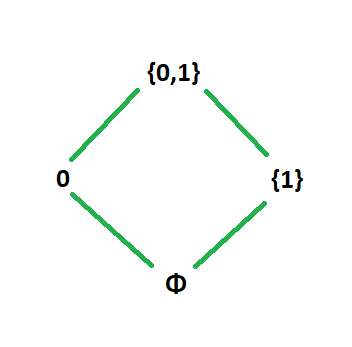
**Hasse Diagram of POSET B
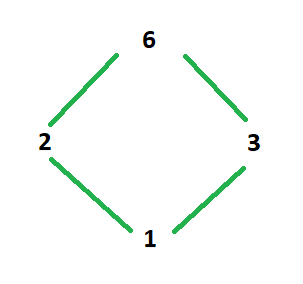
If we try to define a map.
f( Φ ) = 1, f( {0} ) = 2, f( {1} ) = 3 and f( {0, 1} ) = 6. So both the sets are isomorphic. Hence, they are Isomorphic Ordered Set.
**Well Ordered Set
A partially ordered set is called a Well Ordered set if every non-empty subset has a least element. **Example - A set of natural number and less than operation ([N, ≤]) then it is a Well ordered Set because firstly it is a POSET and if we take any two natural numbers e.g. n1 and n2 where n1≤n2. Here, n1 is the least element. So, it is a Well Ordered Set.
**Note: Any Well ordered set is totally ordered.
Every subset of a Well ordered set is Well-ordered with the same ordering.
**Related Articles:
Solved Examples
**Problem 1:
**Let A = {1, 3, 5, 7, 9}, B = {2, 4, 6, 8}, and C = {3, 4, 5, 6}.
**Calculate: Sum((A ∪ B) - C) × Sum(A ∩ C)
Solution:
A ∪ B = {1, 2, 3, 4, 5, 6, 7, 8, 9}
(A ∪ B) - C = {1, 2, 7, 8, 9}
Sum((A ∪ B) - C) = 1 + 2 + 7 + 8 + 9 = 27
A ∩ C = {3, 5}
Sum(A ∩ C) = 3 + 5 = 8
Final result: 27 × 8 = 216
Answer: 216
**Problem 2:
**Given sets P = {x | x is a prime number less than 20} and Q = {x | x is an even number less than 15},
**Calculate: [Sum(P) + Sum(Q)] × [Sum(P ∩ Q) + Sum(P Δ Q)]
Solution:
P = {2, 3, 5, 7, 11, 13, 17, 19}
Q = {2, 4, 6, 8, 10, 12, 14}
Sum(P) = 2 + 3 + 5 + 7 + 11 + 13 + 17 + 19 = 77
Sum(Q) = 2 + 4 + 6 + 8 + 10 + 12 + 14 = 56
P ∩ Q = {2}
P Δ Q = {3, 4, 5, 6, 7, 8, 10, 11, 12, 13, 14, 17, 19}
Sum(P ∩ Q) = 2
Sum(P Δ Q) = 3 + 4 + 5 + 6 + 7 + 8 + 10 + 11 + 12 + 13 + 14 + 17 + 19 = 129
[Sum(P) + Sum(Q)] = 77 + 56 = 133
[Sum(P ∩ Q) + Sum(P Δ Q)] = 2 + 129 = 131
Final result: 133 × 131 = 17,423
Answer: 17,423
**Problem 3:
**Let X = {1, 2, 3, ..., 10} and Y = {x | x is a factor of 60}.
**Calculate: [Sum(X) - Sum(Y)] × Sum(P(X ∩ Y))
Solution:
X = {1, 2, 3, 4, 5, 6, 7, 8, 9, 10}
Y = {1, 2, 3, 4, 5, 6, 10, 12, 15, 20, 30, 60}
Sum(X) = 1 + 2 + 3 + 4 + 5 + 6 + 7 + 8 + 9 + 10 = 55
Sum(Y) = 1 + 2 + 3 + 4 + 5 + 6 + 10 + 12 + 15 + 20 + 30 + 60 = 168
X ∩ Y = {1, 2, 3, 4, 5, 6, 10}
P(X ∩ Y) = {∅, {1}, {2}, {3}, {4}, {5}, {6}, {10}, {1,2}, {1,3}, ..., {1,2,3,4,5,6,10}}
Sum of all non-empty subsets in P(X ∩ Y):
1 + 2 + 3 + 4 + 5 + 6 + 10 +
(1+2) + (1+3) + (1+4) + (1+5) + (1+6) + (1+10) +
(2+3) + (2+4) + (2+5) + (2+6) + (2+10) +
(3+4) + (3+5) + (3+6) + (3+10) +
(4+5) + (4+6) + (4+10) +
(5+6) + (5+10) +
(6+10) +
... (continue for all combinations)
= 889
[Sum(X) - Sum(Y)] = 55 - 168 = -113
Final result: -113 × 889 = -100,457
Answer: -100,457
**Problem 4:
**Let A = {x | x is a multiple of 3 less than 30} and B = {x | x is a perfect square less than 50}.
**Calculate: [Sum(A) × Sum(B)] ÷ Sum(A ∩ B)
Solution:
A = {3, 6, 9, 12, 15, 18, 21, 24, 27}
B = {1, 4, 9, 16, 25, 36, 49}
A ∩ B = {9, 36}
Sum(A) = 3 + 6 + 9 + 12 + 15 + 18 + 21 + 24 + 27 = 135
Sum(B) = 1 + 4 + 9 + 16 + 25 + 36 + 49 = 140
Sum(A ∩ B) = 9 + 36 = 45
Final result: (135 × 140) ÷ 45 = 420
**Problem 5:
**Given sets X = {1, 2, 3, ..., 15} and Y = {x | x is a prime number less than 20},
**Calculate: Sum((X - Y) ∪ (Y - X)) × [Sum(X) ÷ Sum(Y)]
Solution:
X = {1, 2, 3, 4, 5, 6, 7, 8, 9, 10, 11, 12, 13, 14, 15}
Y = {2, 3, 5, 7, 11, 13, 17, 19}
X - Y = {1, 4, 6, 8, 9, 10, 12, 14, 15}
Y - X = {17, 19}
(X - Y) ∪ (Y - X) = {1, 4, 6, 8, 9, 10, 12, 14, 15, 17, 19}
Sum((X - Y) ∪ (Y - X)) = 1 + 4 + 6 + 8 + 9 + 10 + 12 + 14 + 15 + 17 + 19 = 115
Sum(X) = 1 + 2 + 3 + ... + 15 = 120
Sum(Y) = 2 + 3 + 5 + 7 + 11 + 13 + 17 + 19 = 77
Final result: 115 × (120 ÷ 77) ≈ 179.22 (rounded to 2 decimal places)
Answer: 179.22 (rounded)
**Problem 6:
**Let P = {x | x is an even number less than 20} and Q = {x | x is a factor of 100}.
**Calculate: Sum(P(P ∩ Q)) - [Sum(P) × Sum(Q)]
Solution:
P = {2, 4, 6, 8, 10, 12, 14, 16, 18}
Q = {1, 2, 4, 5, 10, 20, 25, 50, 100}
P ∩ Q = {2, 4, 10}
P(P ∩ Q) = {∅, {2}, {4}, {10}, {2,4}, {2,10}, {4,10}, {2,4,10}}
Sum(P(P ∩ Q)) = 2 + 4 + 10 + (2+4) + (2+10) + (4+10) + (2+4+10) = 64
Sum(P) = 2 + 4 + 6 + 8 + 10 + 12 + 14 + 16 + 18 = 90
Sum(Q) = 1 + 2 + 4 + 5 + 10 + 20 + 25 + 50 + 100 = 217
Final result: 64 - (90 × 217) = 64 - 19,530 = -19,466
Answer: -19,466
**Problem 7:
**Let A = {1, 2, 3, ..., 10} and f(x) = x² - 1. Define B = {f(x) | x ∈ A}.
**Calculate: [Sum of prime numbers in B] × [Number of elements in A that map to prime numbers in B]
Solution:
A = {1, 2, 3, 4, 5, 6, 7, 8, 9, 10}
B = {f(1), f(2), f(3), ..., f(10)} = {0, 3, 8, 15, 24, 35, 48, 63, 80, 99}
Prime numbers in B: 3
Sum of prime numbers in B: 3
Elements in A that map to prime numbers in B: 2 (f(2) = 3)
Final result: 3 × 1 = 3
Answer: 3
**Problem 8:
**Let S be the set of all subsets of {1, 2, 3, 4, 5} with exactly 3 elements.
**Calculate: [Sum of all elements in S] ÷ [Number of elements in S]
Solution:
S = {{1,2,3}, {1,2,4}, {1,2,5}, {1,3,4}, {1,3,5}, {1,4,5}, {2,3,4}, {2,3,5}, {2,4,5}, {3,4,5}}
Number of elements in S: 10 (this is 5C3)
Sum of all elements in S: (1+2+3)×4 + (1+2+4)×3 + (1+2+5)×3 + (1+3+4)×3 + (1+3+5)×3 +
(1+4+5)×3 + (2+3+4)×3 + (2+3+5)×3 + (2+4+5)×3 + (3+4+5)×3
= 24 + 21 + 24 + 24 + 27 + 30 + 27 + 30 + 33 + 36 = 276
Final result: 276 ÷ 10 = 27.6
Answer: 27.6
**Problem 9:
**Let f(n) be the number of factors of n. Define A = {f(x) | x ∈ {1, 2, 3, ..., 20}}.
**Calculate: [Sum of elements in A] × [Number of prime numbers in A]
Solution:
f(1) = 1, f(2) = 2, f(3) = 2, f(4) = 3, f(5) = 2, f(6) = 4, f(7) = 2, f(8) = 4, f(9) = 3, f(10) = 4,
f(11) = 2, f(12) = 6, f(13) = 2, f(14) = 4, f(15) = 4, f(16) = 5, f(17) = 2, f(18) = 6, f(19) = 2, f(20) = 6
A = {1, 2, 3, 4, 5, 6}
Sum of elements in A: 1 + 2 + 3 + 4 + 5 + 6 = 21
Prime numbers in A: 2, 3, 5
Number of prime numbers in A: 3
Final result: 21 × 3 = 63
Answer: 63
**Problem 10:
**Let f(n) be the sum of digits of n. Define A = {x | x ∈ {1, 2, 3, ..., 100} and f(x) is prime}.
**Calculate: [Sum of elements in A] ÷ [Number of elements in A]
Solution:
A = {2, 3, 5, 7, 11, 20, 29, 38, 47, 56, 65, 74, 83, 92}
Sum of elements in A: 2 + 3 + 5 + 7 + 11 + 20 + 29 + 38 + 47 + 56 + 65 + 74 + 83 + 92 = 532
Number of elements in A: 14
Final result: 532 ÷ 14 = 38
Answer: 38
Practice Problems on Types of Sets in Discrete Mathematics
**1. Let A = {1, 3, 5, 7, 9} and B = {2, 4, 6, 8}. Calculate |P(A ∩ B)| + |A ∪ B|.
**2. Given sets X = {a, b, c, d, e} and Y = {c, d, e, f, g}, find |P(X Δ Y)|.
**3. Let S be the set of all subsets of {1, 2, 3, 4, 5} with an odd number of elements. Calculate the sum of all elements in S.
**4. Define A = {x | x is a prime number less than 20} and B = {x | x is a multiple of 3 less than 20}. Calculate |P(A ∪ B)| - |P(A ∩ B)|.
**5. Let f(n) be the number of factors of n. Define C = {f(x) | x ∈ {1, 2, 3, ..., 12}}. Calculate the product of all elements in C.
**6. Given sets P = {1, 2, 3, 4, 5} and Q = {4, 5, 6, 7, 8}, calculate |(P ∪ Q) × (P ∩ Q)|.
**7. Let A = {1, 2, 3, ..., 10}. Define a relation R on A such that aRb if and only if a divides b. Calculate the number of elements in R.
**8. Given the universal set U = {1, 2, 3, ..., 10}, and sets A = {2, 4, 6, 8, 10} and B = {1, 3, 5, 7, 9}, calculate |(A' ∩ B') ∪ (A ∩ B)|.
**9. Let S be the set of all strings of length 4 using the digits 0 and 1. Calculate the number of subsets of S that contain exactly 3 elements.
**10. Define f(n) as the sum of the digits of n. Let A = {x | x ∈ {1, 2, 3, ..., 50} and f(x) is even}. Calculate |A|.
Conclusion
Understanding different types of sets in discrete mathematics, such as POSETs, linearly ordered sets, isomorphic ordered sets, and well-ordered sets, is essential for grasping the structure and properties of ordered systems. These concepts have wide applications in computer science, mathematics, and related fields.