Functions in Discrete Mathematics (original) (raw)
Last Updated : 23 Jul, 2025
Functions are an important part of discrete mathematics. This article is all about functions, their types, and other details of functions. A function assigns exactly one element of a set to each element of the other set. Functions are the rules that assign one input to one output. The function can be represented as f: A **⇢ B. A is called the domain of the function and B is called the codomain function.
Table of Content
- What is Function?
- Types of Function
- Inverse of a Function
- Composition of Functions
- Summary: Functions in Discrete Mathematics
- Sample Questions on Functions in Discrete Mathematics
What is Function?
- A function assigns exactly one element of one set to each element of other sets.
- A function is a rule that assigns each input exactly one output.
- A function f from A to B is an assignment of exactly one element of B to each element of A (where A and B are non-empty sets).
- A function f from set A to set B is represented as f: A ⇢ B where A is called the domain of f and B is called as codomain of f.
- If b is a unique element of B to element a of A assigned by function F then, it is written as f(a) = b.
- Function f maps A to B means f is a function from A to B i.e. f: A **⇢ B
Pre-Image and Image of a Function
A function f: A **⇢ B such that for each a ∈ A, there exists a unique b ∈ B such that (a, b) ∈ R then, a is called the pre-image of f and b is called the image of f.
Domain of a Function
- If f is a function from set A to set B then, A is called the domain of function f.
- The set of all inputs for a function is called its domain.
Codomain (Range) of a Function
- If f is a function from set A to set B then, B is called the codomain of function f.
- The set of all allowable outputs for a function is called its codomain.
Read More about **Domain and Range of Function.
Types of Function
Some of the common types of functions are:
- One-One Function
- Many-One Function
- Onto Function
- Into Function
- One-One Correspondent Function
- One-One Into Function
- Many-One Onto Function
- Many-One Into Function
Let's discuss these in detail.
One-One Function ( or Injective Function):
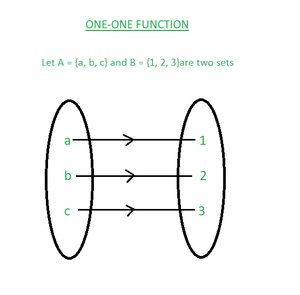
A function in which one element of the domain is connected to one element of the codomain.
A function f: A **⇢ B is said to be a one-one (injective) function if different elements of A have different images in B.
**f: A ⇢ B is one-one
**⇒ a ≠ b ⇒ f(a) ≠ f(b) for all a, b ∈ A
**⇒ f(a) = f(b) ⇒ a = b for all a, b ∈ A
ONE-ONE FUNCTION
Many-One Function
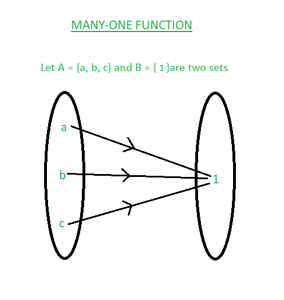
A function f: A **⇢ B is said to be a many-one function if two or more elements of set A have the same image in B.
A function f: A **⇢ B is a many-one function if it is not a one-one function.
**f: A ⇢ B is many-one.
**⇒ a ≠ b but f(a) = f(b) for all a, b ∈ A
MANY-ONE FUNCTION
Onto Function( or Surjective Function)
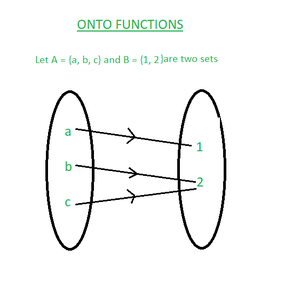
A function f: A ⇢ B is said to be onto (surjective) function if every element of B is an image of some element of A i.e. f(A) = B or range of f is the codomain of f.
A function in which every element of the codomain has one pre-image.
**f: A ⇢ B is onto if for each b∈ B, there exists a∈ A such that f(a) = b.
ONTO FUNCTION
Into Function
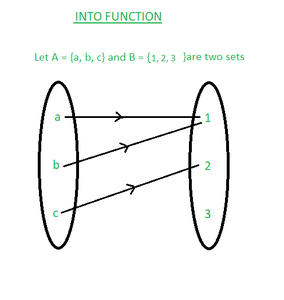
A function f: A **⇢ B is said to be an into a function if there exists an element in B with no pre-image in A.
A function f: A**⇢ B is into function when it is not onto.
INTO FUNCTION
One-One Correspondent Function (or Bijective Function or One-One Onto Function)
A function which is both one-one and onto (both injective and surjective) is called one-one correspondent(bijective) function.
**f : A ⇢ B is one-one correspondent (bijective) if:
- one-one i.e. f(a) = f(b)
- ⇒ a = b for all a, b ∈ A
- onto i.e. for each b ∈ B, there exists
- a ∈ A such that f(a) = b.
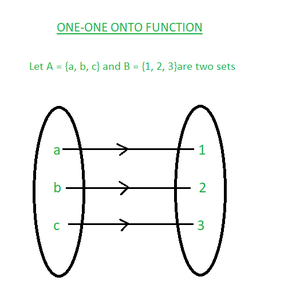
ONE-ONE CORRESPONDENT FUNCTION
One-One Into Function
A function that is both one-one and into is called one-one into function.
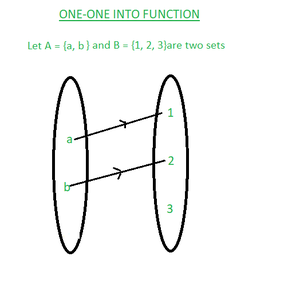
ONE-ONE INTO FUNCTION
Many-One Onto Function
A function that is both many-one and onto is called many-one onto function.
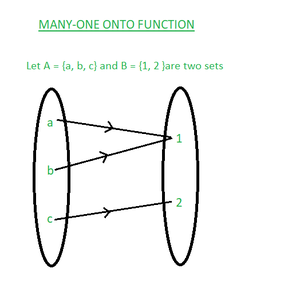
MANY-ONE ONTO FUNCTION
Many-One Into Function
A function that is both many-one and into is called many-one into function.
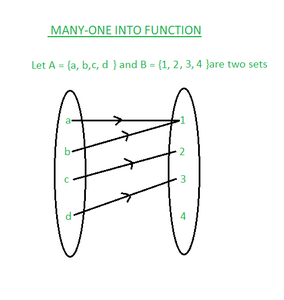
MANY-ONE INTO FUNCTION
Inverse of a Function
Let f: A **⇢ B be a bijection then, a function g: B **⇢ A which associates each element b ∈ B to a different element a ∈ A such that f(a) = b is called the inverse of f.
**f(a) = b ↔︎ g(b) = a
Read More about **Inverse Function.
Composition of Functions
Let f: A **⇢ B and g: B **⇢ C be two functions then, a function gof: A **⇢ C is defined by
****(gof)(x) = g(f(x)), for all x ∈ A**
Here, (gof)(x) is called the composition of f and g.
Read More about **Composition of Function.
Summary: Functions in Discrete Mathematics
Let X and Y be two sets with m and n elements and a function is defined as f : X⇢Y then,
- Total number of functions = nm
- Total number of one-one function = nPm
- Total number of onto functions = nm - nC1(n-1)m + nC2(n-2)m - . . . + (-1)n-1nCn-11m if m ≥ n.
For the composition of functions f and g be two functions :
- fog ≠ gof
- If f and g both are one-one function then fog is also one-one.
- If f and g both are onto function then fog is also onto.
- If f and fog both are one-one function then g is also one-one.
- If f and fog both are onto function then it is not necessary that g is also onto.
- (fog)-1 = g-1o f-1
- f-1o f = f-1(f(a)) = f-1(b) = a
- fof-1 = f(f-1(b)) = f(a) = b
Sample Questions on Functions in Discrete Mathematics
**Question 1: Show that the function f : R ⇢ R, given by f(x) = 2x, is one-one and onto.
**Solution:
**For one-one:
Let a, b ∈ R such that f(a) = f(b) then,
f(a) = f(b)
⇒ 2a = 2b
⇒ a = b
**Therefore, f: R ⇢ R is one-one.
**For onto:
Let p be any real number in R (co-domain). f(x) = p
⇒ 2x = p
⇒ x = p/2
p/2 ∈ R for p ∈ R such that f(p/2) = 2(p/2) = p
For each p∈ R (codomain) there exists x = p/2 ∈ R (domain) such that f(x) = y
For each element in codomain has its pre-image in domain.
So, f: R ⇢ R is onto.
Since f: R ⇢ R is both one-one and onto.
f : R ⇢ R is one-one correspondent (bijective function).
**Question 2: Let f : R ⇢ R ; f(x) = cos x and g : R ⇢ R ; g(x) = x 3 . Find fog and gof.
**Solution:
Since the range of f is a subset of the domain of g and the range of g is a subset of the domain of f. So, fog and gof both exist.
**gof (x) = g(f(x)) = g(cos x) = (cos x)3 = cos3x
**fog (x) = f(g(x)) = f(x3) = cos x3
**Question 3: If f : Q ⇢ Q is given by f(x) = x 2 , then find f -1 (16).
**Solution:
Let f-1(16) = x
f(x) = 16
⇒ x2 = 16
⇒ x = ± 4
Thus, f-1(16) = {-4, 4}
**Question 4: If f : R ⇢ R; f(x) = 2x + 7 is a bijective function then, find the inverse of f.
**Solution:
Let x ∈ R (domain), y ∈ R (codomain) such that f(a) = b
f(x) = y
⇒ 2x + 7 = y
⇒ x = (y -7)/2
⇒ f-1(y) = (y -7)/2
Thus, f-1 : R ⇢ R is defined as f-1(x) = (x -7)/2 for all x∈ R.
**Question 5: If f : A ⇢ B and |A| = 5 and |B| = 3 then find total number of functions.
**Solution:
Total number of functions = 35= 243