Homomorphism & Isomorphism of Group (original) (raw)
Last Updated : 23 Jul, 2025
We can say that "o" is the binary operation on set G if: G is a non-empty set & G * G = { (a,b) : a , b∈ G } and o : G * G --> G. Here, aob denotes the image of ordered pair (a,b) under the function/operation o.
**Example - "+" is called a binary operation on G (any non-empty set ) if & only if: a+b ∈G; ∀ a,b ∈G and a+b give the same result every time when added.
**Real example - '+' is a binary operation on the set of natural numbers 'N' because a+b ∈ N; ∀ a,b ∈N and a+b a+b give the same result every time when added.
**Laws of Binary Operation :
**In a binary operation o, such that: o : G * G --> G on the set G is :
**1. Commutative -
aob = boa ; ∀ a,b ∈G
Example: '+' is a binary operation on the set of natural numbers 'N'. Taking any 2 random natural numbers , say 6 & 70, so here a = 6 & b = 70,
a+b = 6 + 70 = 76 = 70 + 6 = b + a
This is true for all the numbers that come under the natural number.
**2. Associative -
ao(boc) = (aob)oc ; ∀ a,b,c ∈G
Example: '+' is a binary operation on the set of natural numbers 'N'. Taking any 3 random natural numbers , say 2 , 3 & 7, so here a = 2 & b = 3 and c = 7,
LHS : a+(b+c) = 2 +( 3 +7) = 2 + 10 = 12
RHS : (a+b)+c = (2 + 3) + 7 = 5 + 7 = 12
This is true for all the numbers that come under the natural number.
**3. Left Distributive -
ao(b*c) = (aob) * (aoc) ; ∀ a,b,c ∈G
**4. Right Distributive -
(b*c) oa = (boa) * (coa) ; ∀ a,b,c ∈G
**5. Left Cancellation -
aob =aoc => b = c ; ∀ a,b,c ∈G
**6. Right Cancellation -
boa = coa => b = c ; ∀ a,b,c ∈G
**Algebraic Structure :
A non-empty set G equipped with 1/more binary operations is called an algebraic structure.
Example : a. (N,+) and b. (R, + , .), where N is a set of natural numbers & R is a set of real numbers. Here ' . ' (dot) specifies a multiplication operation.
**GROUP :
An algebraic structure (G , o) where G is a non-empty set & 'o' is a binary operation defined on G is called a Group if the binary operation "o" satisfies the following properties -
- Closure -
a ∈ G ,b ∈ G => aob ∈ G ; ∀ a,b ∈ G
- Associativity -
(aob)oc = ao(boc) ; ∀ a,b,c ∈ G.
Identity Element -
There exists e in G such that aoe = eoa = a ; ∀ a ∈ G (Example - For addition, identity is 0)Existence of Inverse -
For each element a ∈ G ; there exists an inverse(a-1)such that : ∈ G such that - aoa-1 = a-1oa = e
**Homomorphism of groups :
Let (G,o) & (G',o') be 2 groups, a mapping "f " from a group (G,o) to a group (G',o') is said to be a homomorphism if -
f(aob) = f(a) o' f(b) ∀ a,b ∈ G
The essential point here is : The mapping f : G --> G' may neither be a one-one nor onto mapping, i.e, 'f' needs not to be bijective.
**Example -
If (R,+) is a group of all real numbers under the operation '+' & (R -{0},*) is another group of non-zero real numbers under the operation '*' (Multiplication) & f is a mapping from (R,+) to (R -{0},*), defined as : f(a) = 2a ; ∀ a ∈ R
Then f is a homomorphism like - f(a+b) = 2a+b = 2a * 2b = f(a).f(b) .
So the rule of homomorphism is satisfied & hence f is a homomorphism.
**Homomorphism Into -
A mapping 'f', that is homomorphism & also Into.
**Homomorphism Onto -
A mapping 'f', that is homomorphism & also onto.
**Isomorphism of Group :
Let (G,o) & (G',o') be 2 groups, a mapping "f " from a group (G,o) to a group (G',o') is said to be an isomorphism if -
- f(aob) = f(a) o' f(b) ∀ a,b ∈ G
- f is a one- one mapping
- f is an onto mapping.
If 'f' is an isomorphic mapping, (G,o) will be isomorphic to the group (G',o') & we write :
G ≅ G'
**Note : A mapping f: X -> Y is called :
- One - One - If x1 ≠x2, then f(x1) ≠ f(x2) or if f(x1) = f(x2) => x1 = x2. Where x1,x2 ∈ X
- Onto - If every element in the set Y is the f-image of at least one element of set X.
- Bijective - If it is one & Onto.
**Example of Isomorphism Group -
If G is the multiplicative group of 3 cube-root units , i.e., (G,o) = ( {1, w, w2 } , *) where w3 = 1 & G' is an additive group of integers modulo 3 - (G', o') = ( {1,2,3) , +3). Then : G ≅ G' , we say G is isomorphic to G'.
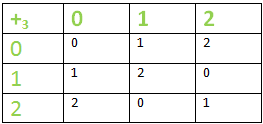
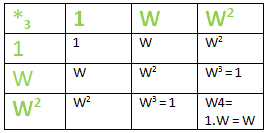
- The structure & order of both the tables are same. The mapping 'f' is defined as :
f : G -> G' in such a way that f(1) = 0 , f(w) = 1 & f(w2) = 2. - Homomorphism property : f(aob) = f(a) o' f(b) ∀ a,b ∈ G . Let us take a = w & b = 1
LHS : f(a * b) = f( w * 1 ) = f(w) = 1.
RHS : f(a) +3 f(b) = f(w) +3 f(1) = 1 + 0 = 1
=>LHS = RHS - This mapping f is one-one & onto also, therefore, a homomorphism.
Solved Examples
**Example 1: Binary Operation Addition on Natural Numbers
**Operation: Define o as ++ on N.
**Verification:
- Commutative: For any a,b∈N, a+b=b+a.
- Associative: For any a,b,c∈N, a+(b+c)=(a+b)+c.
**Example 2: Binary Operation Multiplication on Real Numbers
**Operation: Define o as × on R.
**Verification:
- Commutative: For any a,b∈R, a×b=b×a.
- Associative: For any a,b,c∈R, a×(b×c)=(a×b)×c.
**Example 3: Binary Operation Subtraction on Integers
**Operation: Define o as − on Z.
**Verification:
- Not Commutative: For any a,b∈Z, a−b≠b−a.
- Not Associative: For any a,b,c∈Z, a−(b−c)≠(a−b)−c.
**Example 4: Binary Operation on Matrix Addition
**Operation: Define o as matrix addition on M (set of matrices of same dimension).
**Verification:
- Commutative: For any A,B∈M A+B=B+A.
- Associative: For any A,B,C∈M, A+(B+C)=(A+B)+C.
Practice Problems on Homomorphism & Isomorphism of Group
- **Prove that the operation oo defined as addition on the set of even integers is a binary operation.
- **Show that multiplication is a binary operation on the set of non-zero rational numbers.
- **Determine if the operation defined as subtraction on the set of natural numbers is commutative.
- **Verify if addition is an associative operation on the set of integers.
- **Prove that the operation defined as multiplication on the set of complex numbers is commutative and associative.
- **Determine if the operation defined as division on the set of positive real numbers is a binary operation.
- **Show that addition is a binary operation on the set of polynomials with real coefficients.
- **Verify if the operation defined as exponentiation on the set of natural numbers is associative.
- **Prove that the operation defined as maximum (max) on the set of integers is associative.
- **Show that the operation defined as bitwise AND on the set of integers is commutative and associative.