Mathematics | Independent Sets, Covering and Matching (original) (raw)
Last Updated : 11 Jul, 2025
Mathematics | Independent Sets, Covering and Matching
**1. Independent Sets
- A set of vertices I is called an independent set if no two vertices in set I are adjacent to each other in other words the set of non-adjacent vertices is called an independent set.
- It is also called a **stable set.
- The parameter α0(G) = max { |I|: I is an independent set in G } is called the **independence number of G i.e. the maximum number of non-adjacent vertices.
- Any independent set I with |I| = α0(G) is called a maximum independent set.
 For above given graph G, Independent sets are:
I1 = {1}, I2 = {2}, I3 = {3}, I4 = {4}
I5 = {1, 3} and I6 = {2, 4}
Therefore, the maximum number of non-adjacent vertices i.e Independence number α
0
(G) = 2.
**2. Vertex Covering
- A set of vertices K which can cover all the edges of graph G is called a **vertex cover of G i.e. if every edge of G is covered by a vertex in set K.
- The parameter β0(G) = min { |K|: K is a vertex cover of G } is called the **vertex covering a number of G i.e. the minimum number of vertices that can cover all the edges.
- Any vertex cover K with |K| = β0(G) is called a minimum vertex cover.
For above given graph G, Vertex cover is:
V1 = {1, 3}, V2 = {2, 4},
V3 = {1, 2, 3}, V4 = {1, 2, 3, 4}, etc.
Therefore, minimum number of vertices which can cover all edges, i.e., Vertex covering number β
0
(G) = 2.

**Notes -
- I is an independent set in G if V(G) - I is vertex cover of G.
- For any graph G, α0(G) + β0(G) = n, where n is number of vertices in G.
**Edge Covering -
- A set of edges F which can cover all the vertices of graph G is called a **edge cover of G i.e. if every vertex in G is incident with a edge in F.
- The parameter β1(G) = min { |F|: F is an edge cover of G } is called **edge covering number of G i.e sum of minimum number of edges which can cover all the vertices and number of isolated vertices(if exist).
- Any edge cover F with |F| = β1(G) is called a minimum edge cover.

For above given graph G, Edge cover is:
E1 = {a, b, c, d},
E2 = {a, d} and E3 = {b, c}.
Therefore, minimum number of edges which can cover all vertices, i.e., Edge covering number β
1
(G) = 2.

**Note -
For any graph G, α
1
(G) + β
1
(G) = n, where n is number of vertices in G.
**3. Matching -
- The set of non-adjacent edges is called **matching i.e independent set of edges in G such that no two edges are adjacent in the set.
- he parameter α1(G) = max { |M|: M is a matching in G } is called **matching number of G i.e the maximum number of non-adjacent edges.
- Any matching M with |M| = α1(G) is called a maximum matching.
For above given graph G, Matching are:
M1 = {a}, M2 = {b}, M3 = {c}, M4 = {d}
M5 = {a, d} and M6 = {b, c}
Therefore, maximum number of non-adjacent edges i.e matching number α
1
(G) = 2.
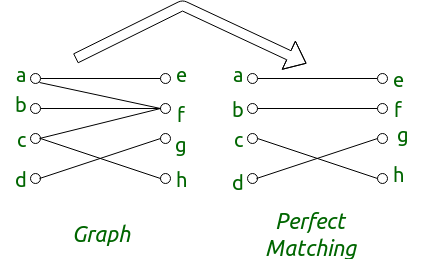
**Complete Matching:
A matching of a graph G is complete if it contains all of G'svertices. Sometimes this is also called a perfect matching.
**HALL’S MARRIAGE THEOREM:
The bipartite graph G =(V, E) with bipartition (V1, V2) has a complete matching from V1 to V2 if and only if |N (A)| > |A| for all subsets A of V1. (This is both necessary and sufficient condition for complete matching.)
Solved Examples
Example 1: Finding an Independent Set
**Problem: Find an independent set in the following graph G:
**Solution: Independent sets: I1={1}, I2={2}, I3={3}, I4={4}, I5={1,3}, I6={2,4}.
Maximum independent set: I5={1,3}or I6={2,4}
Independence number: α0(G)=2
Example 2: Finding a Vertex Cover
**Problem: Find a vertex cover in the same graph G:
**Solution: Vertex covers: V1={1,3}, V2={2,4}, V3={1,2,3}, V4={1,2,3,4}.
Minimum vertex cover: V1={1,3} or V2={2,4}
Vertex covering number: β0(G)=2
Related Articles:
Practice Problems
- **Problem 1: A graph G has vertices labeled {1,2,3,4,5}{1,2,3,4,5}. The edges are {(1,2),(1,3),(2,4),(3,5)}{(1,2),(1,3),(2,4),(3,5)}. Find the independence number α0(G)α0(G).
- **Problem 2: For the same graph G in Problem 1, determine the minimum vertex cover β0(G)β0(G).
- **Problem 3: For the same graph G in Problem 1, find the edge covering number β1(G)β1(G).
- **Problem 4: For the same graph G in Problem 1, determine the maximum matching α1(G)α1(G).
- **Problem 5: A graph G has vertices labeled {A,B,C,D,E,F}{A,B,C,D,E,F}. The edges are {(A,B),(B,C),(C,D),(D,E),(E,F),(F,A)}{(A,B),(B,C),(C,D),(D,E),(E,F),(F,A)}. Find the independent sets of GG.
- **Problem 6: For the same graph G in Problem 5, determine the minimum vertex cover.
- **Problem 7: For the same graph G in Problem 5, find the edge covering number.
- **Problem 8: For the same graph G in Problem 5, determine the maximum matching.
- **Problem 9: Consider a complete graph K5 with vertices {1,2,3,4,5}{1,2,3,4,5}. Find the independence number and minimum vertex cover.
- **Problem 10: Consider a bipartite graph K3,4K3,4 with partition sets {A,B,C}{A,B,C} and {D,E,F,G}{D,E,F,G}. Determine the matching number and edge covering number.