Permutation Groups and Multiplication of Permutation (original) (raw)
Last Updated : 23 Jul, 2025
A **permutation is simply a way of rearranging the elements of a set in a different order. If we have a non-empty set G, a permutation of G is a rule that changes the order of its elements without adding or removing anything.
We often arrange and rearrange objects in different ways whether it’s shuffling a deck of cards, changing the order of books on a shelf, or organizing people in a queue. In mathematics, this concept is known as **permutation, which refers to the different ways we can arrange a set of elements in a specific orde
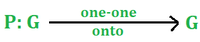
- The degree of a permutation refers to the number of elements in the set. If G has n elements, then the total set of all possible permutations is called Pn.
- Pn is also known as the symmetric group of degree n.
- The number of different ways to arrange these n elements is n! (which means n× (n−1)× (n−2) ×... ×1).
**Examples:
**Case1: Let G = { 1 } element then permutation are Pn = \begin{pmatrix} 1 \\ 1 \end{pmatrix}
**Case 2: Let G = { 1, 2 } elements then permutations are \begin{pmatrix} 1 & 2\\ 1 &2 \end{pmatrix} , \begin{pmatrix} 1 & 2\\ 2 &1 \end{pmatrix}
**Case 3: Let G = { 1, 2, 3 } elements then permutation are **3!=6. These are,
\begin{pmatrix} 1 & 2 & 3\\ 1 & 2 & 3 \end{pmatrix} , \begin{pmatrix} 1 & 2 & 3\\ 2& 1& 3 \end{pmatrix} , \begin{pmatrix} 1 & 2 & 3\\ 3 & 2 & 1 \end{pmatrix} , \begin{pmatrix} 1 & 2 & 3\\ 1 & 3 & 2 \end{pmatrix} , \begin{pmatrix} 1 & 2 & 3\\ 3 & 1 & 2 \end{pmatrix} , \begin{pmatrix} 1 & 2 & 3\\ 2 & 3 & 1 \end{pmatrix}
**Reading the Symbol of Permutation
Suppose that a permutation is \begin{pmatrix} 1 & 2 & 3 &4 &5&6\\ 2&3&1&4&5&6 \end{pmatrix}
In this notation:
- The first row represents the elements of the set {1, 2, 3, 4, 5, 6}.
- The second row shows where each element maps.
- The image of 1 is 2, the image of 2 is 3, the image of 3 is 1, the image of 4 is 4 (self-image), the image of 5 is 6, and the image of 6 is 5.
This can be read as:
- 1→ 2, 2→ 3, 3→1, 4→ 4, 5→ 6, and 6→ 5.
A cycle of length 2, for example, is called a transposition.
**Example:
**1) \begin{pmatrix} 4 & 5\\ \end{pmatrix}
Length is 2, so it is a transposition.
**2) \begin{pmatrix} 1 & 2 & 3\\ \end{pmatrix}
Length is three, so it is not a transposition.
**Multiplication of Permutation
Consider two permutations A and B as follows:
A= \begin{pmatrix} 1 & 2 & 3&4&5\\ 2&3&1&4&5 \end{pmatrix} and \,B= \begin{pmatrix} 1 & 2 & 3 &4&5\\ 1&3&4&5&2 \end{pmatrix}
Problem:
Find the product of the permutations A⋅B and B⋅A.
**Solution:
Product A⋅B: Start by applying B followed by A to each element in the set {1, 2, 3, 4, 5}.
- For 1: B maps 1 to 1, and then A maps 1 to 2, so A⋅B maps 1 to 2.
- For 2: B maps 2 to 3, and then A maps 3 to 1, so A⋅B maps 2 to 1.
- For 3: B maps 3 to 4, and then A maps 4 to 4, so A⋅B maps 3 to 4.
- For 4: B maps 4 to 5, and then A maps 5 to 5, so A⋅B maps 4 to 5.
- For 5: B maps 5 to 2, and then A maps 2 to 3, so A⋅B maps 5 to 3.
Hence,
A.B = \begin{pmatrix} 1 & 2 & 3&4&5\\ 2&1&4&5&3 \end{pmatrix}
Product B⋅A: Start by applying A followed by B to each element in the set {1,2,3,4,5}.
- For 1: A maps 1 to 2, and then B maps 2 to 3, so B⋅A maps 1 to 3.
- For 2: A maps 2 to 3, and then B maps 3 to 4, so B⋅A maps 2 to 4.
- For 3: A maps 3 to 1, and then B maps 1 to 1, so B⋅A maps 3 to 1.
- For 4: A maps 4 to 4, and then B maps 4 to 5, so B⋅A maps 4 to 5.
- For 5: A maps 5 to 5, and then B maps 5 to 2, so B⋅A maps 5 to 2.
Hence,
B.A = \begin{pmatrix} 1 & 2 & 3&4&5\\ 2&1&4&5&3 \end{pmatrix}
Order of a Permutation
The order of a permutation is the smallest number of times the permutation must be applied to return to the original arrangement of elements. In other words, it is the number of times the permutation needs to be repeated to bring all elements back to their starting positions.
**Example: For the permutation \begin{pmatrix} 1 & 2 & 3 & 4 \\ 2 & 3 & 4 & 1 \end{pmatrix},
applying it once shifts all elements, and applying it four times brings them back to the original order.
Thus, the order of this permutation is 4.
read more about order of a permutation
Practice Questions on Permutation Groups and Multiplication of Permutations
Find the number of permutations of the set A = {1 ,2, 3, 4}.
What is the set of all permutations for G = {a, b}?
Given the permutation \begin{pmatrix} 1 & 2 & 3 \\ 2 & 3 & 1 \end{pmatrix}, find the image of element 2
What is the order of the permutation \begin{pmatrix} 1 & 2 & 3 \\ 1 & 3 & 2 \end{pmatrix}?
Find the product of the following permutations: A = \begin{pmatrix} 1 & 2 & 3 \\ 3 & 1 & 2 \end{pmatrix}, B = \begin{pmatrix} 1 & 2 & 3 \\ 2 & 3 & 1 \end{pmatrix}
If A = \begin{pmatrix} 1 & 2 & 3 & 4 \\ 2 & 3 & 4 & 1 \end{pmatrix} and B = \begin{pmatrix} 1 & 2 & 3 \\ 3 & 1 & 2 \end{pmatrix}, find the product A⋅B.
What is the symmetric group Sn?
The symmetric group Sn is the group of all permutations of n elements. It consists of all the possible ways the elements of a set can be arranged or permuted.
What is a transposition?
A transposition is a permutation that swaps exactly two elements of the set. For example:
\begin{pmatrix} 1 & 2 \\ 2 & 1 \end{pmatrix} ,is a transposition because it swaps 1 and 2.
Is permutation multiplication commutative?
No, permutation multiplication is not commutative in general. The order in which permutations are multiplied affects the result. For example, A⋅B≠B⋅A.
The number of permutations of a set with n elements is n! (n factorial). This represents the total number of ways the elements can be arranged in a sequence.
What are the applications of permutation groups in cryptography?
While interesting, this question delves into a specific field of application and is more about the use of permutation groups in cryptography than understanding basic permutation operations.
Can permutation operations be applied to non-numeric data types?
This is more about how set theory or permutation operations are extended to other data types, rather than focusing on the basic mathematical properties and operations of permutations.