Various Implicants in KMap (original) (raw)
Last Updated : 11 Jul, 2025
An implicant can be defined as a product/minterm term in Sum of Products (SOP) or sum/maxterm term in Product of Sums (POS) of a Boolean function. For example, consider a Boolean function, F = AB + ABC + BC. Implicants are AB, ABC, and BC.
There are various implicant in K-Map listed below :
- Prime Implicant (PI)
- Essential Prime Implicant (EPI)
- Redundant Prime Implicant (RPI)
- Selective Prime Implicant (SPI)
POS and SOP are the types of boolean expression formed according to the given K-Map. POS stands for Product of Sum created by using maxterms and SOP stands for Sum of Product created by using minterms.
**Prime Implicants
A group of squares or rectangles made up of a bunch of adjacent minterms which is allowed by the definition of K-Map are called **prime implicants(PI) i.e. all possible groups formed in K-Map.
Example of Prime Implicants
Here we have an example of prime implicant for better understanding given below :

**Essential Prime Implicants
These are those subcubes(groups) that cover at least one minterm that can't be covered by any other prime implicant. **Essential prime implicants(EPI) are those prime implicants that always appear in the final solution.
Example of Essential Prime Implicants

**Redundant Prime Implicants
The prime implicants for which each of its minterm is covered by some essential prime implicant are **redundant prime implicants(RPI). This prime implicant never appears in the final solution.
Example of Redundant Prime Implicants
Here, we have an example with one redundant prime implicant.

**Selective Prime Implicants
The prime implicants for which are neither essential nor redundant prime implicants are called **selective prime implicants(SPI). These are also known as non-essential prime implicants. They may appear in some solution or may not appear in some solution.
Example of Selective Prime Implicants

Solved Examples of Various Implicants in K-Map
Here we have examples of prime implicant for better understanding given below :
**Example 1
Given F = ∑(1, 5, 6, 7, 11, 12, 13, 15), find number of implicant, PI, EPI, RPI and SPI.
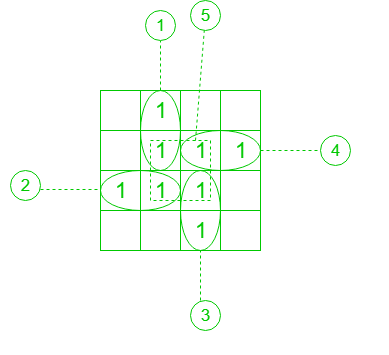
**Expression : BD + A'C'D + A'BC+ ACD+ABC'
No. of Prime Implicants(PI) = 5 {1,2,3,4,5}
No. of Essential Prime Implicants(EPI) = 4 {1,2,3,4}
No. of Redundant Prime Implicants(RPI) = 1 {5}
No. of Selective Prime Implicants(SPI) = 0
**Example 2
Given F = ∑(0, 1, 5, 8, 12, 13), find number of implicant, PI, EPI, RPI and SPI.
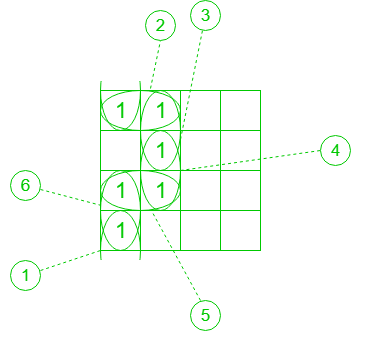
**Expression : A'B'C'+ C'DB + C'D'A
No. of Prime Implicants(PI) = 6 {1,2,3,4,5,6}
No. of Essential Prime Implicants(EPI) = 0
No. of Redundant Prime Implicants(RPI) = 0
No. of Selective Prime Implicants(SPI) = 6 {1,2,3,4,5,6}
**Example 3
Given F = ∑(0, 1, 5, 7, 15, 14, 10), find number of implicant, PI, EPI, RPI and SPI.
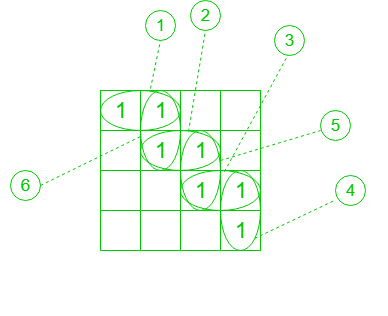
No. of Prime Implicants(PI) = 6 {1,2,3,4,5,6}
No. of Essential Prime Implicants(EPI) = 2 {1,4}
No. of Redundant Prime Implicants(RPI) = 2
No. of Selective Prime Implicants(SPI) = 4 {2,3,5,6}
**Read More:
Practices Problems
**1. Finding Prime Implicants
- Simplify the following Boolean function using a K-Map and identify all prime implicants:
f(A, B, C, D) = ∑(0, 1, 2, 5, 8, 9, 10, 14)
**2. Minimization with Don't Care Conditions
- Given the Boolean function with don't care conditions, use a K-Map to minimize it:
f(A, B, C) = ∑(0, 1, 2, 5, 7) + d(3, 6)
**3. Finding Essential Prime Implicants
- For the following function, find the essential prime implicants using a K-Map:
f(A, B, C, D) = ∑(1, 3, 7, 11, 15) + d(0, 2, 5)
**4. Four-Variable K-Map Minimization
- Simplify the given Boolean function using a 4-variable K-Map:
f(A, B, C, D) = ∑(1, 3, 7, 11, 15, 19, 23, 27, 31)
**5. Implicants and Essential Prime Implicants
- Determine all implicants and essential prime implicants for the function:
f(A, B, C) = ∑(0, 1, 2, 3, 5, 7)
**6. Three-Variable K-Map Simplification
- Use a 3-variable K-Map to simplify the Boolean function:
f(A, B, C) = ∑(1, 3, 4, 6, 7)
**7. Five-Variable K-Map Minimization
- Simplify the following Boolean function using a 5-variable K-Map:
f(A, B, C, D, E) = ∑(1, 3, 7, 15, 31)
**8. Minimizing Boolean Expressions with Don't Cares
- Given the function and don't care conditions, use a K-Map to minimize:
f(A, B, C, D) =∑(2, 3, 5, 7, 11, 13) + d(0, 1, 9, 15)
**9. Identification of Prime and Essential Prime Implicants
- For the following Boolean function, identify all prime implicants and essential prime implicants:
f(A, B, C, D) = ∑(4, 5, 6, 7, 12, 13, 14, 15)
**10. Simplification Using K-Map with Multiple Variables
- Simplify the Boolean function using a K-Map and identify any essential prime implicants:
f(A, B, C, D, E) = ∑(0, 1, 2, 5, 8, 9, 10, 14, 16, 17, 18, 21)