Vector Calculus in Maths (original) (raw)
Last Updated : 6 Oct, 2025
**Vector Calculus in maths is a subdivision of **Calculus that deals with the differentiation and integration of Vector Functions. We already know that Calculus is a branch of mathematics that deals with the rate of change of a function with respect to another function. There are two major divisions of Calculus, namely, **Differential Calculusand **Integral Calculus.
The branch of Differential Calculus deals with the process of finding derivatives or differentiation of functions, while Integral Calculus deals with finding the**antiderivative of a function whose **derivative is given
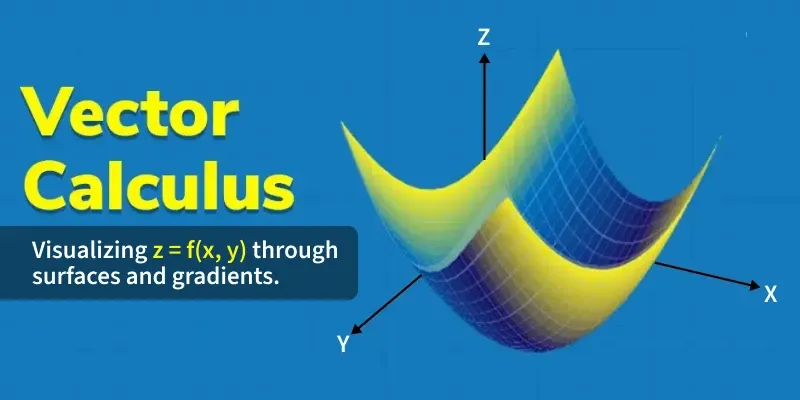
The vector fields are the vector functions whose domain and range are not dimensionally related to each other. The branch of Vector Calculus corresponds to the multivariable **calculus which deals with partial differentiation and multiple integration. This differentiation and integration of vectors is done for a quantity in 3D physical space represented as R3. For n-dimensional space, it is represented as Rn.
Vector Calculus is often called Vector Analysis, deals with vector quantities, i.e., the quantities that have both magnitude as well as direction. Since we know that Vector Calculus deals with differentiation and integration of functions, there are three types of integrals dealt with in Vector Calculus that are
- Line Integral
- Surface Integral
- Volume Integral
Line Integral
Line Integral in mathematics is the integration of a function along a line of the curve. The function can be a scalar or vector whose line integral is given by summing up the values of the field at all points on a curve weighted by some scalar function on the curve. Line Integral is also called Path Integral and is represented by Φ = ∫Lf. Line Integral has its application in physics. For Example, Work Done by Force is along a path given as W = ∫LF(s).ds because we know that work done is given as the product of force and distance covered.
Surface Integral
Surface Integral in mathematics is the integration of a function along the whole region or space that is not flat. In Surface integral, the surfaces are assumed of small points hence, the integration is given by summing up all the small points present on the surface. The surface integral is equivalent to the double integration of a line integral. Surface Integral has got its application in Electromagnetism and many more branches of physics where the vector function is spread over the surface. Surface Integral is represented as ∬sf(x,y)dA.
Volume Integral
A volume integral, also known as a triple integral, is a mathematical concept used in calculus and vector calculus to calculate the volume of a three-dimensional region within a space. It is an extension of the concept of a definite integral in one dimension to three dimensions.
Mathematically, the volume integral of a scalar function **f(x, y, z) over a region **R in three-dimensional space is denoted as:
\bold{\iiint_R f(x, y, z) \ dV}
Where
- **dV represents an infinitesimal volume element, and
- Integral is taken over region **R.
Operation in Vector
The different operations performed with vector quantities are tabulated below with their notation and illustration.
| Operation | Notation | Illustration |
|---|---|---|
| **Vector Addition | r1 + r2 | Addition of two vectors gives a vector |
| **Scalar Multiplication | q.r1 | Multiplying a vector 'r1' with scalar 'q' result in a vector |
| **Dot Product | r1 · r2 | Dot product of two vectors gives a scalar |
| **Cross Product | r1 ⨯ r2 | Cross product of two vectors gives a vector |
| **Scalar Triple Product | r1 · (r2 ⨯ r3) | Dot Product of Cross product of two vectors |
| **Vector Triple Product | r1 ⨯ (r2 ⨯ r3) | Cross Product of Cross Product of two Vectors |
Divergence and Curl
Divergence and Curl are two important operators used in Vector Calculus.
- Divergence is a scalar operator which tells about the behaviour of a function towards or away from a point.
- Curl is a vector operator which tells about the behaviour of a function around a point.
- The vector operator is represented by ∇ which accounts for the partial differentiation of the vector field.
- The Vector Differential Operator (∇) also called Nabla is expressed as ∇ = ∂/∂x i + ∂/∂y j + ∂/∂z k.
Divergence of Vector
If a vector field is given by f(x,y,z) = fxi + fyj + fzk then its divergence is given by taking the scalar of the vector operator is given by
div(f) = ∇.f(x,y,z) = (∂/∂x i + ∂/∂y j + ∂/∂z k) · (fxi + fyj + fzk )
⇒ ∇.f(x,y,z) = ∂x/∂x + ∂y/∂y + ∂z/∂z.
Curl of Vector
If a vector field is given by f(x,y,z) = fxi + fyj + fzk then its curl is given by taking the vector of the vector operator
∇ × f(x,y,z) = (∂/∂x i + ∂/∂y j + ∂/∂z k) ⨯ (fxi + fyj + fzk )
⇒ ∇ × f(x,y,z) = \begin{vmatrix} i & j & k \\ \partial /\partial x& \partial /\partial y & \partial /\partial z \\ f_{x} & f_{y} & f_{z} \\ \end{vmatrix}
⇒ ∇ × f(x,y,z) = (∂z/∂y - ∂y/∂z)i + (∂x/∂z - ∂z/∂x)j + (∂y/∂x - ∂x/∂y).
Gradient of Scalar
The gradient of a scalar field F is given by grad(F) or ∇ F. It gives the measurement of the rate and direction of a scalar-valued function. In the Cartesian system, the gradient of a scalar-valued function is given by
∇ F = (∂/∂x i + ∂/∂y j + ∂/∂z k)F = ∂/∂x i + ∂/∂y j + ∂/∂z k
Vector Calculus Formulas
For a vector field given as F(x,y,z) = p(x,y,z)i + q(x,y,z)j + r(x,y,z)k. The following formulas are given.
Fundamental Theorem of Line Integral
if F = ∇Φ and Curve C has A and B endpoints then its line integral is given as
**∫ c F.dr = Φ(B) - Φ(A)
Circulation Curl Form
There are two theorems under Circulation Curl Form, namely the Green theorem and Stokes theorem.
- **Green Theorem: If D is the region bounded by curve C then, ∮cF.dr = ∬D(∂Q/∂x - ∂P/∂y)dA
- **Stoke's Theorem: For a surface S bounded by curve C stokes theorem given by ∮cF.dr = ∬S(∇ ⨯ F)dS
Flux Divergence Theorem
- The **Flux Divergence Form of Green's Theorem is given as ∬D∇. F dA = ∮cF.n ds
- The **Flux Divergence Form of Stoke's Theorem is given as ∭D ∇. F dV = ∯sF.n dσ
Vector Calculus Applications
**Vector Calculus or vector analysis has a number of applications in the real world:
- Navigation
- Sports
- Partial differential equation
- Three-dimensional geometry
- Used in heat transfer