Introduction to Differential Calculus (original) (raw)
Last Updated : 31 Jan, 2026
Calculus is divided into two parts intergal and differential.
- Integral calculus studies the area under the curve.
- Differential calculus deals with the study of rates of change of functions and how these functions behave when there are very small changes in their independent variables.
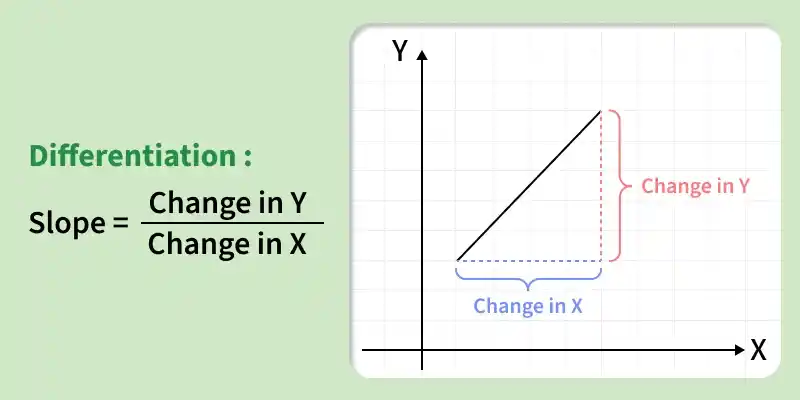
Differentiation as slope
It is primarily concerned with the concept of a derivative, which represents the rate of change of a function with respect to a variable.
**Key Concepts in Differential Calculus
**1. Limits
The limit of any function at a given point tells us about its behaviour at and around the point of consideration.
It is given as lim x⇝a f(x).
For a function y = f(x), the limit x approaches a for the function y = f(x) represents the value the function approaches when we approach the input value x = a.
Limit is unique in nature, i.e., for x tends to **a, there can't be two values of f(x).
**Learn in detail
- Direction Substitution
- L-Hospital Rule
- Limits by Rationalization
- Limits Formulas
- Real-Life Applications
- Finding Limits
**2. Continuity
A function is said to be continuous at a point if there is no break, jump, or hole in the graph of the function at that point.
For a function f(x) to be continuous at a point x = a, the following conditions must be met:
- f(a) exists and has a finite value.
- The limit of f(x) as x approaches a exists (i.e., the left-hand limit and the right-hand limit at x=ax=a are equal).
- The limit of f(x) as x approaches a is equal to f(a).
\lim_{x \to a^{-}}f(x)=\lim_{x \to a^{+}}f(x)=f(a)
**Note: Every differentiable function is continuous, but every continuous function is not differentiable.
**3. Differentiability
Differentiability is a property of a function that tells us whether it has a well-defined tangent line (or slope) at a given point.
A function f(x) is said to be differentiable at a point x = a if the limit
\lim_{x \to a}\frac{f(x)-f(a)}{x-a}
exists and is finite.
That limit, when it exists, is the derivative of f at a, denoted f′(a)
**Conditions for Differentiability: Left and Right-hand Limits
4. Derivatives
Derivative is defined as the change in the output of a function with respect to the given input. This change is used to analyze the various physical factors associated with the function.
| Derivative at a Point | \bold{\lim_{x \to c}\frac{f(x)-f(c)}{x-c}} |
|---|---|
| Derivative of a Function | \bold{f'(x) = \lim_{h \to 0} \frac{f(x + h) -f(x)}{h}} |
| **Derivative as a Rate Measure | \dfrac{dy}{dx}=\bold{\lim_{\Delta x \to 0}\dfrac{\Delta y}{\Delta x}} |
| **Differentiation from the First Principle | \bold{f'(x) = \lim_{h \to 0} \frac{f(x + h) -f(x)}{h}} |
**Rules
To find the derivative of more complicated functions, we have some rules that make the derivative simpler and easier. Some of them are:
**Other Differentiation Techniques
Some other differentiation techniques include:
5. Applications of Derivatives
Derivatives are used extensively in our daily lives, from calculating the speed of a moving vehicle to optimizing business decisions and understanding natural phenomena. In addition to real-life applications, derivatives are also used to solve various problems and help explain complex concepts. Some such use cases in mathematics are: