Introduction to Polygon (original) (raw)
Last Updated : 23 Jul, 2025
Polygon formerly known as Matic network is an open-source decentralized blockchain network founded by Jayant Kanani, Sandeep Nailwal, and Anurag Arjun in the year 2017. The following topics will be discussed here:
- Introduction to Polygon Blockchain
- Key Features of Polygon
- Who is Behind Polygon?
- Are MATIC and Polygon the Same Thing?
- Why is Polygon Good for Ethereum?
- Polygon vs Ethereum Layer 1
- What Makes Polygon so Special?
- Ethereum's Scalability Problem
- Pros of Polygon
- Cons of Polygon
- How does Polygon work?
- What is Polygon Wallet?
Let’s discuss each of these topics in detail.
Introduction to Polygon Blockchain
The native token of Polygon is MATIC, which is used to govern and secure the network. This currency of Polygon enables users to interact with hundreds of dApps involved in the Polygon ecosystem. It is a multi-level platform. Polygon's SDK uses sidechains through Avail which is a scaling system designed for developers to launch their blockchain applications atop the main Polygon chain and other blockchains to connect to Ethereum with the ability to connect to any other blockchain network. The plan of the Polygon network is to connect all the blockchain networks. The faster transaction rate and cheap transaction fees made Polygon attractive to developers.
Key Features of Polygon
- Proof-of-Stake(PoS): Polygon uses a Proof-of-Stake(PoS) consensus mechanism which enables a consensus to be achieved with every block.
- Solution to Ethereum: Polygon tries to provide the solution present in the Ethereum network which is low transaction speed, and high computational power. On the Polygon network, the transaction speed is as high as 65,000.
- Programming Language: The programming language used to develop the Polygon network is Golang, Solidity, and Vyper.
- Availability: On Polygon sidechains there are features like the transactions are quick, low-cost, and safe, with finality on the mainchain and Ethereum as the first suitable Layer 1 base chain.
- High throughput: It was able to reach up to 7,000 TPS on a single sidechain. For horizontal scaling, many chains will be created.
- Customer experience - Polygon provides with WalletConnect support, native mobile applications, SDK, and developer abstraction from the mainchain to the Polygon chain.
- Security: Operators of Polygon chains are also stakers in the PoS protocol system. Polygon is intrinsically more secure than many blockchain networks as a result of the validation system
- Public sidechains: The Matic sidechains are open to the public, permissionless, and also capable of supporting numerous protocols.
Who is Behind Polygon?
Polygon formerly known as Matic is founded by Jayant Kanani, Sandeep Nailwal, and Anurag Arjun in the year 2017.
- They published Polygon's white paper under the name Matic Network in 2017.
- Through that white paper, they were the first ones to address the disadvantage associated with the Ethereum blockchain which are high gas fees, low transaction speed, and high computational power requirement.
- The Polygon network also refers to itself as “Ethereum’s internet of blockchains” because Polygon’s main mission is to aggregate scalable solutions to support a multichain Ethereum ecosystem.
- The Polygon network is Ethereum-native as it is built on top of the Ethereum blockchain network, aligned to be interoperable with all of Ethereum’s existing and even future infrastructures while offering it a framework for interoperability with other layer-2 solutions, sidechains, and autonomous blockchains.
The Polygon network is also categorized as a layer-2 aggregator, aiming to create a multichain ecosystem of Ethereum-compatible blockchains with superior interoperability.
Are MATIC and Polygon the Same Thing?
Matic network was initially launched in the year 2019 and was later renamed Polygon in February 2021. Still, the native token of Polygon is MATIC. Matic tokens are traded on the Ethereum blockchain this is because Polygon was developed to help scale Ethereum through side chains. Matic tokens on the Polygon network are used to govern and secure the Polygon network. MATIC is an ERC-20 token, which means it is compatible with other Ethereum-based currencies.
Why is Polygon Good for Ethereum?
- Polygon provides a decentralized platform that helps facilitate low-cost transactions.
- The Polygon project was initially launched to connect and grow projects compatible with Ethereum.
- Polygon is a secondary scaling solution for the Ethereum blockchain network.
- This works on top of the other blockchain networks rather than creating one of its own.
Polygon vs Ethereum Layer 1
Below are some of the differences between Polygon and Ethereum layer 1:
| Polygon | Ethereum |
|---|---|
| Polygon is a Layer 2 blockchain network. | Ethereum is an example of a Layer 1 blockchain network. |
| A Layer 2 blockchain network is one built on other blockchain networks. | Layer 1 blockchain network is based blockchain architecture. |
| Layer 2 blockchain network interacts with the base blockchain network. | Layer 2 makes Layer 1 blockchain more scalable. |
What Makes Polygon so Special?
- On the Polygon network, the transaction speed is as high as 65,000 transactions per second while on Ethereum the transaction speed is 13-15 transactions per second.
- Since Polygon provides a hybrid environment, it is this fast compared to other blockchain networks.
- Polygon’s main network is a Proof-of-Stake (PoS) sidechain in which network participants can stake MATIC to validate the transactions and vote on network upgrades.
- Polygon has made the Ethereum network more Scalable by many methods like Zero knowledge roll-ups, PoS, sharding, etc. These help to encrypt a large number of transactions in less time as compared to the PoW used by Ethereum.
- Polygon community is also a reason which makes it so special which helps in fixing the bug.
Ethereum's Scalability Problem
Ethereum uses Proof-of-Work(PoW) consensus protocol, due to this it requires a huge amount of computational power. The transaction speed on the Ethereum network is also slow as compared to other blockchain networks like Solana, Ethereum offers 12-25 TPS within six minutes of confirmation time. The gas fees are also very high on the Ethereum network. When comes to scalability Polygon is better than Ethereum and a little similar to Solana. Since Ethereum is a layer 1 network, Sidechains or layer 2 networks can be created on top of it, which can complement the Ethereum network and enhance its capacity. There is a scalability challenge due to the inherent properties of Ethereum mining that restrict block generation to between 7-15 transactions per second. A key contributing factor to this restriction is the need for every node to process each and every transaction that happens on the network. There are potential solutions to this which are :
- Sharding: This involves dividing the chain state into smaller pieces which are known as Shards. So the nodes present inside that shard must process all the transactions that originated inside that shard. Thus by reducing the number of nodes the overall network can be improved.
- State chain: In this solution, the process currently worked on is prioritized and the other operation is shifted to off-chain. Only the proof is submitted to the main chain.
- Plasma: It is an off-chain scaling technique, here the interaction with the main chain is minimal and it relies on off-chain.
How Polygon Works?
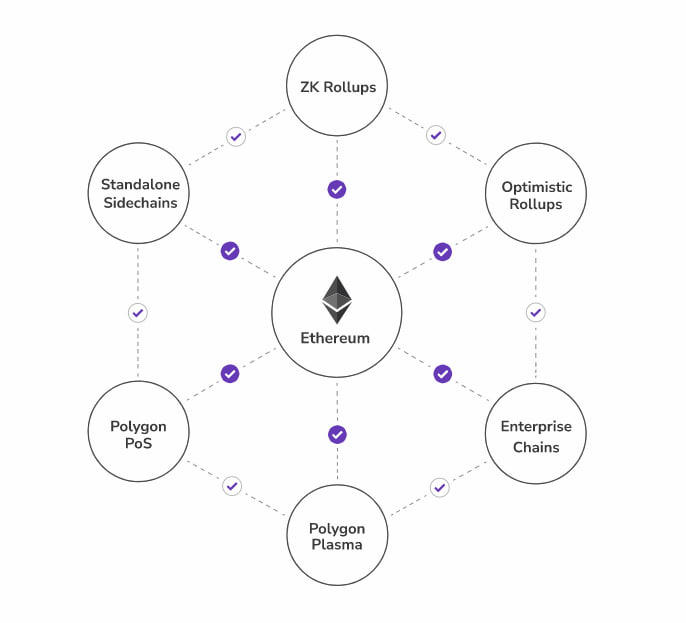
Polygon uses a Proof-of-Stake(PoS) consensus mechanism which enables a consensus to be achieved with every block. The proof-of-stake method requires network participants to validate the transaction on the Polygon network, successful validators in the Polygon network are rewarded with MATIC. The programming language used to develop the Polygon network is Golang, Solidity, and Vyper. Polygon comes with the idea that it works like a Proof-of-State blockchain and exchanges are present in the form of clusters. Polygon has a three-layer of architecture:
1. Staking smart contracts on Ethereum: Polygon maintains a set of smart contracts on Ethereum, which handles Staking management for the Proof-of-Stake layer and Checkpoints/snapshots of the sidechain state.
2. Heimdall (Proof of Stake layer): Heimdall is the PoS validator node that works in consonance with the Staking contracts on Ethereum to enable the PoS mechanism on Polygon. This is responsible for block validation, and block procedure committee selection which is a committee selected from the Validators pool on the basis of their stake which happens at regular intervals. Along with this Heimdal is responsible for checkpointing a representation of the sidechain blocks to Ethereum in our architecture and various other responsibilities which are important for two reasons :
- It provides finality to the root chain, in cryptocurrency finality is the assurance or guarantee that the transaction once done cannot be reversed or altered once completed.
- It provides proof of burn-in withdrawal of assets, in cryptocurrency burning means to remove the token from the available supply. For the purpose of burning the wallet address used is known as "burner" or "eater" addresses. Burning refers to sending the token to the address which can only receive the token.
3. Bor (Block Producer Layer): Bor is the Polygon block producer layer - the entity responsible for aggregating transactions into blocks. Blocks are produced at the Bor node and the sidechain VM is EVM-compatible. The blocks that are produced in the Bor node are periodically validated on their Heimdall node and on the checkpoints consisting of Merkle tree hash. The Merkle tree hash is made by hashing the nodes repeatedly until only one node is remaining.
What is a Polygon Wallet?
Polygon wallet is a blockchain wallet that is used to store the native token of Polygon MATIC. Here Polygon users can store, receive or send the native token MATIC. Polygon wallet provides high security and privacy and it charges marginal transaction fees. Wallet users can send requests for a certain amount of Matic from other users after which the wallet system will generate a unique wallet address that can be sent to a third party or a QR code will be generated which stores the financial information which is to be read by the user on the other end. The Polygon wallet enables users to send, and request MATIC tokens along with facilities like loans and interest accounts. The Polygon wallet provides some key features like :
- Low transaction fees.
- Multi-factor Authentication.
- The minimum deposit amount is Low.
- Digital signature.
- Bonus features.
Not all Polygon Wallets are secure some of them are built by criminals which act as a backdoor for hackers to steal your money by taking your private key. Then some wallets are having privacy features like multi-factor authentication, security audits, etc. Many secure MATIC wallets even come with insurance that protects your funds in case of any kind of bad thing takes place for example YouHodler wallets.
Pros of Polygon
Below are the pros of Polygon Blockchain:
- Polygon is intrinsically more secure than many blockchain networks as a result of the validation system
- On the Polygon blockchain, the network transactions are processed at a record speed of 2.1 seconds.
- Polygon uses a joint system consisting of PoS and the Heimdall architecture that increases scalability and power
- The multi-chain system allows Polygon to access and use the full power of Ethereum as it is built on top of it.
- It has a fully customizable tech stack, due to which users have a similar experience as Ethereum.
Cons of Polygon
Below are the cons of Polygon Blockchain:
- Polygon is not an independent blockchain network and rather depends on the Ethereum blockchain to conduct transactions.
- The Polygon native token MATIC can only be used for transactions on the network, and it can't be used for everyday transaction
- With developments in Ethereum 2.0, it is possible that Polygon will no longer be required as the second layer of Ethereum
- Because of its autonomy, it faces serious competition from other blockchain technologies.