ETL Process in Data Warehouse (original) (raw)
Last Updated : 6 Nov, 2025
ETL(Extract, Transform, Load) is a key process in data warehousing that prepares data for analysis. It involves:
- **Extracting data from multiple sources
- Transforming it into a consistent format
- Loading it into a central data warehouse or data lake
**Note: ETL helps businesses unify and clean data, making it reliable and ready for analysis. It improves data quality, security and accessibility, enabling better insights and faster decision-making in a world of diverse data sources.
ETL Process
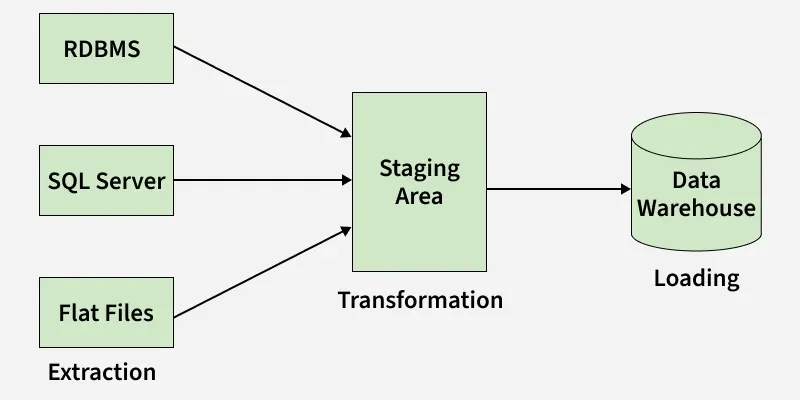
The ETL process, which stands for Extract, Transform and Load, is a critical methodology used to prepare data for storage, analysis and reporting in a data warehouse. It involves three distinct stages that help to streamline raw data from multiple sources into a clean, structured and usable form.
ETL
The Extract phase is the first step in the ETL process, where raw data is collected from various data sources. These sources can be diverse, ranging from structured sources like databases (SQL, NoSQL), to semi-structured data like JSON, XML or unstructured data such as emails or flat files. The main goal of extraction is to gather data without altering its format, enabling it to be further processed in the next stage.
Types of data sources can include:
- **Structured: SQL databases, ERPs, CRMs
- **Semi-structured: JSON, XML
- **Unstructured: Emails, web pages, flat files
2. Transformation
The Transform phase is where the magic happens. Data extracted in the previous phase is often raw and inconsistent. During transformation, the data is cleaned, aggregated and formatted according to business rules. This is a crucial step because it ensures that the data meets the quality standards required for accurate analysis.
Common transformations include:
- **Data Filtering: Removing irrelevant or incorrect data.
- **Data Sorting: Organizing data into a required order for easier analysis.
- **Data Aggregating: Summarizing data to provide meaningful insights (e.g., averaging sales data).
**Note: The transformation stage can also involve more complex operations such as currency conversions, text normalization or applying domain-specific rules to ensure the data aligns with organizational needs.
3. Loading
Once data has been cleaned and transformed, it is ready for the final step: Loading. This phase involves transferring the transformed data into a data warehouse, data lake or another target system for storage. Depending on the use case, there are two types of loading methods:
- **Full Load: All data is loaded into the target system, often used during the initial population of the warehouse.
- **Incremental Load: Only new or updated data is loaded, making this method more efficient for ongoing data updates.
Pipelining in ETL Process
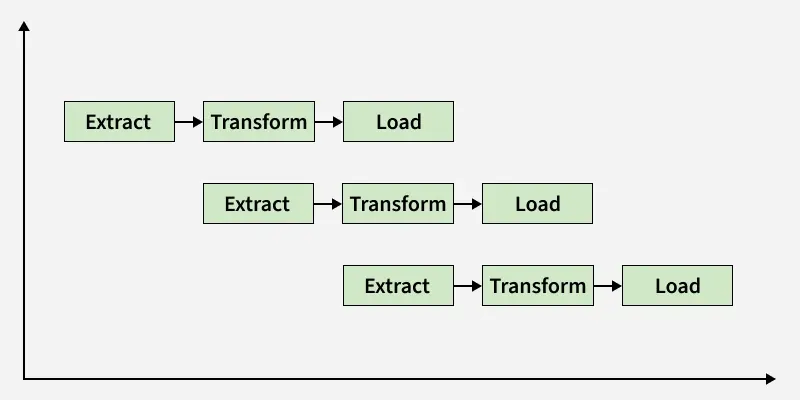
Pipelining in the ETL process involves processing data in overlapping stages to enhance efficiency. Instead of completing each step sequentially, data is extracted, transformed and loaded concurrently. As soon as data is extracted, it is transformed and while transformed data is being loaded into the warehouse, new data can continue being extracted and processed.
- This parallel execution reduces downtime, speeds up the overall process and improves system resource utilization, making the ETL pipeline faster and more scalable.
- In short, the ETL process involves extracting raw data from various sources, transforming it into a clean format and loading it into a target system for analysis.
ETL PipeliningETL Pipelining
**Note: This is crucial for organizations to consolidate data, improve quality and enable actionable insights for decision-making, reporting and machine learning. ETL forms the foundation of effective data management and advanced analytics.
Importance of ETL
- **Data Integration: ETL combines data from various sources, including structured and unstructured formats, ensuring seamless integration for a unified view.
- **Data Quality: By transforming raw data, ETL cleanses and standardizes it, improving data accuracy and consistency for more reliable insights.
- **Essential for Data Warehousing: ETL prepares data for storage in data warehouses, making it accessible for analysis and reporting by aligning it with the target system's requirements.
- **Enhanced Decision-Making: ETL helps businesses derive actionable insights, enabling better forecasting, resource allocation and strategic planning.
- **Operational Efficiency: Automating the data pipeline through ETL speeds up data processing, allowing organizations to make real-time decisions based on the most current data.
Challenges in ETL Process
The ETL process, while essential for data integration, comes with its own set of challenges that can hinder efficiency and accuracy. These challenges, if not addressed properly, can impact the overall performance and reliability of data systems.
- **Data Quality Issues: Inconsistent, incomplete or duplicate data from multiple sources can impact transformation and loading, leading to inaccurate insights.
- **Performance Bottlenecks: Large datasets can slow down or cause ETL processes to fail, particularly during complex transformations like cleansing and aggregation.
- **Scalability Issues: Legacy ETL systems may struggle to scale with growing data volumes, diverse sources and more complex transformations.
Solutions to Overcome ETL Challenges
- **Data Quality Management: Use data validation and cleansing tools, along with automated checks, to ensure accurate and relevant data during the ETL process.
- **Optimization Techniques: Overcome performance bottlenecks by parallelizing tasks, using batch processing and leveraging cloud solutions for better processing power and storage.
- **Scalable ETL Systems: Modern cloud-based ETL tools (e.g., Google BigQuery, Amazon Redshift) offer scalability, automation and efficient handling of growing data volumes.
ETL (Extract, Transform, Load) tools play a vital role in automating the process of data integration, making it easier for businesses to manage and analyze large datasets. These tools simplify the movement, transformation and storage of data from multiple sources to a centralized location like a data warehouse, ensuring high-quality, actionable insights. Some of the widely used ETL tools include:
- **Apache Nifi: Open-source tool for real-time data flow management and automation across systems.
- **Talend: Open-source ETL tool supporting batch and real-time data processing for large-scale integration.
- **Microsoft SSIS: Commercial ETL tool integrated with SQL Server, known for performance and scalability in data integration.
- **Hevo: Modern data pipeline platform automating ETL and real-time data replication for cloud data warehouses.
- **Oracle Warehouse Builder: Commercial ETL tool for managing large-scale data warehouses with transformation, cleansing and integration features.
Open-Source vs. Commercial ETL Tools
**1. Open-Source ETL Tools:
- These tools, like Talend Open Studio and Apache Nifi, are free to use and modify.
- They offer flexibility and are often ideal for smaller businesses or those with in-house technical expertise.
- However, open-source tools may lack the advanced support and certain features of commercial tools, requiring more effort to maintain and scale.
**2. Commercial ETL Tools:
- Tools like Microsoft SSIS, Hevo and Oracle Warehouse Builder are feature-rich, offer better customer support and come with more robust security and compliance features.
- These tools are generally easier to use and scale, making them suitable for larger organizations that require high performance, reliability and advanced functionalities. However, they come with licensing costs.
Choosing the Right ETL Tool for Your Data Warehouse
- **Data Volume: Large enterprises dealing with massive datasets may prefer commercial tools like Microsoft SSIS or Oracle Warehouse Builder for their scalability and performance.
- **Real-Time Processing: For real-time data integration and AI applications, tools like Hevo or Talend are ideal, as they support both batch and streaming data processing.
- **Budget: Smaller businesses or startups may benefit from open-source tools like Apache Nifi or Talend Open Studio, as they provide robust features without the hefty price tag of commercial tools.
- **Ease of Use: If ease of use and a user-friendly interface are important, commercial tools often provide more intuitive visual design and drag-and-drop interfaces.