Java OOP(Object Oriented Programming) Concepts (original) (raw)
Last Updated : 6 Jun, 2026
Object-Oriented Programming (OOP) is a programming paradigm based on the concept of objects that contain data (fields) and behavior (methods). It focuses on designing software that closely represents real-world entities. It is used to:
- Improves code reusability
- Enhances maintainability and scalability
- Makes programs easier to understand and manage
- Closely models real-world entities
**Characteristics of OOP
The diagram below demonstrates the Java OOPs Concepts
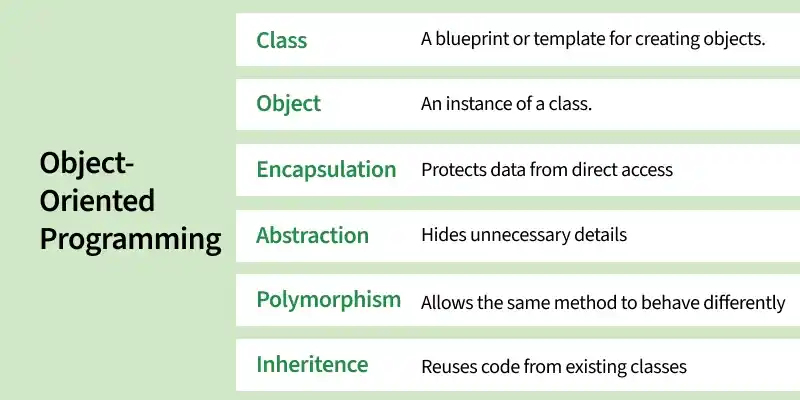
Object Oriented Programming
Class
A Class in Java is a blueprint or template used to create objects. It defines the properties (data) and behaviors (methods) that objects of that class will have.
- A class is a user-defined data type.
- It contains variables (fields) and methods.
- Multiple objects can be created from a single class.
**Example: A Car represents a class (blueprint), while BMW, Mercedes, and Audi represent objects (instances) created from that class.
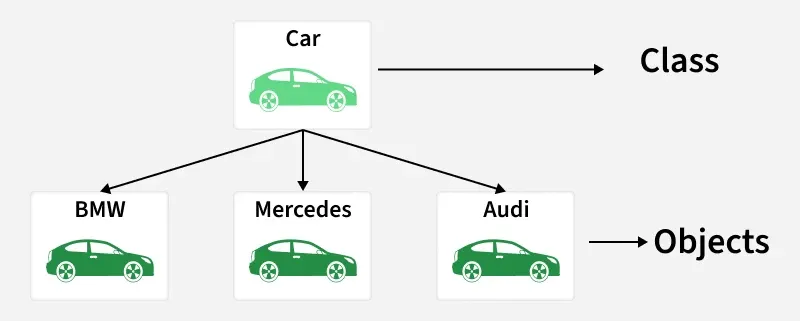
class-object
Object
An Object in Java is an instance of a class that represents a real-world entity. It is used to access the variables and methods defined inside a class.
- **State: Represents the current data or attributes of an object.
- **Behavior: Represents the actions that an object can perform.
- **Identity:Every object has a unique identity in memory that distinguishes it from other objects, even if they contain the same data.
**Example: Dog is a class, Tommy is an object of that class.
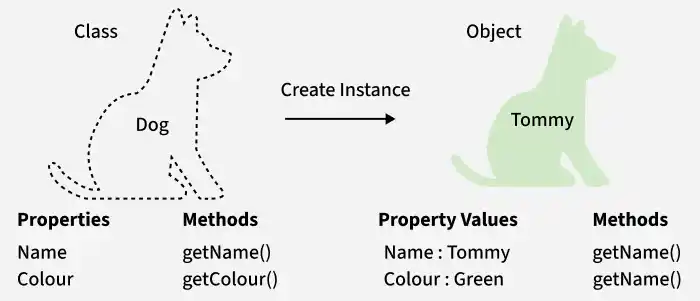
Object
Constructor
A Constructor is a special member of a class that is automatically invoked when an object is created. It is primarily used to initialize the object's data members and set up the initial state of an object.
- Constructor name must be the same as the class name.
- It does not have any return type, not even void.
- It is automatically called when an object is created using the new keyword.
- Constructors help initialize object properties during object creation.
**Example: When creating a Car object, a constructor can automatically assign values such as brand, model, and color.
Types of Constructor
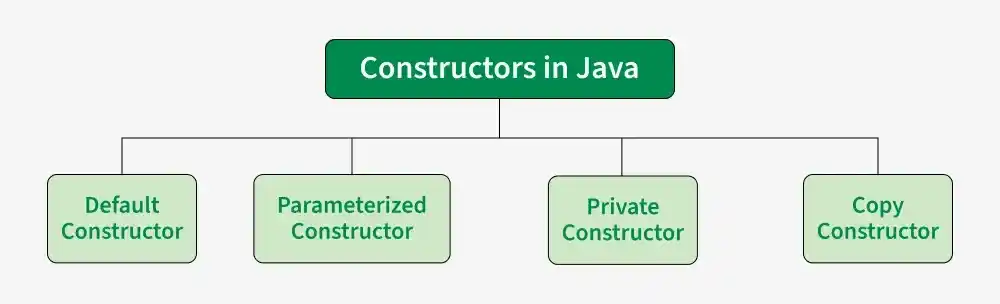
- **Default Constructor: A constructor that does not accept any parameters and initializes an object with default values.
- **Parameterized Constructor: A constructor that accepts parameters to initialize an object with specific values.
- **Copy Constructor: A user-defined constructor that creates a new object by copying the data of another object of the same class.
- **Private Constructor: A constructor declared with the private access modifier that prevents object creation from outside the class.
Abstraction
Abstraction in Java is the process of hiding implementation details and showing only the essential features of an object. It helps users focus on what an object does rather than how it does it.
- **Hides complexity: Internal implementation details are hidden from the user.
- **Improves maintainability: Changes in implementation do not affect the user code.
- **Enhances flexibility: Supports loose coupling through abstract classes and interfaces.
**Example: An ATM or a coffee machine represents abstraction, where the user interacts with simple operations while the internal working and implementation details remain hidden.
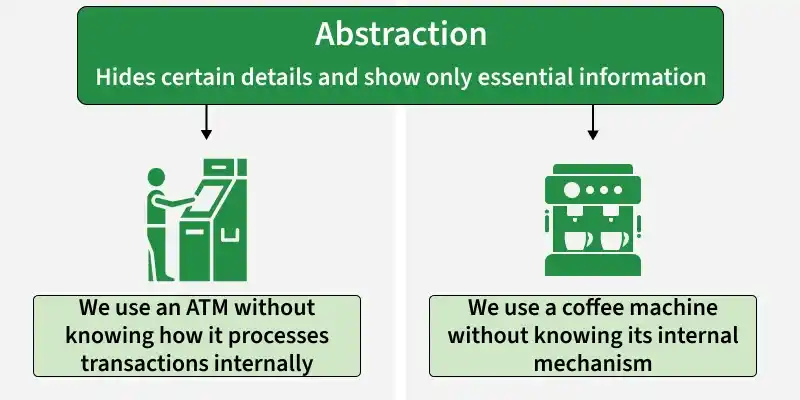
Abstraction
How to Achieve Abstraction
- It is achieved in Java using abstract classes and interfaces.
- Interfaces can provide 100% abstraction, while abstract classes provide partial abstraction.
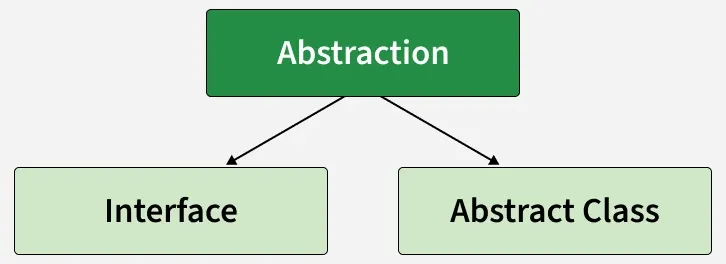
Achieve Abstraction
**Example: Abstract class defines a common base (Shape) using inheritance, while an interface (Drawable) defines behavior implemented by multiple classes.
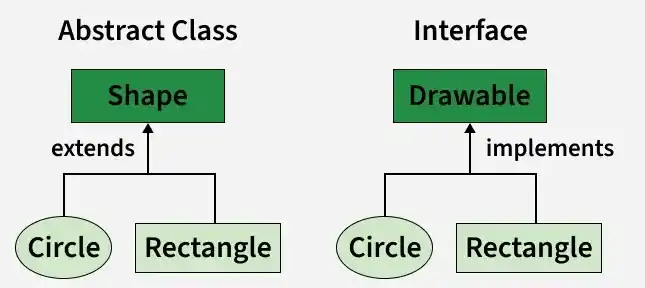
abstract-class-interface
Encapsulation
Encapsulation is the process of wrapping data and methods into a single unit, usually a class, and restricting direct access to the data. It acts as a protective shield that prevents data from being accessed directly from outside the class.
- Data members are hidden using the private access modifier.
- Access to data is provided through public getter and setter methods.
- It improves data security, maintainability, and controlled access.
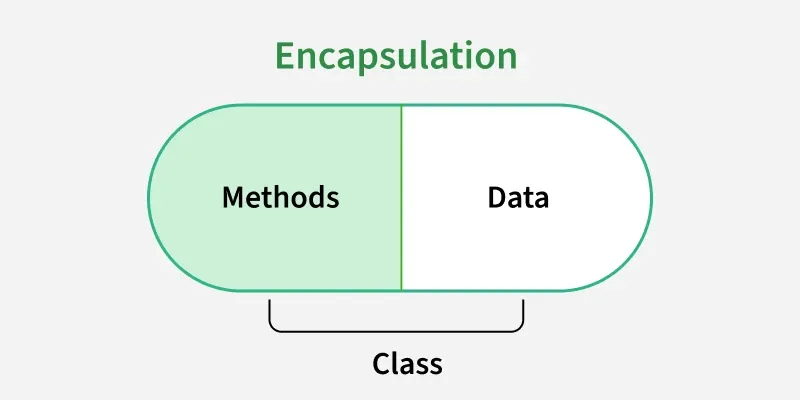
Encapsulation
Association
Association is an OOP concept that defines a relationship between two or more classes that are connected to each other. It represents how objects interact with each other and communicate. In association, objects of one class are related to objects of another class, but they can exist independently.
- Represents a relationship between objects
- Does not imply ownership
- Objects are independent of each other
Types of Association
Association in Java can be further classified into the following types:
1. Aggregation (Weak Association)
Aggregation represents a “has-a” relationship where one class contains a reference to another class, but both can exist independently.
- It is a weak relationship
- Objects have independent lifecycles
- One object can exist without the other
**Example: A Company has Employees, but employees can exist independently even if the company no longer exists.
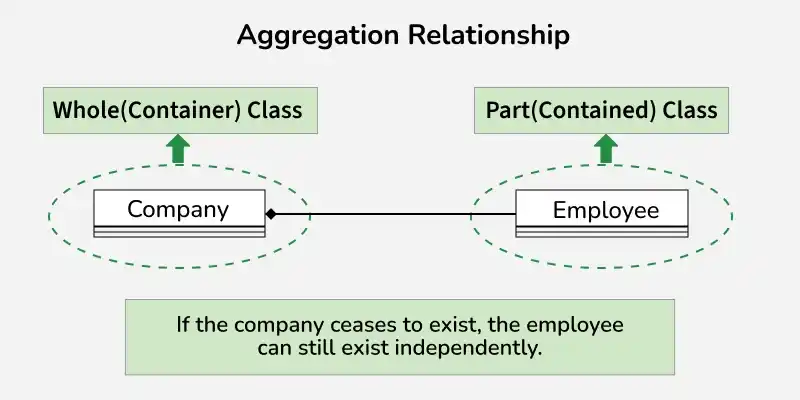
Aggregation
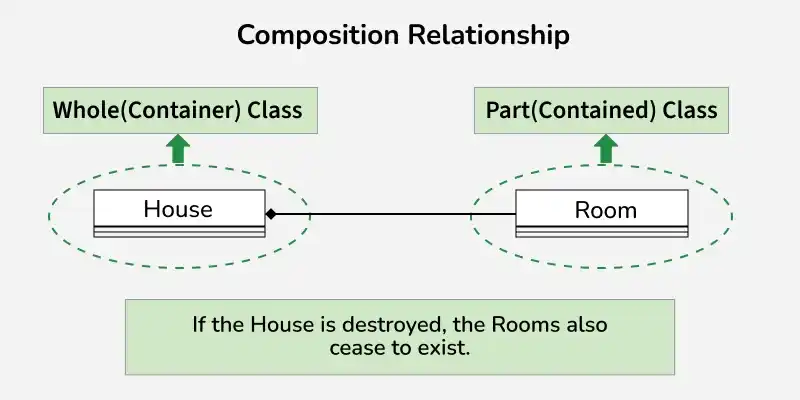
2. Composition (Strong Association)
Composition is a strong form of association where one class owns another class. If the parent object is destroyed, the child object also gets destroyed.
- It is a strong relationship
- Objects have dependent lifecycles
- Child object cannot exist without the parent
**Example: A House is composed of Rooms, and if the house is destroyed, the rooms cannot exist independently.
Inheritance
Inheritance is a core OOP concept in Java that allows one class to acquire the fields and methods of another class using the extends keyword. It represents an “is-a” relationship between classes.
- The class being inherited is called the superclass, and the inheriting class is the subclass.
- A subclass can use existing features of the superclass and also add its own.
- Inheritance promotes code reusability and reduces redundancy.
**Example: Dog, Cat, Cow can be Derived Class of Animal Base Class.
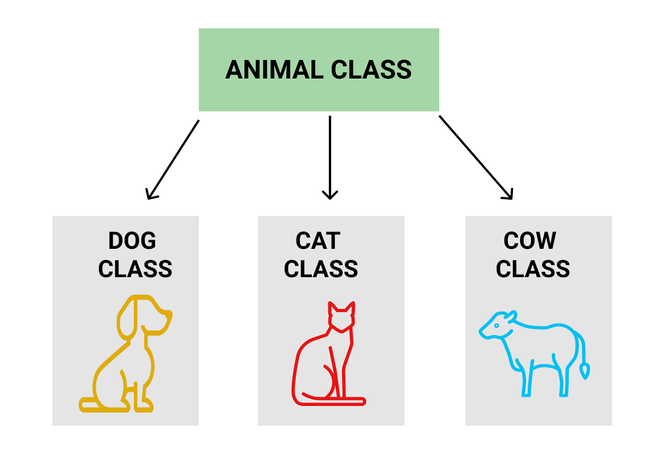
Inheritance
Types of Inheritance
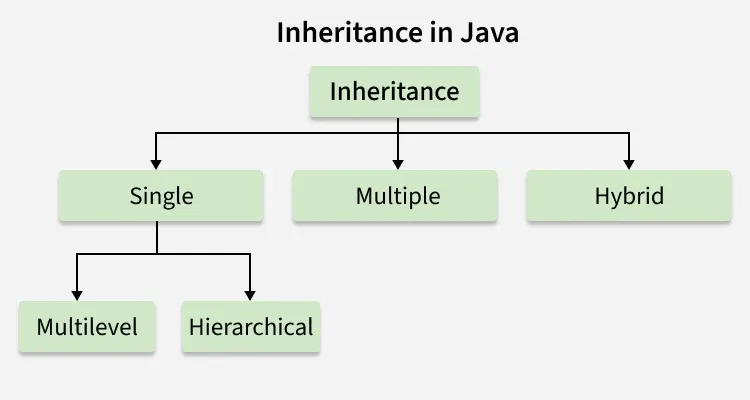
Java supports the following types of inheritance:
- **Single Inheritance: One subclass inherits from one superclass.
- **Multilevel Inheritance: A class is derived from another derived class, forming a chain.
- **Hierarchical Inheritance: Multiple subclasses inherit from a single superclass.
- **Multiple Inheritance (through Interface): A class inherits from multiple interfaces since Java does not support multiple inheritance using classes.
- **Hybrid Inheritance (through Interface): A combination of two or more types of inheritance, achievable using interfaces.
**Polymorphism
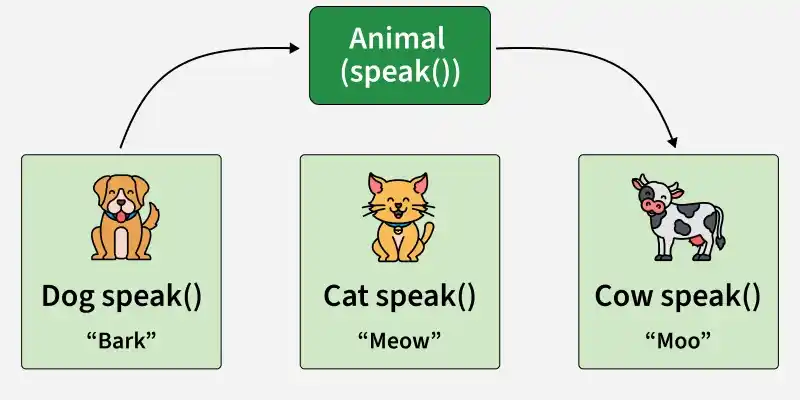
Polymorphism means “many forms”, where a single entity can behave differently in different situations. In Java, it allows the same method or object to show different behavior based on context.
- Same method, different behavior depending on the object
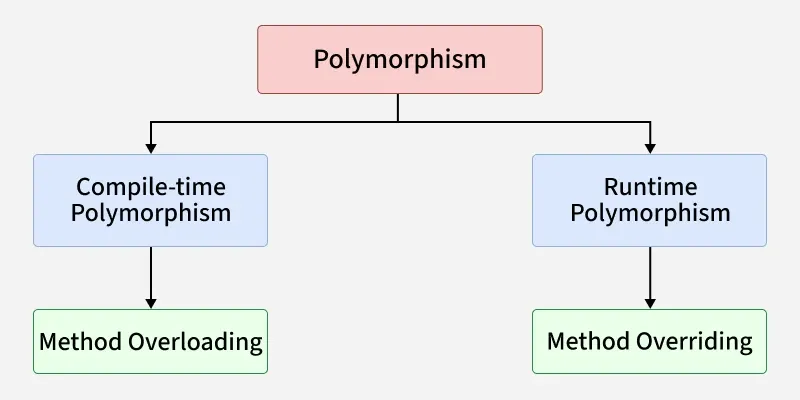
- Achieved through method overloading and method overriding
**Example: Different animals represent polymorphism, where the same method speak() produces different outputs like Bark, Meow, and Moo depending on the object.
Polymorphism
Types of Polymorphism
Polymorphism in Java is mainly of 2 types as mentioned below:
Polymorphism in Java
- Compile-time Polymorphism(Method Overloading**) :**Achieved when multiple methods have the same name but different parameters. The method call is resolved at compile time.
- Runtime Polymorphism (Method Overriding **):** Achieved when a subclass provides a specific implementation of a method already defined in its superclass. The method call is resolved at runtime based on the object
Advantage of OOP over Procedure-Oriented Programming Language
Object-oriented programming (OOP) offers several key advantages over procedural programming:
- **Code reusability: Classes and objects allow reuse of existing code, reducing duplication and improving efficiency.
- **Better structure and maintainability: Programs are organized into logical units, making code easier to understand, debug, and maintain.
- **Supports DRY principle: Common functionality is written once and reused, leading to cleaner and more maintainable code.
- **Faster development: Modular and reusable components help in quicker and scalable application development.
Limitations of OOP
While OOP provides many benefits, it also has some limitations:
- **Steeper Learning Curve: Concepts such as classes, objects, inheritance, polymorphism, abstraction, and encapsulation can be challenging for beginners.
- **Additional Overhead for Small Programs: OOP may introduce extra classes and structure that are unnecessary for simple applications.
- **Increased Design Complexity: Designing a proper class hierarchy and object relationships requires careful planning.
- **Higher Memory Consumption: Creating and managing a large number of objects can require more memory compared to procedural approaches.