Hibernate Eager/Lazy Loading (original) (raw)
Last Updated : 28 Mar, 2026
Eager and Lazy Loading in Hibernate are strategies that define how related data is fetched from the database. They control whether associated entities are loaded immediately with the parent object or only when needed, helping balance performance and resource usage.
- Eager Loading fetches related data instantly along with the main entity
- Lazy Loading delays fetching until the data is actually accessed
- Choosing the right strategy improves performance, memory usage, and query efficiency
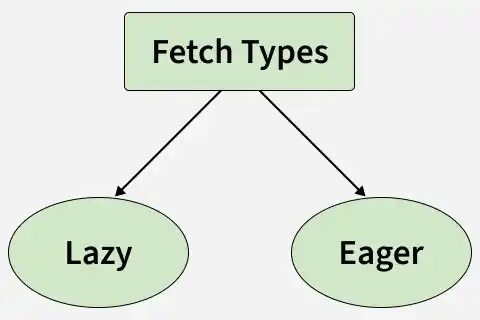
**Note: You can specify the fetch type of an association by using the fetch attribute of the @OneToMany, @ManyToOne, @OneToOne, or @ManyToMany annotations.
**LAZY Loading
FetchType.LAZY is used to delay the loading of associated entities until they are actually accessed. This helps optimize performance by avoiding unnecessary data retrieval at the time of the main entity loading.
- Loads associated data only on first access, not during initial fetch.
- Default for collection associations like @OneToMany and @ManyToMany.
- Can cause extra queries (N+1 problem) if not handled properly. Java `
@Entity public class Employee { @OneToOne(fetch = FetchType.LAZY) @JoinColumn(name = "address_id") private Address address;
// other fields and methods}
`
**Note: In this example, the Address entity associated with an Employee will be fetched lazily when it is accessed for the first time.
EAGER Loading
FetchType.EAGER means the associated entity is loaded immediately along with the main entity. It ensures that related data is always available at the time of fetching the parent entity.
- Fetches associated data instantly with the parent entity.
- Useful when related data is always required.
- Can impact performance if associated data is large or not always needed. Java `
@Entity public class Employee { @OneToOne(fetch = FetchType.EAGER) @JoinColumn(name = "address_id") private Address address;
// other fields and methods}
`
**Note: In this example, the Address entity associated with an Employee will be fetched eagerly when the Employee is loaded from the database.
Eager Loading Vs Lazy Loading
| Feature | Eager Loading | Lazy Loading |
|---|---|---|
| Definition | Loads related data immediately with the parent entity | Loads related data only when it is accessed |
| Fetching Time | At the time of initial query | On-demand (when getter is called) |
| Performance | Can be slower if unnecessary data is fetched | Improves performance by loading only required data |
| Memory Usage | Higher (loads all related data) | Lower (loads data only when needed) |
| Use Case | When related data is always required | When related data is not always needed |
| Annotation | FetchType.EAGER | FetchType.LAZY |
| Database Queries | Fewer queries but heavier data | More queries but optimized data loading |
| Risk | Over-fetching data | May cause LazyInitializationException |