Sparse Matrix in Machine Learning (original) (raw)
Last Updated : 23 Jul, 2025
In the realm of mathematics and computer science a sparse matrix is a matrix in which most of the elements are zero. The Sparse matrices are prevalent in the many applications where the majority of the data entries are zero making them a crucial concept in the optimizing storage and computational efficiency.
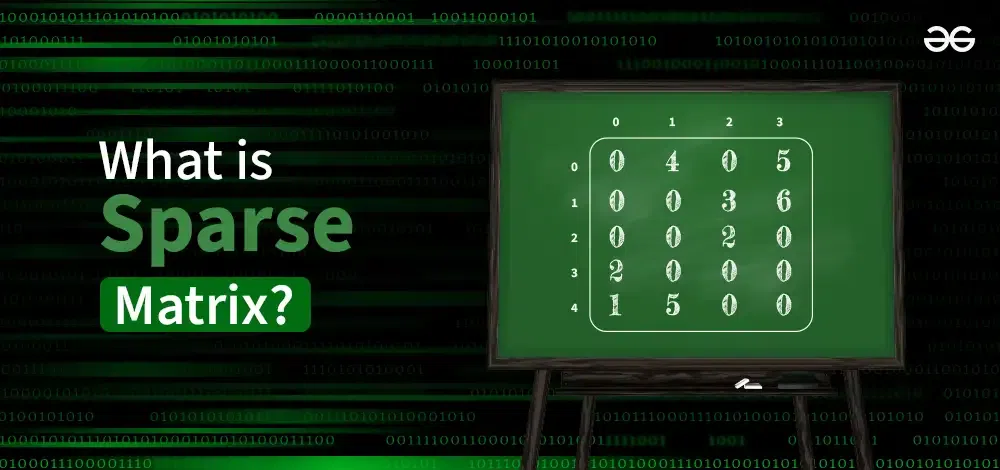
What is Sparse Matrix?
In this article, we will explore about **What is Sparse Matrix, Numerical Examples of Sparse Matrices, Applications in Machine Learning and Data Science and Popular Libraries for Sparse Matrices.
Table of Content
- What is a Sparse Matrix?
- Numerical Examples of Sparse Matrices
- Applications in Machine Learning and Data Science
- Storage Efficiency and Memory Usage
- Sparse vs Dense Matrices
- Sparse Matrix in Python
- Popular Libraries for Sparse Matrices
What is a Sparse Matrix?
The sparse matrix is a matrix in which the vast majority of its elements are zero. Formally, a matrix is considered sparse if the number of the non-zero elements is much smaller compared to the total number of the elements in the matrix. The Sparse matrices can be very large but have only a few non-zero elements.
Characteristics of Sparse Matrices
- **High Proportion of Zeroes: The defining feature of the sparse matrix is that most of its elements are zeros.
- **Storage Efficiency: The Sparse matrices can be stored the more efficiently compared to dense matrices reducing the amount of the memory required.
- **Computational Efficiency: The Operations on sparse matrices can be optimized by the focusing only on the non-zero elements.
Numerical Examples of Sparse Matrices
**Example 1: 3x3 Sparse Matrix
Consider the following 3x3 matrix:
\begin{bmatrix} 0 & 0 & 3 \\ 0 & 5 & 0 \\ 0 & 0 & 0 \end{bmatrix}
In this matrix, only two elements are non-zero (3 and 5) making it a sparse matrix with the 78% of the elements as zero.
**Example 2: 4x4 Sparse Matrix
Now, take a look at this 4x4 matrix:
\begin{bmatrix} 0 & 0 & 0 & 8 \\ 0 & 0 & 9 & 0 \\ 0 & 0 & 0 & 0 \\ 10 & 0 & 0 & 0 \end{bmatrix}
Here, only three elements (8, 9 and 10) are non-zero making it a sparse matrix with the 81% of its elements being zero.
Applications in Machine Learning and Data Science
The Sparse matrices are widely used in the various fields particularly in the machine learning and data science:
- **Recommendation Systems: In collaborative filtering for the recommendation systems user-item interaction matrices are often sparse as users typically interact with the only a small subset of items.
- **Text Mining: The Term-document matrices in text mining are sparse because each document contains only a small fraction of the total vocabulary.
- **Graph Representation: The Adjacency matrices for the large sparse graphs are often sparse, as most nodes are not connected to the each other.
Storage Efficiency and Memory Usage
The Storing sparse matrices in their entirety using the traditional dense matrix formats can be highly inefficient. Instead, specialized the storage formats are used:
- **Compressed Sparse Row (CSR): The Stores only non-zero elements and their indices compressing row-wise.
- **Compressed Sparse Column (CSC): The Similar to CSR but compresses column-wise.
- **Coordinate List (COO): The Stores a list of tuples containing the row index, column index and value of the each non-zero element.
These formats significantly reduce memory usage by the avoiding storage of the zero elements.
Sparse vs Dense Matrices
- **Dense Matrix: A matrix where most of the elements are non-zero. Dense matrices are often represented in the straightforward contiguous memory layout.
- **Sparse Matrix: A matrix where most elements are zero requiring specialized storage formats to the efficiently manage memory.
The Operations on sparse matrices are often optimized to focus on the non-zero elements whereas operations on dense matrices involve all elements.
Sparse Matrix in Python
The Python offers several libraries for the handling sparse matrices. One popular library is SciPy in which provides efficient tools for the creating and manipulating sparse matrices.
**Example 1 : Creating a Sparse Matrix in Python
Let's create the following sparse matrix using the Python and SciPy:
\begin{bmatrix} 0 & 0 & 3 \\ 0 & 5 & 0 \\ 0 & 0 & 0 \end{bmatrix}
Python `
import numpy as np from scipy.sparse import csr_matrix
Define a dense matrix
dense_matrix = np.array([[0, 0, 3], [0, 5, 0], [0, 0, 0]])
Convert the dense matrix to the sparse matrix
sparse_matrix = csr_matrix(dense_matrix)
Print the sparse matrix
print(sparse_matrix)
`
**Output :
(0, 2) 3
(1, 1) 5
This output shows the sparse matrix's non-zero values along with their indices.
**Example 2: Sparse Matrix Operations
In this example, we will perform the addition on two sparse matrices:
Python `
import numpy as np from scipy.sparse import csr_matrix
Define two dense matrices
matrix1 = np.array([[0, 0, 3], [0, 5, 0], [0, 0, 0]]) matrix2 = np.array([[0, 2, 0], [4, 0, 0], [0, 0, 1]])
Convert the matrices to the sparse matrices
sparse_matrix1 = csr_matrix(matrix1) sparse_matrix2 = csr_matrix(matrix2)
Perform addition of two sparse matrices
result = sparse_matrix1 + sparse_matrix2
Print the result
print(result)
`
**Output :
(0, 1) 2
(0, 2) 3
(1, 0) 4
(1, 1) 5
(2, 2) 1
In this output, the result shows the non-zero elements after adding the two matrices.
Popular Libraries for Sparse Matrices
The Several libraries and tools support sparse matrix operations providing the efficient implementations and storage formats:
- **SciPy (Python): The Offers a range of functions for the creating and manipulating sparse matrices using the formats like CSR and CSC.
- **NumPy (Python): While primarily for dense matrices it can interface with the sparse matrix libraries.
- **MATLAB: The Provides built-in support for sparse matrices with the various functions for the operations and storage.
- **Eigen (C++): A C++ template library for the linear algebra that includes support for the sparse matrices.
Conclusion
The Sparse matrices play a vital role in the various domains where the majority of the matrix elements are zero. Their efficient storage and processing are crucial for the handling large datasets and optimizing the computational resources. By using specialized storage formats like Compressed Sparse Row (CSR), Compressed Sparse Column (CSC) and Coordinate List (COO) we can significantly reduce the memory usage and enhance performance.