Feature Engineering (original) (raw)
Last Updated : 30 Apr, 2026
Feature Engineering is the process of selecting, creating or modifying features like input variables or data to help machine learning models learn patterns more effectively. It involves transforming raw data into meaningful inputs that improve model accuracy and performance.

Feature Engineering Architecture
This step may include handling missing values, encoding categories, scaling numbers, creating new features or combining existing ones. It helps turn messy real-world data into a form that models can understand and use for better predictions.
Importance of Feature Engineering
- **Improve accuracy: Choosing the right features helps the model learn better, leading to more accurate predictions.
- **Reduce overfitting: Using fewer, more important features helps the model avoid memorizing the data and perform better on new data.
- **Boost interpretability: Well-chosen features make it easier to understand how the model makes its predictions.
- **Enhance efficiency: Focusing on key features speeds up the model’s training and prediction process, saving time and resources.
Processes Involved in Feature Engineering
Lets see various features involved in feature engineering:
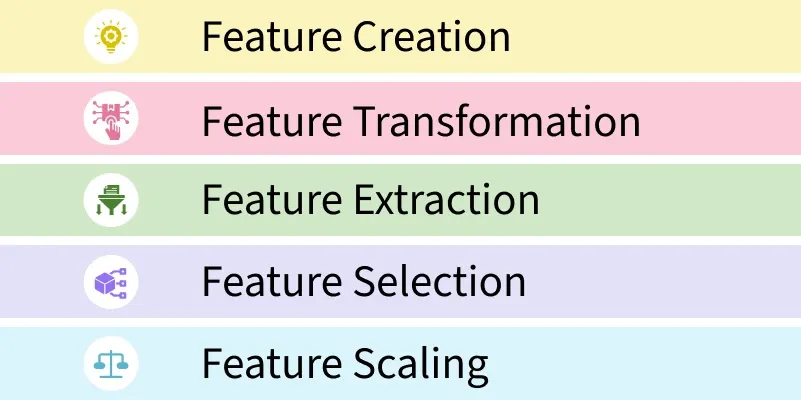
Processes involved in Feature Engineering
**1. Feature Creation: Feature creation involves generating new features from domain knowledge or by observing patterns in the data. It can be:
- **Domain-specific: Created based on industry knowledge like business rules.
- **Data-driven: Derived by recognizing patterns in data.
- **Synthetic: Formed by combining existing features.
**2. Feature Transformation: Transformation adjusts features to improve model learning:
- **Normalization & Scaling: Adjust the range of features for consistency.
- **Encoding: Converts categorical data to numerical form i.e one-hot encoding.
- **Mathematical transformations: Like logarithmic transformations for skewed data.
**3. Feature Extraction: Transform existing features into a lower-dimensional or more informative representation (e.g., PCA).
- **Dimensionality reduction: Techniques like PCA reduce features while preserving important information.
- **Aggregation & Combination: Summing or averaging features to simplify the model.
**4. Feature Selection: Feature selection involves choosing a subset of relevant features to use:
- **Filter methods: Based on statistical measures like correlation.
- **Wrapper methods: Select based on model performance.
- **Embedded methods: Feature selection integrated within model training.
**5. Feature Scaling: Scaling ensures that all features contribute equally to the model:
- **Min-Max scaling: Rescales values to a fixed range like 0 to 1.
- **Standard scaling: Standardizes features to have mean 0 and variance 1
Steps in Feature Engineering
Feature engineering can vary depending on the specific problem but the general steps are:
- **Data Cleaning: Identify and correct errors or inconsistencies in the dataset to ensure data quality and reliability.
- **Data Transformation: Transform raw data into a format suitable for modeling including scaling, normalization and encoding.
- **Feature Extraction: Create new features by combining or deriving information from existing ones to provide more meaningful input to the model.
- **Feature Selection: Choose the most relevant features for the model using techniques like correlation analysis, mutual information and stepwise regression.
- **Feature Iteration: Continuously refine features based on model performance by adding, removing or modifying features for improvement.
Common Techniques in Feature Engineering
**1. One-Hot Encoding: One-Hot Encoding converts categorical variables into binary indicators, allowing them to be used by machine learning models.
Python `
import pandas as pd
data = {'Color': ['Red', 'Blue', 'Green', 'Blue']} df = pd.DataFrame(data)
df_encoded = pd.get_dummies(df, columns=['Color'], prefix='Color')
print(df_encoded)
`
Output
Color_Blue Color_Green Color_Red 0 False False True 1 True False False 2 False True False 3 True False False
**2. Binning: Binning transforms continuous variables into discrete bins, making them categorical for easier analysis.
Python `
import pandas as pd
data = {'Age': [23, 45, 18, 34, 67, 50, 21]} df = pd.DataFrame(data)
bins = [0, 20, 40, 60, 100] labels = ['0-20', '21-40', '41-60', '61+']
df['Age_Group'] = pd.cut(df['Age'], bins=bins, labels=labels, right=False)
print(df)
`
Output
Age Age_Group 0 23 21-40 1 45 41-60 2 18 0-20 3 34 21-40 4 67 61+ 5 50 41-60 6 21 21-40
**3. Text Data Preprocessing: Involves removing stop-words, stemming and vectorizing text data to prepare it for machine learning models.
Python `
import nltk from nltk.corpus import stopwords from nltk.stem import PorterStemmer from sklearn.feature_extraction.text import CountVectorizer
texts = ["This is a sample sentence.", "Text data preprocessing is important."]
stop_words = set(stopwords.words('english')) stemmer = PorterStemmer() vectorizer = CountVectorizer()
def preprocess_text(text): words = text.split() words = [stemmer.stem(word) for word in words if word.lower() not in stop_words] return " ".join(words)
cleaned_texts = [preprocess_text(text) for text in texts]
X = vectorizer.fit_transform(cleaned_texts)
print("Cleaned Texts:", cleaned_texts) print("Vectorized Text:", X.toarray())
`
**Output:

**4. Feature Splitting: Divides a single feature into multiple sub-features, uncovering valuable insights and improving model performance.
Python `
import pandas as pd
data = {'Full_Address': [ '123 Elm St, Springfield, 12345', '456 Oak Rd, Shelbyville, 67890']} df = pd.DataFrame(data)
df[['Street', 'City', 'Zipcode']] = df['Full_Address'].str.extract( r'([0-9]+\s[\w\s]+),\s([\w\s]+),\s(\d+)')
print(df)
`
Output
Full_Address Street City Zipcode0 123 Elm St, Springfield, 12345 123 Elm St Springfield 12345 1 456 Oak Rd, Shelbyville, 67890 456 Oak Rd Shelbyville 67890...
- **Featuretools: Automates feature creation from structured data with easy library integration.
- **TPOT: Uses genetic algorithms to optimize pipelines and feature selection.
- **DataRobot: Automates ML workflows with support for various data types and teamwork.
- **Alteryx: Provides a drag-and-drop interface for data preparation and feature engineering.
- **H2O.ai: Offers tools for feature engineering, scaling, encoding, and visualization.