Unemployment and its Types (original) (raw)
Last Updated : 12 Jun, 2026
Employment is one of the most important indicators of economic development. A person is considered employed when he or she is engaged in any productive activity that generates income or contributes to production. However, when people who are willing and able to work at the prevailing wage rate are unable to find suitable jobs, the situation is known as unemployment. Unemployment is a serious economic and social problem because it leads to poverty, lower living standards, and wastage of human resources. Unemployment refers to a condition in which individuals who are capable of working and actively seeking employment do not get work opportunities. It indicates underutilization of a country's labor force and affects economic growth negatively
Types of Unemployment in India
India's current unemployment issue is primarily structural. Some of the main types of unemployment in our nation are as follows:
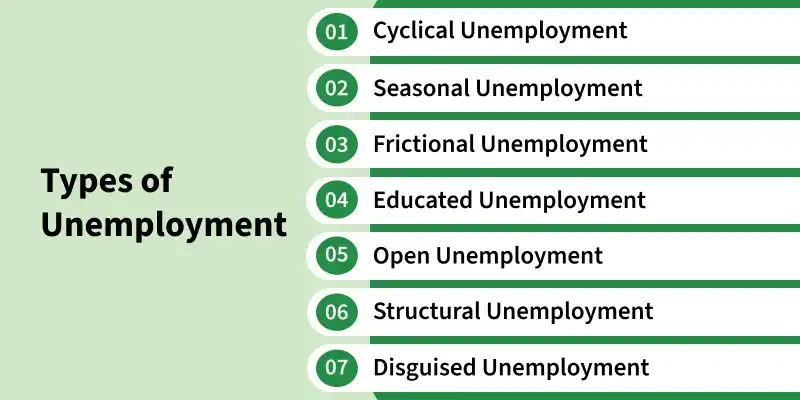
Disguised Unemployment (Hidden Unemployment)
It refers to a situation where more workers are engaged in an activity than are actually required. Although all workers appear to be employed, the removal of some workers does not reduce total output. In such cases, the marginal productivity of the surplus workers is zero. This form of unemployment is most commonly found in the agricultural sector of developing countries like India, where family members work together on small farms.
In rural areas, especially in agriculture, it is common to see many people working on the same piece of land even though fewer workers could perform the same task efficiently. As a result, labour is underutilized, and productivity remains low.
**Causes of Disguised Unemployment:
- Lack of alternative employment opportunities outside agriculture.
- Small size of land holdings, which cannot productively employ all family members.
- Growth in population and large family sizes.
- Joint family system, where all members continue to work on family farms regardless of actual requirement.
**Seasonal Unemployment
Seasonal unemployment refers to a situation where workers remain unemployed during certain seasons of the year because work is not available throughout the year. In India, this type of unemployment is mainly associated with agriculture, where employment is limited to specific agricultural operations such as sowing, transplanting, and harvesting.
During the off season, agricultural labourers and small farmers have little or no work. As a result, many of them migrate temporarily to urban areas in search of casual or daily wage employment. The extent of seasonal unemployment varies across regions depending on rainfall, crop cycles, soil conditions, and availability of irrigation facilities.
**Main Causes of Seasonal Unemployment:
- Seasonal nature of agricultural operations
- Dependence on monsoon rainfall
- Limited irrigation and multiple cropping facilities
- Absence of alternative rural employment opportunities
Open Unemployment
Open unemployment occurs when people who are willing and able to work at the prevailing wage rate fail to obtain employment. This type of unemployment is clearly visible and is commonly measured in terms of the number of unemployed persons actively seeking work.
In India, open unemployment is more prominent in urban areas and among educated youth. Many individuals possess educational qualifications but are unable to find suitable jobs due to slow industrial growth and insufficient job creation. Additionally, the mismatch between education and skill requirements of the labour market further contributes to open unemployment.
**Main Causes of Open Unemployment:
- Rapid growth of population and labour force
- Slow expansion of industrial and service sectors
- Mismatch between education and job market needs
- Preference for white collar jobs and reluctance to take manual or vocational work
Educated Unemployment
Educated unemployment occurs when individuals who have received formal education are unable to find jobs suitable to their qualifications or remain unemployed altogether. This is one of the most serious forms of unemployment in India. The problem arises because the number of educated people is growing faster than the number of employment opportunities. Many graduates and postgraduates seek white-collar jobs, while vocational and technical skills are often lacking. There is also a mismatch between the education system and the requirements of the labour market.
**Causes:
- Rapid expansion of general education
- Insufficient job opportunities
- Lack of technical and vocational training
- Preference for government and white-collar jobs
- Mismatch between education and industry needs
**Example: A university graduate who remains unemployed despite actively searching for a suitable job.
Frictional Unemployment
Frictional unemployment is temporary unemployment that occurs when a person leaves one job and takes time to find another. It also occurs when fresh entrants join the labour market and search for employment.
This type of unemployment is considered natural and unavoidable in a dynamic economy because workers continuously move between jobs in search of better opportunities. The period of unemployment usually lasts until the worker finds a new job that matches their skills and preferences.
**Causes:
- Job switching by workers
- Entry of new workers into the labour force
- Lack of information about job vacancies
- Geographical mobility issues
- Temporary disruptions in industries
Structural Unemployment
Structural unemployment arises when there is a mismatch between the skills possessed by workers and the skills demanded by employers. It occurs due to structural changes in the economy, technological advancements, or changes in consumer demand. As economies develop, some industries expand while others decline. Workers employed in declining industries may lose their jobs and find it difficult to secure employment without acquiring new skills. Structural unemployment tends to last longer because workers require retraining and skill development.
**Causes:
- Technological progress and automation
- Changes in industrial structure
- Shifts in consumer preferences
- Inadequate skill development
- Regional economic imbalances
Cyclical Unemployment
Cyclical unemployment is caused by fluctuations in the business cycle. During periods of recession or economic slowdown, demand for goods and services decreases. As a result, firms reduce production, cut investments, and lay off workers, leading to unemployment. When the economy enters a phase of recovery and expansion, demand increases, production rises, and employment opportunities improve. Therefore, cyclical unemployment is directly linked to the ups and downs of economic activity and is more common in developed capitalist economies.
**Causes:
- Economic recession
- Decline in aggregate demand
- Reduction in investment and production
- Business cycle fluctuations
- Financial crises
Effects of Unemployment
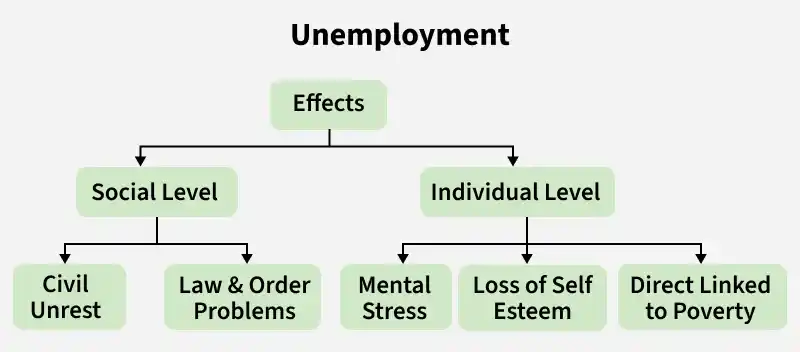
1.**Civil Unrest: Unemployment can cause dissatisfaction, leading to protests, strikes, and social conflicts.
2.**Law & Order Problems: Rising unemployment may increase crime and create challenges in maintaining public order.
3.**Mental Stress: Unemployment causes anxiety, depression, and uncertainty about the future.
4.**Loss of Self-Esteem: Lack of a job can reduce confidence and self-respect.
5.**Direct Link to Poverty: Without regular income, people may struggle to meet basic needs and fall into poverty.