Algebraic Equations (original) (raw)
Last Updated : 23 Feb, 2026
An algebraic equation is a mathematical statement that shows two expressions are equal and contains one or more variables.
It is formed using:
- Variable: A letter representing an unknown value (x, y, z)
- Constant: A fixed number (5, −3, 12)
- Coefficient: A number multiplied by a variable (3 in 3x)
- Equal Sign (=): Shows both sides are equal
**Example : x + 5 = 12 here, **x is a variable, and the equation states that when 5 is added to x, the result is 12.
Degree of Algebraic Equations
The degree of an algebraic equation is the highest power (exponent) of the variable in the equation when it is expressed in its standard form.
- The degree determines the number of roots or solutions the equation can have.
- An algebraic equation can have n solutions, where n is the degree of that algebraic equation.
- A linear equation of degree 1 only has a single solution. A quadratic equation of degree 2 can have two solutions.
Types of Algebraic Equations
There are many different forms of algebraic equations based on their structure and the number of variables involved. Based on their degrees, the algebraic equations can be divided into mainly four categories:
**Linear Equation
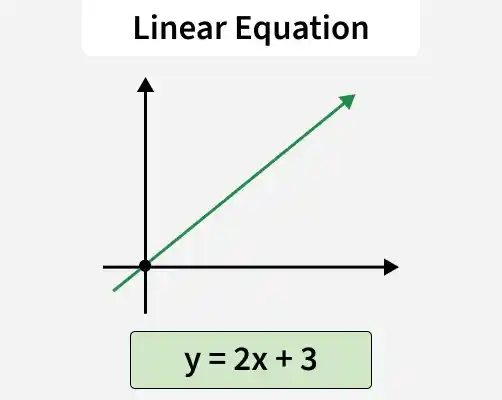
A linear equation is an equation in which the highest power of a variable is 1. They are also known as first-order equations. These equations are the simplest type and represent a straight line when graphed.
The general form of linear equation is represented as:
ax+b=0 , where a and b are constants(a ≠ 0) and x is the variable ( Linear equation in one variable)
ax+by+c=0 , where a, b, c are constants (a ≠0,b ≠0) and (x , y) are variables ( Linear equation in two variable)
**Some Examples of linear Equation:
- 2x + 3 = 7
- 2x − 3y = 9
Quadratic Equation
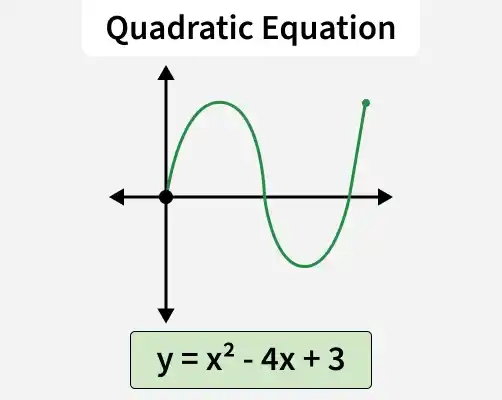
A quadratic Equation is a type of algebraic equation in which the highest power of a variable is 2. They are also known as second-degree equation and it forms a U-shaped curve called a parabola when plotted on a graph.
The general form of quadratic equation is:
ax2 + bx + c = 0,
where a, b, and c are constants and x is the variable.
**Some examples of quadratic equations are :
- 3x2 + 5x + 7 = 0
- y = 4x2 + 2x + 6
A quadratic equation can have two solutions which can be either imaginary or real depending on the equation.
Cubic Equation
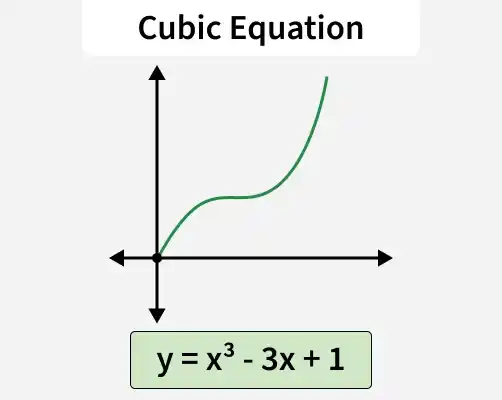
A cubic Equations is a type of equation where the highest power of the variable is 3. They are also known as third- degree equations. and they form an "S" or "N" shape on the graph, with up to three points where it crosses the x-axis .
A cubic equation has the general form :
ax3 + bx2 + cx + d = 0.
where x is a variable and a, b, c, and d are constants.
A cubic equation can have one, two, or three solutions that are real or complex numbers, depending on the coefficients in the equation.
Some examples of Cubic Equations are :
- 3x3 + x2 + 4x + 9 = 0
- 7x3 + 5x + 3 = 0
Higher-Order Algebraic Equations
Higher-order algebraic equations are equations where the highest power of the variable (called the degree) is greater than three. These equations go beyond linear (x1), quadratic (x2), and cubic (x3) equations, involving degrees such as 4, 5, or even higher.
Some Examples of Higher-Order Equations:
- Quartic Equation (Degree 4): x4 + 2x3 − x2 + 5 = 0
- Quintic Equation (Degree 5): 2x5 − 3x3 + x2 − 4 = 0
Solving Algebraic Equations
1. **Linear equation in one variable: To solve a linear equation in one variable, isolate the variable by performing inverse operations on both sides of the equation while keeping it balanced. Simplify step by step until the variable is alone.
**2. Linear equation in two variable:
- **Substitution Method****:** Solve one equation for one variable in terms of the other.
Substitute this expression into the second equation and solve for the remaining variable. - **Elimination Method (or Addition/Subtraction Method): Add or subtract the equations to eliminate one variable.
Solve for the remaining variable, then substitute back to find the other.
Solving Quadratic Equations
**Quadratic Equations: There are **four main methods to solve quadratic equations:
- **Factoring: Split the equation into factors and solve for the variable.
- **Quadratic Formula: Use the formula x = \frac{-b \pm \sqrt{b^2 - 4ac}}{2a}.
- **Completing the Square: Rewrite the equation into a perfect square form and solve.
- **Graphing: Plot the equation and find the points where it crosses the x-axis.
**Also Check:
Algebraic Equation Formulas
- (a + b)2 = a2 + 2ab + b2
- (a - b)2 = a2 - 2ab + b2
- (a + b)(a - b) = a2 - b2
- (x + a)(x + b) = x2 + x(a + b) + ab
- (a + b)3 = a3 + 3a2b + 3ab2 + b3
- (a - b)3 = a3 - 3a2b + 3ab2 - b3
- a3 + b3 = (a + b)(a2 - ab + b2)
- a3 - b3 = (a - b)(a2 + ab + b2)
- (a + b + c)2 = a2 + b2 + c2 + 2ab + 2bc + 2ca
Solved Examples
**Example 1: Solve: 3x−5 = 16
Given , 3x-5 = 16
3x = 16+5
3x = 21
x = 21/3
x = 7
**Example 2: Solve: x2+5x+6 = 0
Given, x2+5x+6
By factorizing -
x2+5x+6 = x2 + (3x+2x) + 6
x(x+3)+2(x+3) = (x+3) (x+2)
x = -2,-3
**Example 3: Expand: (2x+5)2
Given, (2x+5)2
Using identity: (a+b)2 = a2 + 2ab + b2
(2x)2 + 2(2x)(5) + 52
4x2 + 20x + 25
**Example 4: The sum of a number and 12 is 30. Find the number.
Let the number be x
According to question-
x+12 = 30
x = 30-12
x = 18