Algebraic Methods of Solving Pair of Linear Equations in Two Variables (original) (raw)
Last Updated : 13 Apr, 2026
The algebraic method is a technique used to solve a pair of linear equations in two variables using algebraic operations instead of graphs. It helps find the exact values of the variables that satisfy both equations.
Algebraic methods are mainly divided into three types:
**Substitution Method
The substitution method is an algebraic technique used to solve a pair of linear equations by expressing one variable in terms of the other and substituting it into the second equation. This reduces the system to a single equation with one variable, making it easier to solve.
Steps to solve by the algebraic method
**Step 1: Solve one of the equations for any one variable (x or y).
**Step 2: Substitute this expression into the other equation.
**Step 3: Solve the resulting equation to find the value of the remaining variable.
**Step 4: Substitute this value back into any original equation to find the other variable.
**Example: Solve the system of equations: x − 2y = 8, x + y = 5
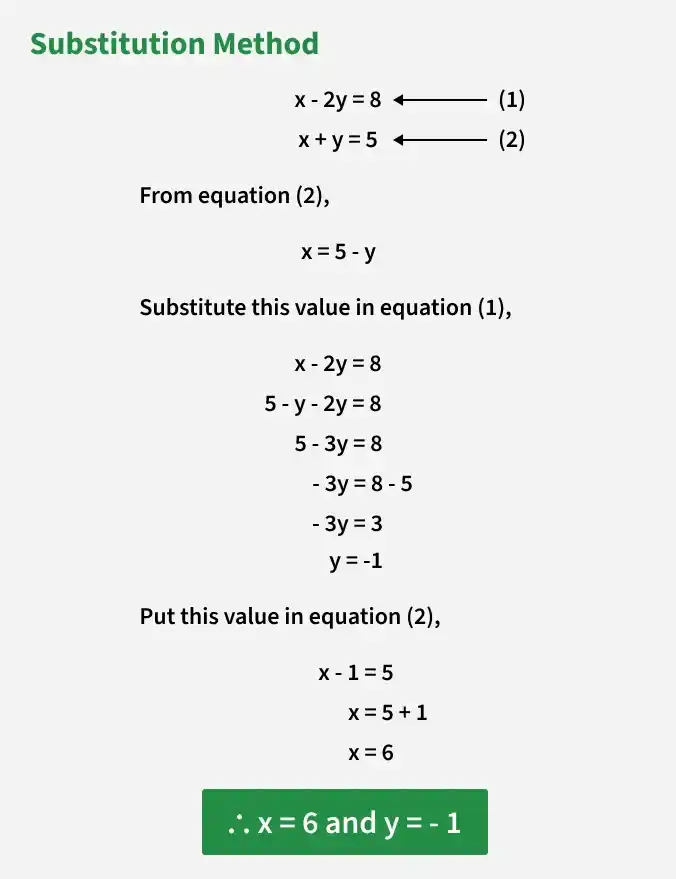
**Elimination Method
The elimination method is an algebraic technique used to solve a pair of linear equations by eliminating one variable through the addition or subtraction of the equations. After eliminating one variable, the remaining equation is solved to find the value of the other variable.
Steps
**Step 1: Make the coefficients of one variable the same in both equations by multiplying or dividing the equations if required.
**Step 2: Add or subtract the equations so that one variable gets eliminated.
**Step 3: Solve the resulting equation to find the value of the remaining variable.
**Step 4: Substitute this value into any original equation to find the value of the other variable.
**Example: Solve the system of equations: x − 2y = 8, 2x + y = 5
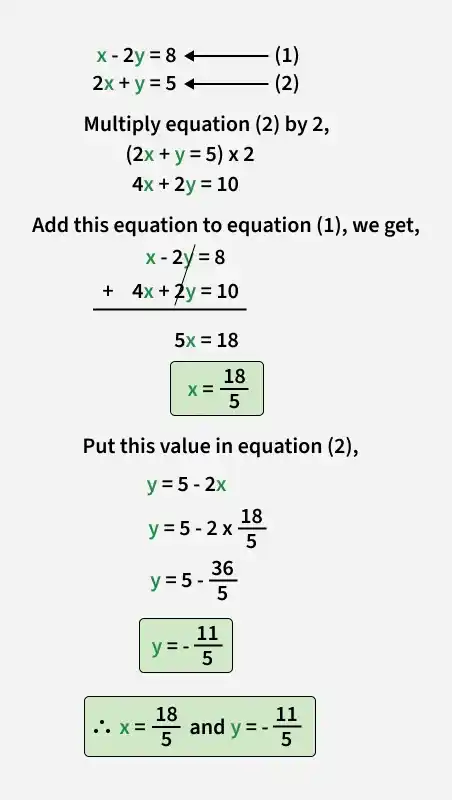
**Cross-Multiplication Method
The cross multiplication method is an algebraic technique used to solve a pair of linear equations in two variables. It directly gives the values of the variables using a formula derived from the coefficients of the equations, making it a quick method for solving such systems.
For the pair of equations:
a₁x + b₁y + c₁ = 0
a₂x + b₂y + c₂ = 0
By using cross multiplication, the values of x and y will be
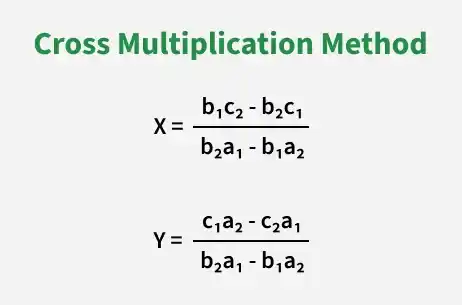
**Derivation for Cross-multiplication
a1x + b1y + c1 = 0 ⇢(1)
a2x + b2y + c2 = 0 ⇢(2)
Multiply by b2 in equation (1) and b1 in equation (2):
a1b2x + b1b2y + c1b2 = 0 ⇢(3)
a2b1x + b1b2y + c2b1 = 0 ⇢(4)
Subtracting equation (4) from equation (3) will provide the values of x and y as,
x=\frac{(b_{1}c_{2})-(b_{2}c_{1})}{(b_{2}a_{1})-(b_{1}a_{2})}\\y=\frac{(c_{1}a_{2})-(c_{2}a_{1})}{(b_{2}a_{1})-(b_{1}a_{2})}
**Easy Technique to understand the formulae
Write down coefficients in original form:
a1 b1 c1
a2 b2 c2
Ignore the coefficients of x and cross-multiply the remaining coefficients, then subtract them:
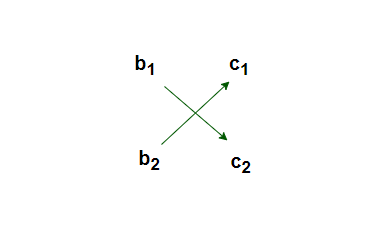
Thus, the solution of the equation of part one becomes ⇒\frac{x}{(b_{1}c_{2})-(b_{2}c_{1})}
Now, ignore the coefficient of y and cross-multiply the remaining terms:
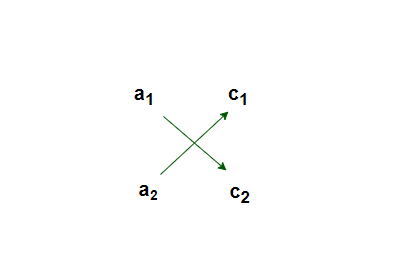
Remember to consider the equation under (-y). The second part of the solution ⇒ \frac{-y}{(a_{1}c_{2})-(a_{2}c_{1})}
For the third part, ignore the coefficients of 1 and cross-multiply the remaining terms and subtract them:
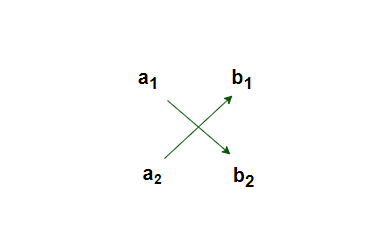
The third part of the equation becomes ⇒ \frac{1}{(a_{1}b_{2})-(a_{2}b_{1})}
Combining all three parts ⇒ \frac{x}{(b_{1}c_{2})-(b_{2}c_{1})}=\frac{-y}{(a_{1}c_{2})-(a_{2}c_{1})}=\frac{1}{(a_{1}b_{2})-(a_{2}b_{1})}
Related Articles
Solved Examples
**Example 1: Find all possible solutions of the following system of equations using the elimination method.
2x + 3y = 8 - (1)
4x + 6y = 7 - (2)
Multiply equation (1) by 2 and equation (2) by 1. This will make coefficients of x in both the equations same. Then we get the equations as:
4x + 6y = 16
4x + 6y = 7
Subtracting both of the equations,
we get 0 = 9
This is false. So, no solution exists for this system of linear equations.
**Example 2: The sum of a two-digit number and the number obtained by reversing the digits is 66. If the digits of the number differ by 2, find the number. How many such numbers are there?
Let x and y be the ten's and unit's digit respectively. So the first number can be written as 10x + y is the expanded form(for example 56= 10(6) + 5).
(10x + y) + (10y + x) = 66,
i.e⇒ 11(x + y) = 66
i.e ⇒ x + y = 6
It's also given that the digits differ by 2,
So, either x - y = 2 or y - x = 2. Let's look for both of the cases,
**Case 1: x - y = 2,
Substituting x = y + 2 in the equation given above,
y + 2 + y = 6
⇒ 2y = 4
⇒ y = 2.
So, x = 4
**Case 2: y - x = 2,
Substituting y = x + 2, in the equation given above,
x + y = 6.
⇒ x + x + 2 = 6
⇒ 2x = 4
⇒ x = 2
y = 4.
**Example 3: Find the value of the variables satisfying the equation using the cross-multiplication method: 2x + 3y = 11, 3x + 2y = 9
Write equations in general form:
2x + 3y - 11 = 0
3x + 2y - 9 = 0
Using Cross- multiplication method,
\frac{x}{(b_{1}c_{2})-(b_{2}c_{1})}=\frac{-y}{(a_{1}c_{2})-(a_{2}c_{1})}=\frac{1}{(a_{1}b_{2})-(a_{2}b_{1})}
Put the values of all the coefficients in the formula,
\frac{x}{(3.(-9))-(2.(-11))}=\frac{-y}{(2.(-9))-(3.(-11))}=\frac{1}{(2.2)-(3.3)}
\frac{x}{-5}=\frac{-y}{15}=\frac{1}{-5}
Solving, we get: x = 1, y = 3
**Example 4: Using the cross-multiplication method, solve for x and y: 3x - 4y - 2 = 0, y - 2x - 7 = 0
Using the formula: \frac{x}{(b_{1}c_{2})-(b_{2}c_{1})}=\frac{-y}{(a_{1}c_{2})-(a_{2}c_{1})}=\frac{1}{(a_{1}b_{2})-(a_{2}b_{1})}
Substitute the values in the formula: \frac{x}{(-4.(-7))-(-2.(-2))}=\frac{-y}{(3.(-7))-(1.(-2))}=\frac{1}{(3.(-2))-(1.(-4))}
Solving the equation, x = -6, y = -5