Pair of Linear Equations in Two Variables (original) (raw)
Last Updated : 23 Jul, 2025
Linear Equation in two variables are equations with only two variables and the exponent of the variable is 1. This system of equations can have a unique solution, no solution, or an infinite solution according to the given initial condition. Linear equations are used to describe a relationship between two variables. Sometimes in some situations, we don't know the values of the variables we want to observe. So, then we formulate the equations describing how they behave and solve them. The Number of equations obtained should be equal to the number of variables.
Let's learn about the Pair Of Linear Equation In Two Variables and their solution in this article.
Table of Content
- Pair of Linear Equations In Two Variables
- What are Pair of Linear Equations in Two Variables?
- Pair of Linear Equations in Two Variables Formulas
- Representation of Pair of Linear Equation in Two Variables
- Graphical Representation
- Algebraic Methods of Solving a Pair of Linear Equations
- Pair of Linear Equations in Two Variables Class 10 Extra Questions
- Pair of Linear Equations in Two Variables Solutions
Pair of Linear Equations In Two Variables
A linear equation is defined as:
**ax + by + c = 0
where,
- **a, b and **c are real numbers
- **a and **b both are not zero
A pair is formed by two such linear equations. It can be represented as:
**a 1 x + b 1 y + c 1 = 0
**a 2 x + b 2 y + c 2 = 0
where,
**a 1 , b 1 , c 1 , a 2 , b 2 and **c 2 are real numbers.
Since a linear equation represents a line on the Cartesian plane. A pair represents two lines on the Cartesian plane. The solution to this system will be the points that satisfy both of these equations. There are three possibilities in such a system.
What are Pair of Linear Equations in Two Variables?
Pair of linear equations in two variables refers to a system of two equations with two variables, typically _x and _y. These equations are linear, meaning that each variable is raised to the power of one and doesn't involve any other operations like multiplication or division. The general form of a pair of linear equations in two variables is:
**General Form: ax + by = c
where **a, **b, and **care constants, and **x and **y are the variables. The objective when dealing with such a pair of equations is to find the values of _**x_and **y that satisfy both equations simultaneously.
This often involves techniques like substitution, elimination, or graphical methods. Pair of linear equations in two variables are extensively used in various fields including mathematics, physics, economics, and engineering to model and solve real-world problems involving two unknown quantities.
No Solution
If lines are parallel to each other then they have no solution.
For example, 2x + 3y = 11 and 2x + 3y = 13 are parallel lines and they have no solution.
Unique Solution
If two lines intersect each other at any point then they have a unique solution.
For example, 2x + 3y = 11 and 3x + 2y = 11 are intersecting lines and they have a unique solution.
Infinitely Many Solutions
If two lines are overlapping with each other then they have infinite solutions.
For example, 2x + 3y = 11 and 4x + 6y = 22 are overlapping lines and they have infinite solutions.
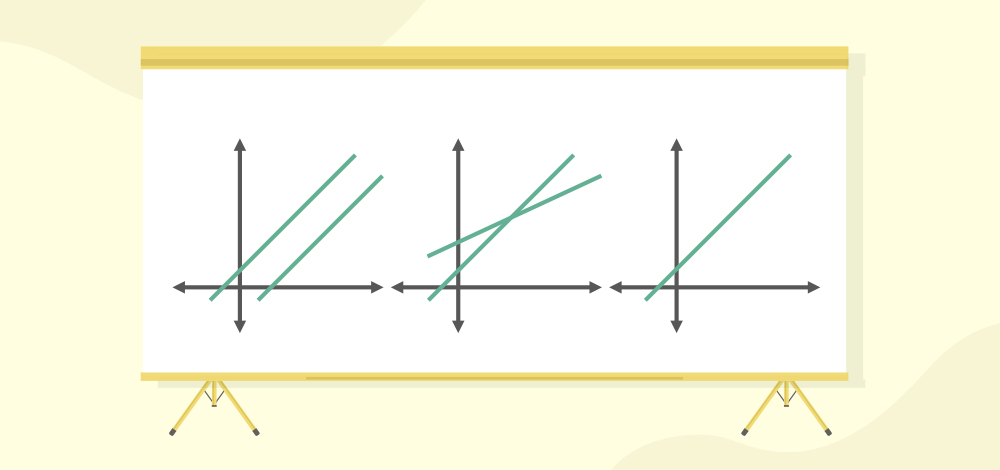
Solution of Linear Equation in Two Variables
Pair of Linear Equations in Two Variables Formulas
The pair of linear equations in two variables can be represented as:
- **Standard Form: ax+by=c
- **Slope-Intercept Form: y=mx+b
- **Point-Slope Form: y−y1=m(x−x1)
Where:
- _a, _b, and _c are constants, and _a and _b are not both zero.
- _m represents the slope of the line.
- _b is the y-intercept (the point where the line intersects the y-axis).
- __x_1 and __y_1 are coordinates of a point on the line.
Standard Form
The standard form of a linear equation in two variables, _x and _y, is represented as **ax****+** by**= c, where _a, _b, and _c are constants, and _a and _b are not both zero. In this form, _a and _b represent the coefficients of the _x and _y terms, respectively, and _c is the constant term. Standard form is beneficial for solving equations using methods like elimination and substitution, especially when working with systems of equations.
**Slope-Intercept Form
The slope-intercept form of a linear equation is written as **y= mx+ b, where _m represents the slope of the line, and _b is the y-intercept, the point where the line intersects the y-axis. In this form, _m determines the inclination or steepness of the line, while _b represents the y-coordinate of the point where the line crosses the y-axis. Slope-intercept form is particularly convenient for graphing linear equations, as it directly provides information about the slope and y-intercept.
**Point-Slope Form
The point-slope form of a linear equation is expressed as **y−y 1 =m(x−x 1 ), where _m is the slope of the line, and ****(x** 1 ,y 1 ) is a point on the line. This form is derived from the slope formula, ****(y** 2 −y 1 )/(x 2 −x 1 ), where _m represents the rate of change between two points on the line. Point-slope form is useful for finding the equation of a line given its slope and a point on the line. It offers flexibility in finding the equation of a line passing through a specific point with a given slope.
Representation of Pair of Linear Equation in Two Variables
The pair of linear equations can be solved and represented by two methods which include,
- Graphical Method
- Algebraic Method
The general form of a pair of linear equations in two variables is:
**a 1 x + b 1 y + c 1 = 0
**a 2 x + b 2 y + c 2 = 0
where,
**a 1 , b 1 , c 1 , a 2 , b 2 and **c 2 are real numbers
**a 1 2 + b 1 2 ≠ 0
**a 2 2 + b 2 2 ≠ 0
The pair of linear equations have three conditions,
- If a1/a2 ≠ b1/b2 the pair of linear equations is consistent.
- If a1/a2 = b1/b2 ≠ c1/c2 the pair of linear equations is inconsistent.
- If a1/a2 = b1/b2 = c1/c2 the pair of linear equations is dependent and consistent.
If we compare the coefficients a1, b1, c1, a2, b2 and c2 of different pairs of equations which have a unique solution, infinite solutions, and no solutions. We obtain the results given below in the table.
For two lines:
a1x + b1y + c1 = 0
a2x + b2y + c2 = 0
| Graphical Representation | Algebraic Interpretation | Conditions |
|---|---|---|
| One intersection | Unique Solution | a1/a2 ≠ b1/b2 |
| Coincident Lines | Infinitely Many Solutions | a1/a2 = b1/b2 = c1/c2 |
| No intersection/ Parallel Lines | No Solution | a1/a2 = b1/b2 ≠ c1/c2 |
Graphical Representation
In this method, we represent the equations on the graph and find out their intersection through it. We look for the points which are common to both lines, sometimes there is only a point like that, but it might also happen that there are no solutions or infinite solutions.
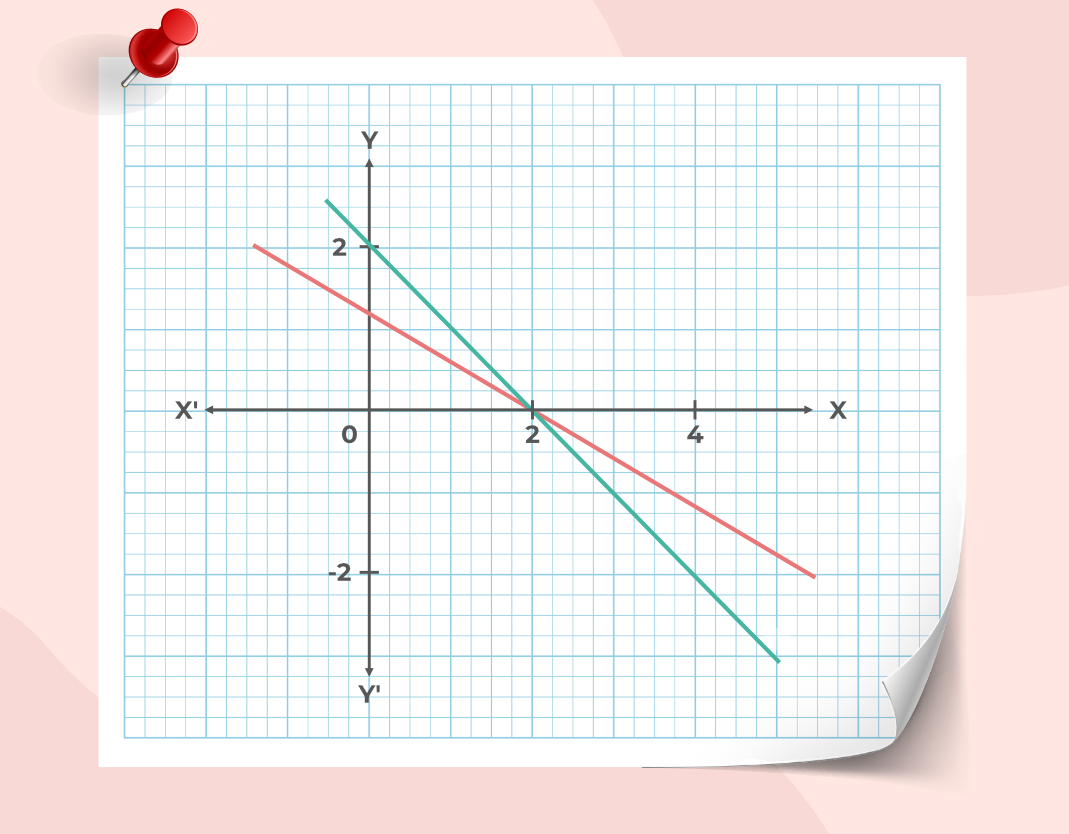
**Example: Find out the intersection of the following lines.
**3x + 5y = 6
**x + y = 2
**Solution:
We will plot both the lines on the graph.
Graphical Representation of linear equation
These lines intersect at (2,0).
Algebraic Methods of Solving a Pair of Linear Equations
Various methods of Solving a Pair of Linear Equations are,
- Substitution Method
- Elimination Method
- Cross-Multiplication Method
**Substitution Method
In this method, we use one equation to express a variable in terms of the other variable thereby reducing the number of variables in the equation. Then we substitute that expression into the other equation that is given to us.
**Example: Solve the following pair of equations with the substitution method.
**x + y = 3
**3x + y = 16
**Solution:
Let's pick the equation
x + y = 3
x = 3 - y
Substituting the value of x in the other equation,
3x + y = 16
3(3 - y) + y = 16
9 - 3y + y = 16
-2y =7
y = -7/2
**Elimination Method
This method is sometimes more convenient than the substitution method. In this method, we eliminate one variable by multiplying and adding equations with suitable constants, this is done to eliminate one variable, and when the equation is left with just one variable, it can easily be solved.
**Example: Solve the following equations with the elimination method.
**x + y = 3
**x - y = 5
**Solution:
We have two equations,
x + y = 3 .......(1)
x - y = 5 ...... (2)
Adding the equation (1) and (2) to eliminate the variable -y.
2x = 8
x = 4
Substituting the value of x in equation (1)
4 + y = 3
y = -1
**Cross-Multiplication Method
This method looks more complex than the other methods, but it is one of the most efficient ways to solve linear equations. Let's say the two lines whose equation is:
a1x + b1y + c1 = 0
a2x + b2y + c2 = 0
In this cross-multiplication method,
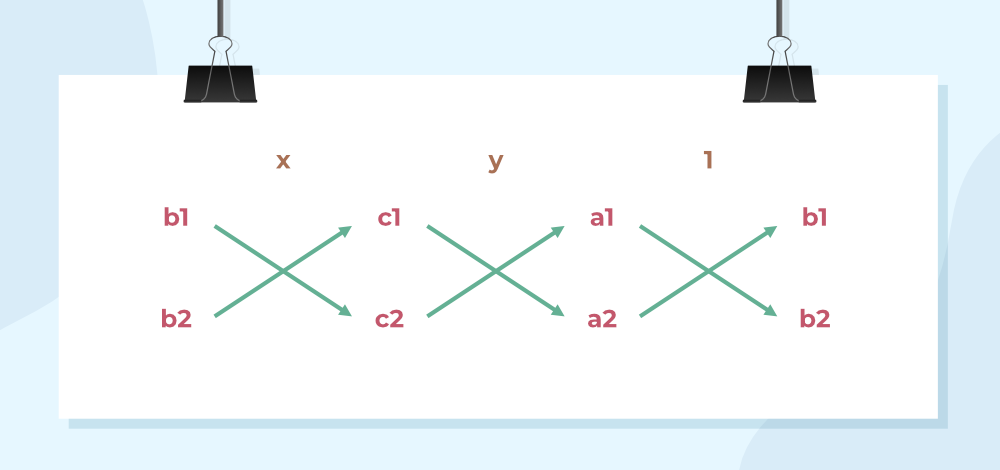
Cross-Multiplication Method
The solution is given by:
**x/(b 1 c 2 -b 2 c 1 ) = y/(c 1 a 2 -c 2 a 1 ) = 1/(a 1 b 2 -a 2 b 1 )
**Example: Solve the following equations with the cross-multiplication method.
**2x + 3y = 46
**3x + 5y = 74
**Solution:
a1 = 2, a2 = 3, b1 = 3, b2 = 5, c1 = 46 and c2 = 74
x/(b1c2-b2c1) = y/(c1a2-c2a1) = 1/(a1b2-a2b1)
x/(3-(-74)-5(-46)) = y/(-46(3)-(-74)2) = 1/(2(5)-3(3))
x/8 = y/10 = 1/1
x = 8 and y = 10
Solved Examples on Linear Equations in Two Variables
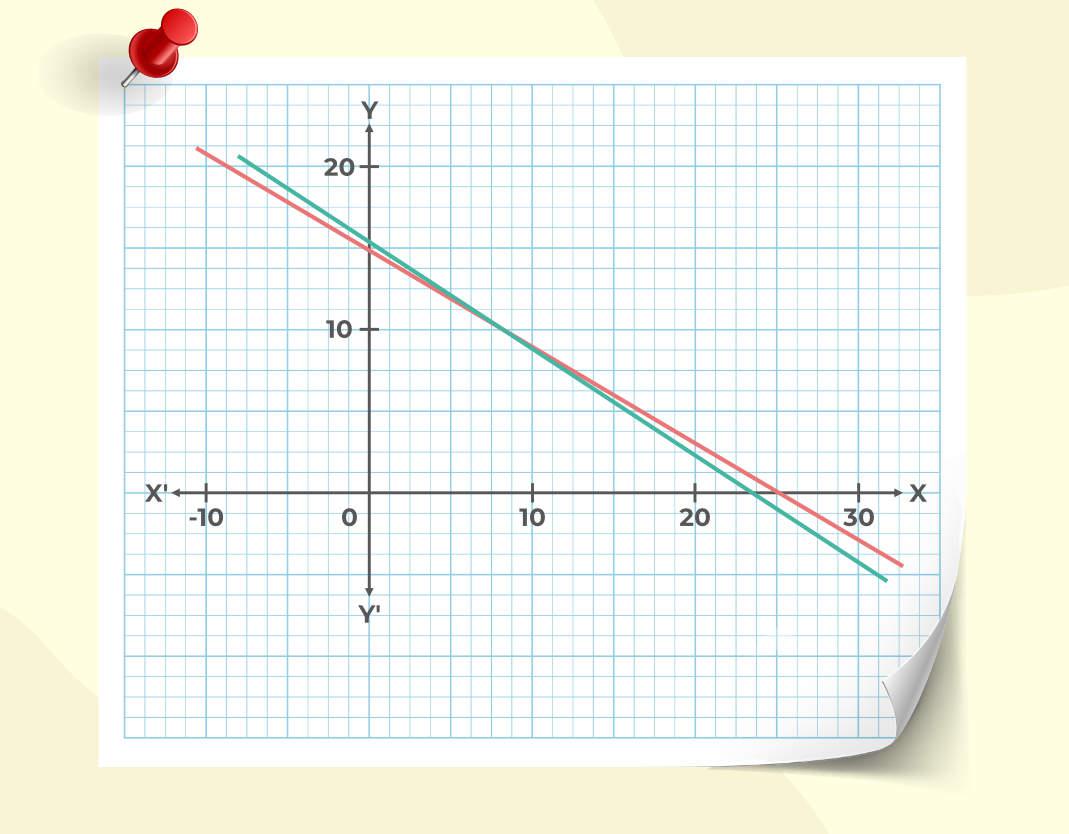
**Example 1: Solve the following pair of equations graphically:
**2x + 3y = 46
**3x + 5y = 74
**Solution:
We need to plot them of graph separately and then look at their intersection.
Graph Plotting of Example 1
This graph intersects are (10,8).
**Example 2: Solve the following pair of linear equations with the substitution method.
**5x + 4y = 20
**x + 2y = 4
**Solution:
We have to solve these two equations
5x + 4y = 20
x + 2y = 4
Let's we pick the second equation,
x = 4 - 2y
Now substituting the value of x in the other equation.
5(4 - 2y) + 4y = 20
20 - 10y + 4y = 20
-6y = 0
y = 0
Finding out the value of x by substituting the value of y in the equation,
x = 4 - 2y
x = 4
(4, 0) is the solution to this pair of linear equations.
**Example 3: Solve the following equations with the elimination method.
**4x + 5y = 20
**8x + 2y = 5
**Solution:
Let the equations be,
4x + 5y = 20 ........(1)
8x + 2y = 5 ..... (2)
We need to eliminate one of the variables here from these two equations,
Multiply equation (1) with 2 and subtract it with (2).
2 x(1) -(2)
8x + 10y = 40 ..... 2 x(1)
8x + 2y = 5 .....(2)
Subtracting both of these,
8y = 35
y = 35/8
Substituting this value in equation (1)
4__x_+5(35/8)=20 = 4__x_+175/8=20
4__x_ = 20 –175/8
4__x_ = −15/8
_x = −15/32
- Solve the pair of equations: _x_−2__y_=5 and 2__x+__y_=4.
- Find the solution to the system of equations: 4__x_+3__y_=10 and 2__x_−__y_=3.
- Determine whether the equations 5__x_−2__y_=8 and 10__x_−4__y_=16 have a unique solution, infinitely many solutions, or no solution.
- Solve the system of equations: 3__x_+2__y_=7 and 2__x_−3__y_=1.
- Find the values of _x and y that satisfy the equations: 2__x+5__y_=17 and 3__x_−__y_=5.
Pair of Linear Equations in Two Variables Solutions
Get free NCERT Solutions for Class 10 Maths Chapter 3 - Pair of Linear Equations in Two Variables and develop an easy approach to solving problems related to this chapter. In NCERT Class 10 Maths, Chapter 3 titled "Pair of Linear Equations in Two Variables" covers various themes including an introduction to linear equations, understanding pairs of linear equations, representing them graphically, converting equations into linear form, and applying these equations to solve practical problems in real-world scenarios.
| Related Articles | |
|---|---|
| Graph of Linear Equations in Two Variables | Cramer’s Rule |
| Quadratic Equations | Graphical Methods of Solving Pair of Linear Equations in Two Variables |