Algebraic Solutions of Linear Inequalities in One Variable (original) (raw)
Last Updated : 14 Oct, 2025
A linear inequality is a mathematical expression involving an inequality symbol (<, >, ≤, or ≥) and a linear expression. Unlike linear equations, which give a specific solution, linear inequalities define a range of possible solutions.
**Example: 2x + 3 > 5
Strict and Slack Inequalities
Inequalities can be classified into two main types:
**Strict Inequalities: These are inequalities that do not include the boundary value. Symbols: < (less than) and > (greater than).
**Example: x > 3 means x can take any value greater than 3 but not 3 itself.
**Slack Inequalities: These inequalities include the boundary value as part of the solution. Symbols: ≤ (less than or equal to) and ≥ (greater than or equal to).
**Example: x ≥ 2 means x can take any value greater than or equal to 2, including 2.
Steps to Solve Linear Inequalities in One Variable
To solve a linear inequality in one variable, we need to follow these steps:
- **Step 1: Separate the constants on one side and the variables on the other side.
- **Step 2: Simplify both the side to convert into an equation of the form mx > n or mx < n.
- **Step 3: Divide both the side by m, if m is negative then reverse the inequality sign.
Sample Problems on Linear Inequality in One Variable
**Problem 1: Solve for x, if x + 4 ≥ 18.
**Solution:
x + 4 ≥ 18
x + 4 - 4 ≥ 18 - 4
x ≥ 14
**Problem 2: Solve for x, if -3x ≥ 21.
**Solution:
= −3x ≥ 21
= x ≤ 21/-3 ( Change in sign is due to division of both sides by a negative number )
= x ≤ −7
**Problem 3: Solve for x, if 5 - 2x ≥ 19.
**Solution:
5 - 2x ≥ 19
= -2x ≥ 19 - 5
= -2x ≥ 14
= x ≤ 14/-2 (Change in sign is due to division by a negative number)
= x ≤ -7
**Problem 4: Solve for x, if 7x + 4 < 5(x + 2).
**Solution:
7x + 4 < 5(x + 2)
7x + 4 < 5x + 10
7x - 5x < 10 - 4
2x < 6
x < 3
Practice Questions on Linear Inequality in One Variable
**Question 1: Solve for x, if x + 6 ≥ 20.
**Question 2: Solve for x, if -4x ≥ 28.
**Question 3: Solve for x, if 8 - 3x ≥ 24.
**Question 4: Solve for x, if 6x + 5 < 4(x + 3).
Graph of Linear Inequality in One Variable
As there is only one variable it will be represented on a number line. Steps for graphing a solution of a linear inequality on a number line:
- **Step 1: Solve the inequality
- **Step 2: Make a number line and plot the point on the number line
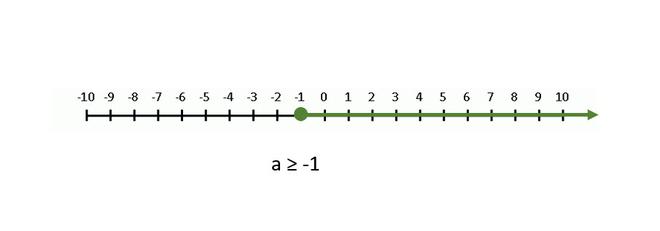
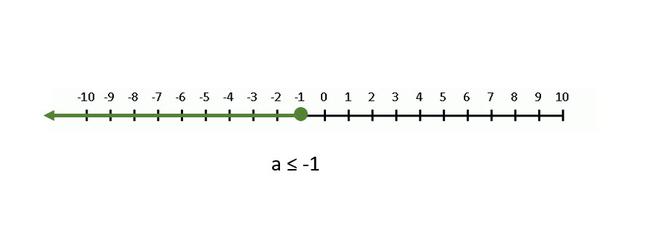
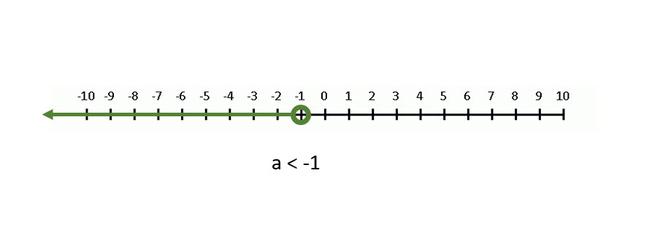
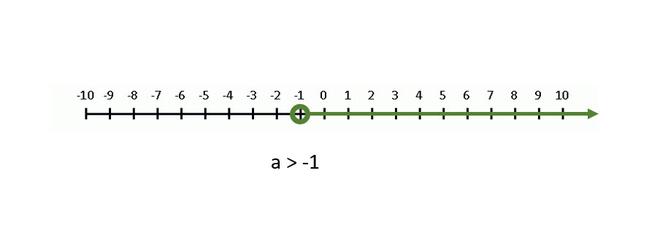
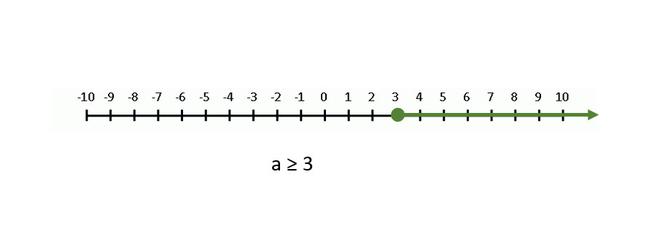
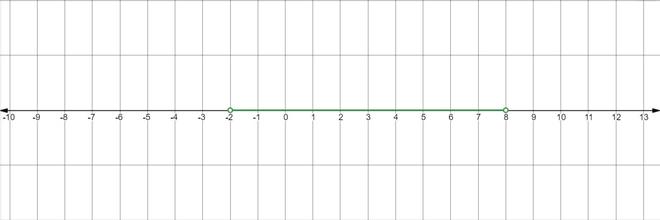
- **Step 3: Locate the real no. found after solving the inequality. Use an open circle for Strict Inequality(< and >) and a closed circle for Slack Inequality(≤ and ≥)
- **Step 4: In the final inequality if the sign is > or ≥ draw the line towards the positive axis or towards the negative axis if the sign is < or ≤
Sample Problems on Graphs
**Problem 1: Solve the linear inequality (3a + 7)/2 ≥ a + 5, and represent the solution on the number line.
**Solution:
(3a + 7)/2 ≥ a + 5
= 3a + 7 ≥ 2a + 10
= a ≥ 3
**Problem 2: Solve the linear inequality −13 < 3x - 7 < 17 and represent the solution on the number line.
**Solution:
-13 < 3x - 7 < 17
-13 + 7 < 3x - 7 + 7 < 17 + 7
-6 < 3x < 24
-6/3 < x < 24/3
-2 < x < 8
**Word Problems on Linear Inequality
**Problem 1: In the first four papers each of 100 marks, Devesh got 97, 75, 75, 84 marks. If he wants an average of greater than 80 marks and less than 85 marks, find the range of marks he should score in the fifth paper.
**Solution:
Let x be the marks in the fifth paper. According to the statement,
80 < (97 + 75 + 75 + 84 + x)/5 < 85
= 400 < 331 + x < 425
= 400 - 331 < x < 425 - 331
= 69 < x < 94Therefore, Devesh needs to score greater than 69 and less than 94 to get his desired average.
**Problem 2: Surya has two rods. The length of one rod is three meters longer than the other, each of the rods is shorter than 19m, and the sum of the two rods is longer than 23m. Find a possible range of length of the shorter rod.
**Solution:
Let the length of the shorter rod be x. Then the length of the other rod is x + 3.
In solving this kind of problem, when both the rod lengths are less than some number, we have to take the length of the longer rod to form inequality.
x + 3 < 19
x < 16The sum of the length of the rods is more than 23,
x + x + 3 > 23
= 2x > 20
= x > 10Thus, 10 < x < 16
**Problem 3: Ola charges a Rs 20 flat rate in addition to Rs 4 per kilometer. Arnab has no more than Rs 100 to spend on a ride. How many kilometers can Arnab travel without exceeding his budget?
**Solution:
Let the no of kilometer traveled by Arnab be x.
According to the statement,
4x + 20 ≤ 100
= 4x ≤ 80
= x ≤ 20Thus, Arnab can travel 20 kilometers or less before reaching his limit of Rs 100.
Mixed Practice Questions
**Question 1: Solve the linear inequality (2b + 5)/3 ≥ b + 4, and represent the solution on the number line.
**Question 2: Solve the linear inequality −10 < 4y − 8 < 20, and represent the solution on the number line.
**Question 3: In the first three exams each of 120 marks, Rohan scored 110, 90, and 95 marks. If he wants an average greater than 100 marks and less than 110 marks, find the range of marks he should score in the fourth exam.
**Question 4: Manish has two pieces of wire. One piece is 2 meters longer than the other, each piece is shorter than 15m, and the sum of the two pieces is greater than 20m. Find the possible range of the length of the shorter piece.
**Question 5: Ravi charges Rs 15 as a base fare, and Rs 5 per kilometer. Sunil has no more than Rs 80 to spend on a ride. How many kilometers can Sunil travel without exceeding his budget?