Linear Inequalities (original) (raw)
Last Updated : 14 Apr, 2026
Linear inequalities are mathematical statements that show the relationship between two expressions using inequality symbols instead of an equal sign.
They are similar to a linear equation, but instead of "=," they use symbols like
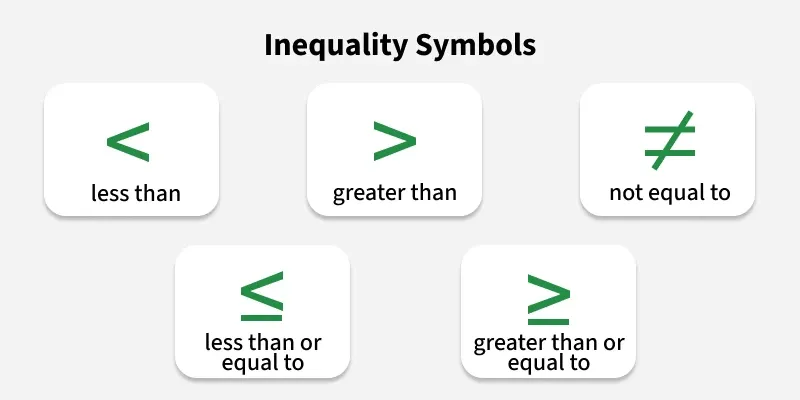
**Inequality Symbol Meanings:
- **Strict inequality symbols: **> and < (do not include the boundary points).
- **Non-strict inequality symbols: ≥ and ≤ (include the boundary points).
**Examples-
| Linear Inequality | Meaning |
|---|---|
| x > 5 | x is greater than 5 |
| x < 6 | x is less than 6 |
| x ≥ 1 | x is greater than or equal to 1 |
| x ≤ 0 | x is less than or equal to 0 |
| x ≠ 1 | x is not equal to 1 |
Linear Inequalities Rules
All the mathematical operations, i.e., addition, subtraction, multiplication, and division, are applicable to linear inequalities also.
**1. Adding or Subtracting the Same Value: Adding or subtracting the same number (or expression) on both sides does not change the inequality.
**Example: x + 3 > 7 ⇒ x > 4
2x − 5 ≤ 9 ⇒ 2x ≤ 14 ⇒ x ≤ 7
**2. Multiplying or Dividing by a Positive Number: Multiplying or dividing both sides by a positive number does not change the inequality.
**Example: 3x < 12 ⇒ x < 4
\frac{2x}{3} \geq 4 \Rightarrow x\geq 12
**3. Multiplying or Dividing by a Negative Number: Multiplying or dividing both sides by a negative number reverses the inequality.
**Example: −2x > 6 ⇒ x < −3 (reverse the inequality sign)
\frac{-3x}{4} \leq 9 \quad \Rightarrow \quad x \geq -12 \quad (reverse the inequality sign)
**4. Combining Inequalities: Each inequality is solved separately, and the results are combined.
**Example: 2x − 3 ≥ 5 and x + 1 < 6
Solve each inequality:
- 2x ≥ 8 ⇒ x ≥ 4
- x < 5
Combine: 4 ≤ x < 5
**5. Inequalities Involving Absolute Values: An absolute value inequality is split into two inequalities.
**Example: ∣x − 3∣ ≤ 5
This splits into two inequalities: −5 ≤ x − 3 ≤ 5
Solve: −2 ≤ x ≤ 8
Types of Linear Inequalities
There are generally two types of linear inequalities that are,
1. Linear Inequalities in One Variable
The linear inequalities that deal with only one variable are called linear inequalities with one variable. For example, x > 5.
In order to solve the linear inequality with variables on one side, the following steps are followed:
- Use the rules of inequality to isolate the variable on one side.
- The inequality so obtained is the required answer and tells the value of the variable.
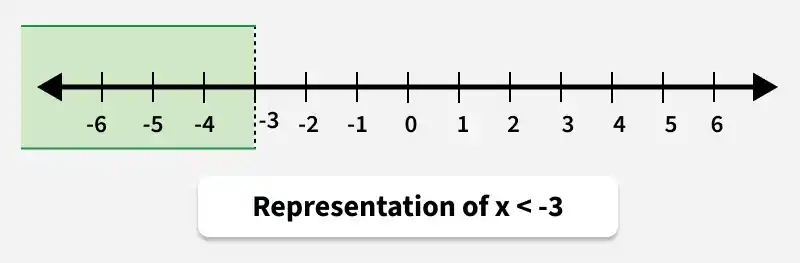
For example: Consider the inequality x + 10 < 7. This can be solved as:
- Subtract 10 from both sides to get x + 10 - 10 < 7 - 10
- Thus, we get x < -3.
2. Graphing Linear Inequalities with One Variable
The basic steps followed to represent a linear inequality with one variable on a number line are:
- If the linear inequality is a strict inequality, then use an open interval to represent the set of numbers that satisfy the linear inequality. An open interval is represented using ( ) parentheses.
- If the linear inequality is not a strict inequality, then use a closed interval to represent the set of numbers that satisfy the linear inequality. A closed interval is represented using [ ] parentheses.
Linear Inequalities in Two Variables
A linear inequality in two variables is an inequality that has two variables (like x and y) and shows a relationship using symbols like >, <, ≥, or ≤.
**Example: x + y > 4
Graph of Linear Inequalities in Two Variables
The graph of a system of linear inequalities is plotted using the Cartesian coordinate system, which has an X-axis and a Y-axis. The following steps are followed to solve them through graphs:
- Replace all the inequality symbols with the = sign so as to obtain an equation of a line.
- Plot the lines on the graph.
- Select a point on the LHS or RHS side of the line on the graph. If it satisfies the linear inequality, then mark the region on that side where the point lies. Else, mark the region on the other side of the line.
- Repeat this step for all the linear inequalities given to us.
- Once the regions have been marked, shade the region that is common to all the linear inequalities.
- The common shaded region is the solution to the given system of linear inequalities. In case there is no common area, then there is no solution to the system of linear inequalities.
**Example: Consider the following system of linear inequalities: x - 2y < -1 and 2x - y > 1
**Step 1: Replace all the inequality symbols with = sign so as to obtain an equation of line: x - 2y = -1 and 2x - y = 1
**Step 2: Plot the lines on the graph as follows:
**Step 3: Select the point (2, 2) for line x - 2y = 1. Check if this point satisfies linear inequality or not. As 2 - 2(2) = -2 < -1, the point satisfies the linear inequality. Thus the area on the side of the point is marked.
Select the point (2, 1) for line 2x - y = 1. Check if this point satisfies linear inequality or not. As 2(2) - 1 = 3 > 1, the point satisfies the linear inequality. Thus the area on the side of the point is marked.
**Step 4: The area common to both the lines is shaded in the diagram.
Thus all the points that lie in the shaded region satisfy the linear inequality.

Applications of Linear Inequalities
Linear inequalities have various applications, such as
- They are used to model real-life business problems.
- They are used in a game called inequality sudoku.
- They also find applications in astronomy and space research.
- They are also used in business to make decisions such as maximizing the profit and minimizing the cost of production.
**Also Check
Solved Examples
**Example 1: Solve the inequality 2x + 3 < 5.
Given 2x + 3 < 5
Subtract 3 from both sides
2x < 2Divide both sides by 2
x < 1Thus x < 1 is the required inequality.
**Example 2: Solve the inequality x + 3 < 5 + 2x.
Given x + 3 < 5 + 2x
Subtract x from both sides
x + 3 - x < 5 + 2x - x
3 < 5 + xSubtract 5 from both sides
-2 < xThus x > -2 is the required inequality.
**Example 3: Solve the inequality x/5 + 3 < 8.
Given x/5 + 3 < 8
Subtract 3 from both sides
x/5 + 3 - 3 < 8 - 3
x/5 < 5Multiply both sides by 5
x < 25Thus x < 25 is the required inequality.
**Practice Questions
**Q1. Solve and graph: 2x − 3 < 7.
**Q2. Solve and graph: x/2 + 5 ≥ 9.
**Q3. Graph the inequality: 2x−y ≤ 4.
**Q4. Graph and find the solution region: x + y ≤ 8 and x − y > 2.
**Q5. Graph and find the solution region: y ≥ 2x − 1y and y < −x + 5y